Where airliners cruise
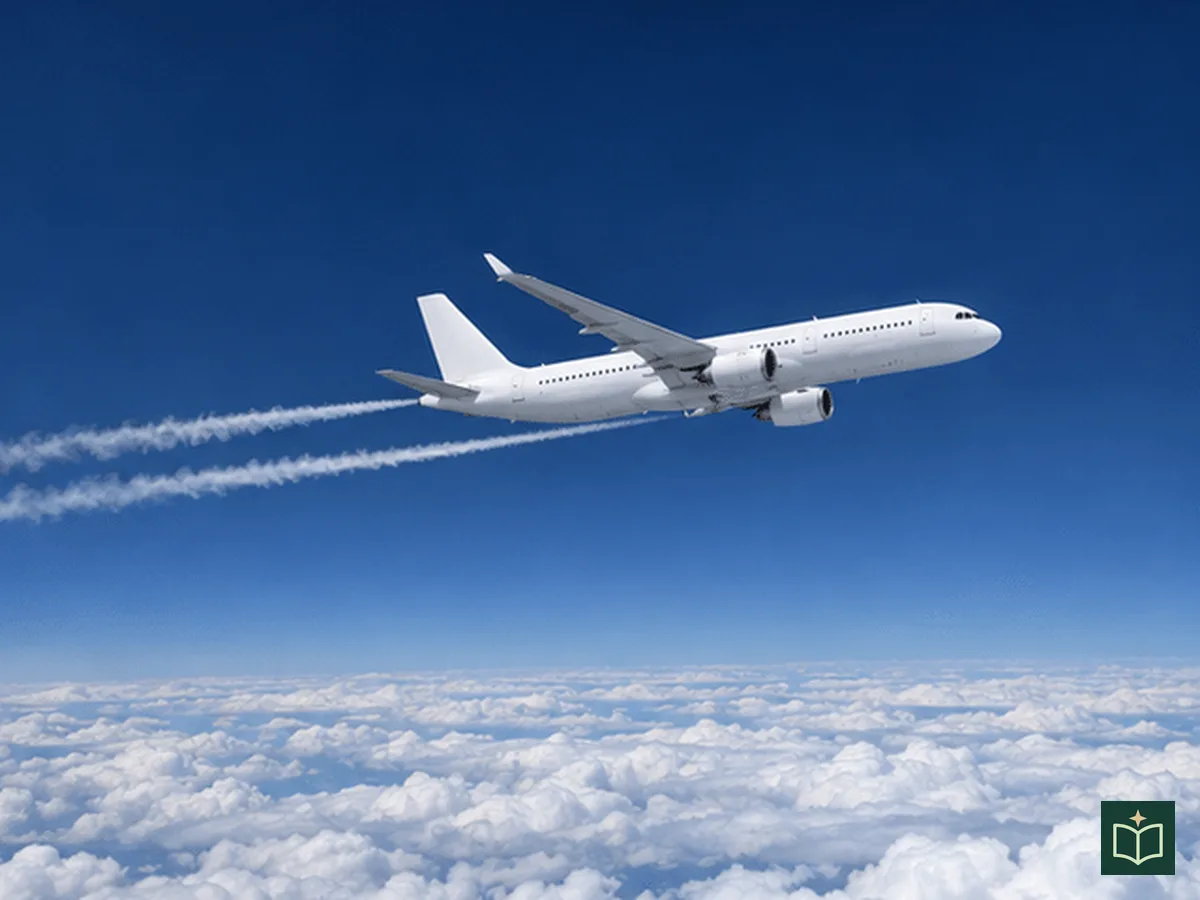
Most commercial jets cruise between roughly 10 and 12 kilometres above sea level, or about 33,000 to 39,000 feet. Business jets often fly higher, and propeller aircraft lower. These heights are not chosen for the view. They are where a jet airliner's wing and engines work together most economically, covering the greatest distance for each kilogram of fuel. The precise altitude on any flight depends on the aircraft's weight, the winds and temperatures aloft, air traffic control and the length of the route. A short hop may never reach the best cruising level at all, because climbing that high would take up most of the flight.
Thin air, less drag
Aerodynamic drag depends on the density of the air as well as on speed. At 11 kilometres, the International Standard Atmosphere gives a density of about 0.36 kilograms per cubic metre, roughly 30 per cent of the 1.225 at sea level. A wing needs a certain combination of density and speed to generate enough lift to hold the aircraft up. In thinner air it must therefore fly faster. Because lift and drag both depend on the same combination, the drag at cruise is similar to that at a slower speed lower down, but the aircraft covers far more ground. Fuel burned per hour stays similar, while kilometres per hour increase.
How much faster
The arithmetic is simple. For the same lift, speed must rise with the square root of the ratio of densities. Sea-level air is about 3.4 times as dense as air at 11 kilometres, and the square root of that is about 1.83. So, in principle, an aircraft can fly roughly 80 per cent faster through the air at cruise height than at sea level for the same lift and similar drag. Real speeds are limited by the speed of sound, which at that altitude, in air at about −56°C, is about 1,060 kilometres per hour. A typical airliner cruising at Mach 0.85 therefore travels at roughly 900 kilometres per hour through the air.
Why engines like it
Turbofan engines produce less thrust in thin air, but this suits cruise, when far less thrust is needed than for take-off. The very cold air at altitude helps. A jet engine is a heat engine, and the greater the difference between the temperature of combustion and that of the incoming air, the more efficiently it converts fuel into useful work. Cold, dense-enough air also lets compressors work efficiently. At cruise, the engines run at a steady, relatively high setting that matches their design point. Fly much lower, and the aircraft meets thick air that forces it to slow down; fly much higher, and the engines and wings run short of air.
The ceiling and the step climb
There is an upper limit. As altitude increases, the speed at which the wing stalls rises while the maximum safe speed, linked to the speed of sound, stays roughly fixed or falls. At extreme heights the two approach each other, a narrow band pilots call the coffin corner. The best altitude also depends on weight. A heavily loaded aircraft at the start of a long flight cannot climb as high efficiently. As it burns fuel and becomes lighter, its optimum altitude rises, so long-haul flights often climb in steps, moving up in stages as the hours pass. Air traffic controllers and wind patterns determine when such climbs are permitted.
Where the fuel goes
Take-off and the initial climb demand the most thrust, so engines burn fuel fastest at that stage, lifting a fully loaded aircraft several kilometres in a matter of minutes. On a short flight, that climb accounts for a large share of total fuel; on a long-haul flight, cruise dominates. This is one reason short flights use more fuel per passenger-kilometre than longer ones. Descent, by contrast, can be flown with engines near idle. Flying high has one environmental side effect beyond carbon dioxide: in cold, humid air, engine exhaust forms contrails, which can spread into cirrus-like cloud and trap heat, a subject of active research into adjusting flight levels.
Sources & further reading
- NASA Glenn Research Center · Earth atmosphere model ↗
- FAA · Pilot's Handbook of Aeronautical Knowledge ↗
Figures are rounded and widely published; check the linked organisations for the latest editions. These organisations do not endorse this website.