A fair yardstick
Comparing a bicycle with a jumbo jet needs a common unit. Transport analysts use energy per passenger-kilometre: the energy a journey consumes divided by the people carried and the distance travelled. It is usually given in megajoules (MJ), the same unit used for fuel on energy labels. The measure deliberately ignores speed, comfort and cost, so it answers only one question: how much energy does it take to move one person one kilometre? The figures below are rough averages from widely published studies. Real values swing with vehicle design, terrain, driving style and, above all, how full the vehicle is. Treat them as orders of magnitude rather than precise scores.
Muscles lead the table
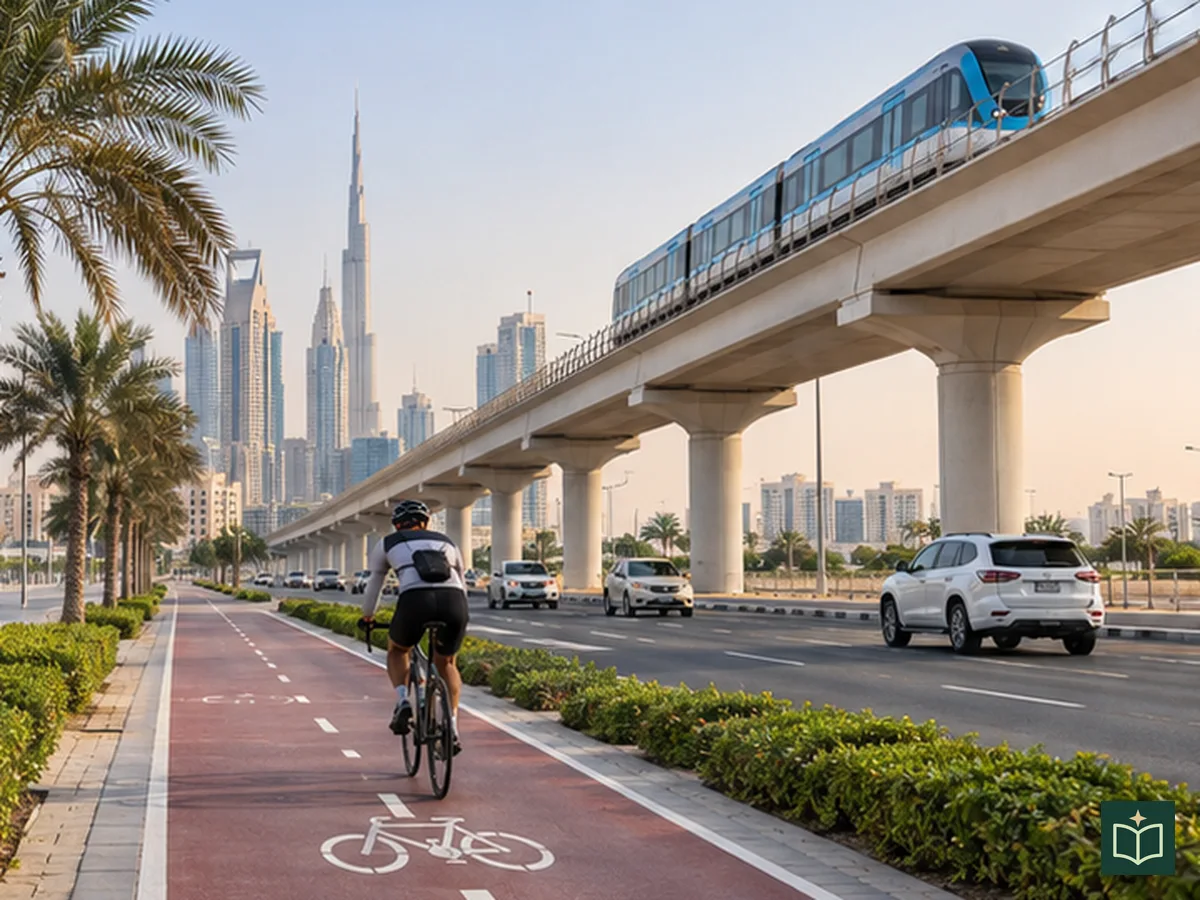
The bicycle is the most efficient way humans have found to move themselves. A rider at a gentle 16 km/h burns roughly 300 kilocalories an hour, about 0.08 MJ per kilometre. Walking at 5 km/h uses around 250 kilocalories an hour, or about 0.2 MJ per kilometre, because each stride lifts and drops the body while a wheel rolls smoothly. Both figures count food energy, which itself took fuel to grow, process and transport, and some researchers debate how much of that to include. Even generous adjustments, however, leave walking and cycling at or near the top of any ranking, well ahead of every motorised mode.
Trains and buses
Steel wheels on steel rails roll with very little resistance, and a long train has small frontal area for the number of people inside. A well-filled electric train can need roughly 0.1 to 0.3 MJ per passenger-kilometre, and metro systems such as Dubai's also recover energy from braking. Buses come next: a busy city or coach service may use about 0.3 to 0.6 MJ per passenger. Both modes look far worse late at night, when vehicles run nearly empty but still burn most of their energy. Operators therefore judge public transport over a whole day of service, and planners treat high ridership as an energy policy in its own right.
Cars and aircraft
A petrol car using 7 litres per 100 km burns about 2.4 MJ for every kilometre. With only a driver, that is 2.4 MJ per passenger-kilometre; with four people it drops to about 0.6 MJ, competitive with a bus. Electric cars use roughly a third as much energy at the wheel, though generating the electricity adds losses upstream. A modern airliner on a long route burns around 3.5 litres of jet fuel per passenger per 100 km, or about 1.2 MJ per passenger-kilometre. That makes a full plane comparable to a car carrying one or two people, though flights tend to cover far greater distances than most car trips.
Ships at both extremes
Ships divide sharply. Container ships and tankers are among the most efficient freight carriers ever built, moving a tonne of cargo across an ocean for very little fuel per tonne-kilometre. Passenger ships are a different case. Ferries and especially cruise ships carry restaurants, pools, cabins, air conditioning and heavy steel hulls, so their energy per passenger-kilometre is often higher than that of an aircraft over the same distance. Much of that energy goes into hotel services rather than propulsion. Fast ferries, which push through the water at high speed, are usually the worst performers of all. The lesson is that carrying people comfortably costs more than carrying boxes.
Occupancy changes the order
Because every figure is divided by the number of people on board, occupancy matters as much as the vehicle itself. A family of four sharing a car can beat a lightly used bus, and a packed airliner can beat a solo motorist on the same route. Conversely, the most efficient train is wasteful when it runs empty. This is why the ranking is best read as a guide to potential: walking, cycling, trains and buses have the lowest floors, while cars and aircraft rely on filling their seats. Transport planners use the same logic when they promote car-sharing, timetable buses to demand, or price peak and off-peak seats differently.
Sources & further reading
Figures are rounded and widely published; check the linked organisations for the latest editions. These organisations do not endorse this website.