A real pattern
Travel from Scandinavia towards the equator and food generally becomes more heavily spiced. Researchers first measured this systematically in the late 1990s, when biologists at Cornell University analysed thousands of traditional meat recipes from cookbooks representing dozens of countries. They found that recipes from hotter countries used more spices, and more kinds of spice, per dish. India, Thailand, Indonesia and Ethiopia sat near the top; Norway, Finland and Hungary near the bottom. The pattern has become one of the best-known findings in food geography. The harder question is why it exists, and whether climate itself is the cause or simply travelling alongside other factors.
The food-safety idea
The most famous explanation is that spices protect food. Before refrigeration, meat spoiled quickly in hot weather, and many spices, including garlic, onion, oregano, cinnamon and cumin, slow the growth of bacteria in laboratory tests. The Cornell researchers argued that cuisines in hot places may have favoured spicy recipes because people who ate them were less likely to fall ill. The idea is appealing and probably contains some truth. Cooking, drying, salting and eating food promptly also reduce risk, however, and the amounts of spice used in many dishes may be too small to have a strong antibacterial effect in practice.
Challenges to the theory
Later research complicated the picture. A large study published in 2021, covering tens of thousands of recipes from cuisines around the world, confirmed that spice use is higher in hotter countries. It also found that spice use rises in places with greater poverty and poorer health, and that neighbouring or related cultures tend to share spicing habits regardless of climate. Once those factors were considered, the evidence that spice is an adaptation against infection looked much weaker. Spicy cuisines also cluster in regions with many native spice plants, so availability may matter as much as need. The pattern is real, but its causes appear to be mixed.
Heat, sweat and chillies
Another popular idea is that hot food cools you down. Capsaicin, the compound that makes chillies burn, triggers sweating, and evaporating sweat cools the skin. That works best in dry air; in humid heat, sweat drips rather than evaporates, so the effect is modest. History also limits this theory. Chilli peppers are native to the Americas and reached Asia and Africa only in the sixteenth century, carried by Portuguese and Spanish traders. The fiery curries of India and the chilli-rich dishes of Thailand and Sichuan are therefore only a few centuries old in their current form. Earlier, heat came from black pepper, long pepper and ginger.
The Gulf’s fragrant middle way
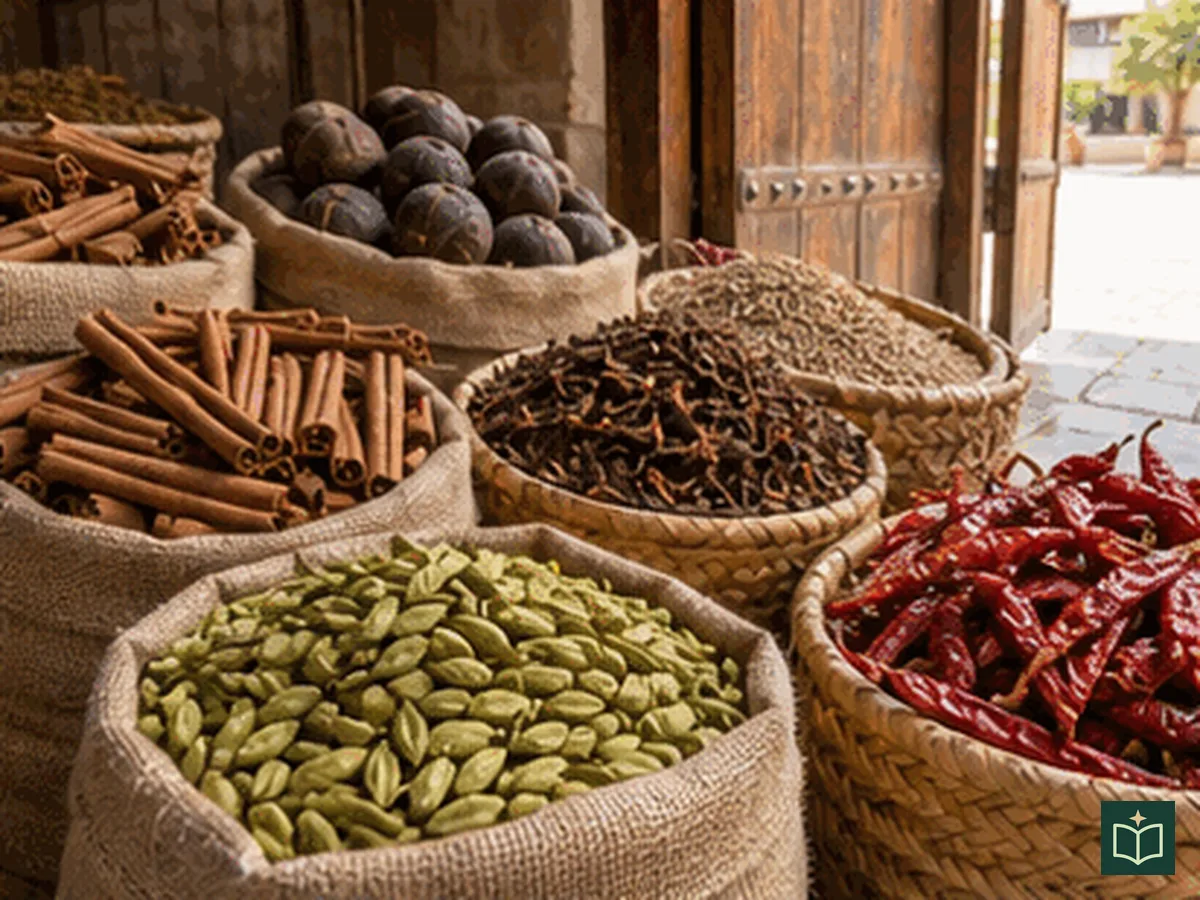
Gulf cooking shows that “spicy” can mean aromatic rather than hot. Dishes such as machboos, harees and thareed are seasoned with blends known as bzar or baharat, built on cardamom, cinnamon, cloves, cumin, black pepper and dried lime, with saffron for special occasions. Chilli is used, but traditional Emirati food is rarely fiery. These spices arrived through centuries of Indian Ocean trade linking the Gulf with India, East Africa and Persia, rather than from local plants. That history supports a broader point: what a region cooks with depends heavily on its trading partners and cultural ties, not only on its temperature.
What the pattern can teach
The story of spice and climate is a useful lesson in reading geographical correlations. Two things can rise together, here temperature and spice, while both are linked to further factors such as biodiversity, wealth, trade routes and shared ancestry. Teasing these apart requires comparing many cultures while allowing for their relationships, much as biologists compare related species. The safest conclusion is that hot countries do tend to cook with more spice, that food safety may have played some role, and that taste, availability and history shaped each cuisine in its own way. Nobody needs a theory to enjoy the results.
Sources & further reading
Figures are rounded and widely published; check the linked organisations for the latest editions. These organisations do not endorse this website.