A park on top of a volcano
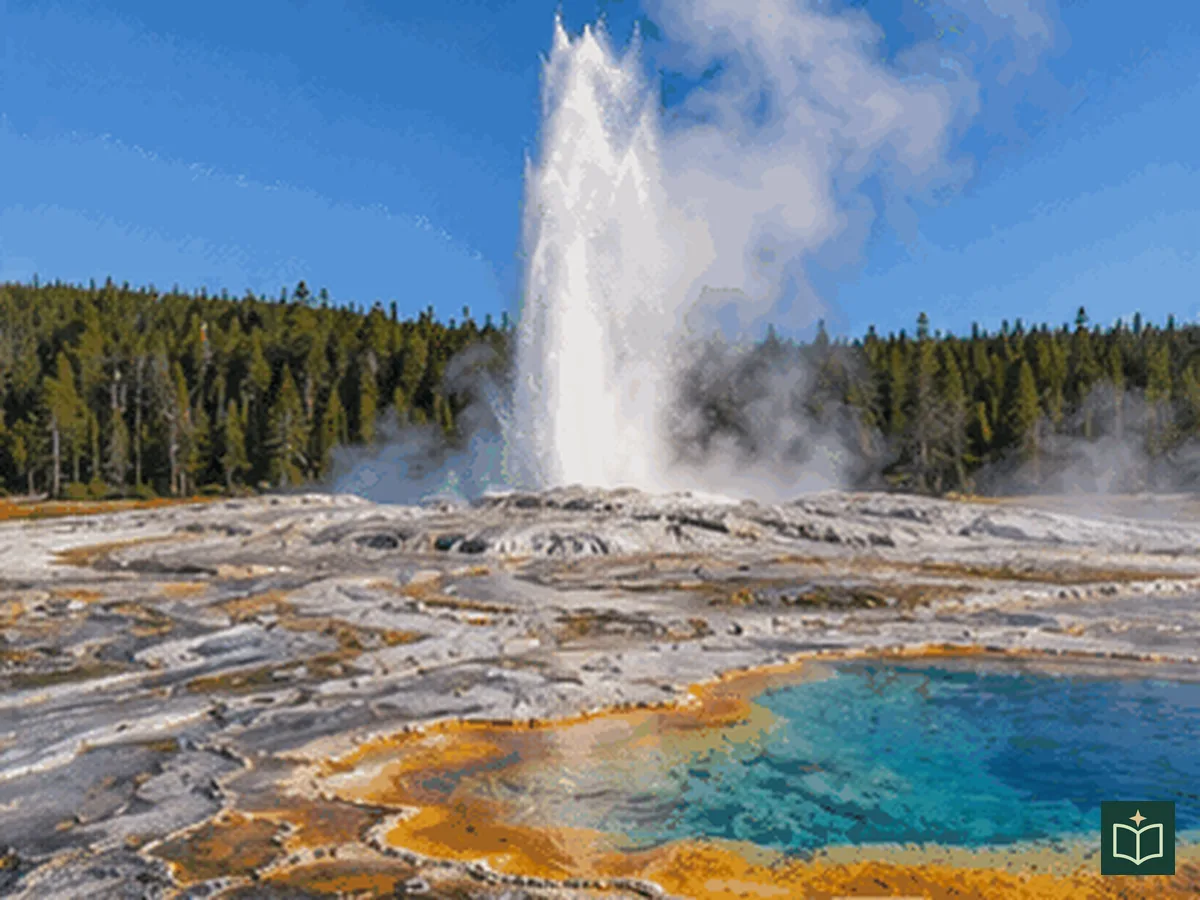
Yellowstone National Park, mostly in Wyoming, is famous for geysers, boiling pools and bubbling mud. All of them are powered by an active volcanic system lying a few kilometres beneath the surface. The park holds more than 10,000 hydrothermal features, around half of the world’s geysers, including Old Faithful, which erupts roughly every hour and a half. Much of the central park lies inside a caldera, a vast depression roughly 45 by 70 kilometres across, so large and so worn that visitors rarely realise they are standing in one. It formed when the ground collapsed after an enormous eruption emptied the magma chamber beneath it.
The hotspot and its trail
Yellowstone sits above a hotspot, a long-lived source of heat rising from deep in Earth’s mantle. As the North American plate drifts slowly south-westward over it, the volcanic activity appears to move north-eastward across the land. The result is a trail of older calderas, now buried under lava, stretching across Idaho along the Snake River Plain and back roughly 16 million years to the borders of Nevada and Oregon. Hawaii’s islands trace a similar path across the Pacific plate. Beneath Yellowstone today, seismic images reveal a large reservoir of hot rock. Only a small fraction of it, often estimated at 5 to 15 per cent, is actually molten.
Three giant eruptions
Yellowstone has produced three caldera-forming eruptions. The first, about 2.1 million years ago, was one of the largest known volcanic eruptions, spreading ash over much of North America. The second, about 1.3 million years ago, was smaller. The third, about 631,000 years ago, created the present caldera. Since then there have been dozens of smaller lava flows, the most recent about 70,000 years ago. The intervals between the big eruptions were about 800,000 and 670,000 years, which has led to claims that the volcano is “overdue”. Volcanologists reject this: two intervals do not make a schedule, and volcanoes do not erupt on a timetable.
How geysers work
Yellowstone’s geysers depend on three ingredients: abundant water from rain and snow, intense heat from below, and a plumbing system of narrow cracks. Water seeps down, is heated well above its normal boiling point by the hot rock, and is kept liquid by the pressure of the water column above. When some of it flashes to steam, it pushes water out of the vent, lowering the pressure further, so the rest boils almost instantly and erupts. Hot springs form where water circulates freely without a constriction. Their vivid colours come from heat-loving microbes, each living in a particular temperature band.
How likely is a big eruption?
The United States Geological Survey operates the Yellowstone Volcano Observatory, which monitors earthquakes, ground movement, gases and temperatures. Small earthquake swarms happen most years, and the caldera floor rises and falls by a few centimetres a year as fluids move beneath it. None of this indicates an imminent eruption. The USGS estimates the annual chance of another caldera-forming eruption at about one in 730,000, comparable to the odds of a large asteroid impact on Earth in any given year. Far more likely hazards are hydrothermal explosions, when superheated water flashes to steam and blasts out a crater, and large earthquakes on faults around the park.
Why Yellowstone matters
Yellowstone became the world’s first national park in 1872, largely because of its geothermal wonders. It remains a natural laboratory for studying how heat moves from Earth’s interior to the surface and how life survives at extreme temperatures. An enzyme from a microbe first found in one of its hot springs became central to the laboratory technique used to copy DNA, now standard in medicine and research. The volcano also reminds us that some of the most dramatic geological events happen on timescales far beyond human experience. Watching Yellowstone carefully is less about predicting doom than about understanding a living planet.
Sources & further reading
Figures are rounded and widely published; check the linked organisations for the latest editions. These organisations do not endorse this website.