Springs and aquifers
Groundwater is not an underground lake but water filling the tiny spaces in sand, gravel and cracked rock. A layer that stores and transmits water readily is called an aquifer. Where an aquifer meets the surface on a hillside or in a valley floor, water seeps or flows out as a spring. Most springs simply mark the point where the water table, the top of the saturated ground, intersects the land. Artesian springs and wells are different. Their water is under pressure and rises higher than the top of the aquifer it comes from, sometimes gushing above the ground without any pump.
How the pressure builds
Artesian conditions need a particular geometry. An aquifer, often a tilted layer of sandstone or limestone, is sandwiched between layers of clay or dense rock that water cannot easily pass through. At one end, usually on high ground, the aquifer is exposed and rain soaks in. Further down the slope, the water is trapped beneath the confining layer. The weight of all the water higher up the aquifer presses on the water below, much as water in a high tank pressurises the pipes in a building. Drill through the seal, and the water rises up the borehole towards the level of its source.
A worked example
Suppose an aquifer takes in rain where it outcrops on hills 300 metres above sea level, and a well is drilled into it on a plain at 50 metres. In theory the water could rise up to 250 metres above the plain, the difference in height between the intake and the well. In reality friction as water seeps through the rock uses up much of that energy, so the level reached, called the potentiometric surface, is lower. If it still lies above the ground, the well flows freely. The name comes from Artois in northern France, where flowing wells were drilled from the twelfth century onwards.
Australia’s great basin
The largest example is the Great Artesian Basin, which lies beneath about 1.7 million square kilometres of eastern and central Australia. Rain falling on the Great Dividing Range soaks into sandstone layers that slope westward beneath the interior. Some of the water has been underground for hundreds of thousands of years, and the oldest is estimated at up to two million years. From the late nineteenth century, thousands of bores tapped it, and water gushed out freely to supply sheep and cattle stations across otherwise dry country. So much flowed to waste through open drains that pressure dropped, and governments now cap bores to conserve it.
Bahrain’s sweet water from the sea
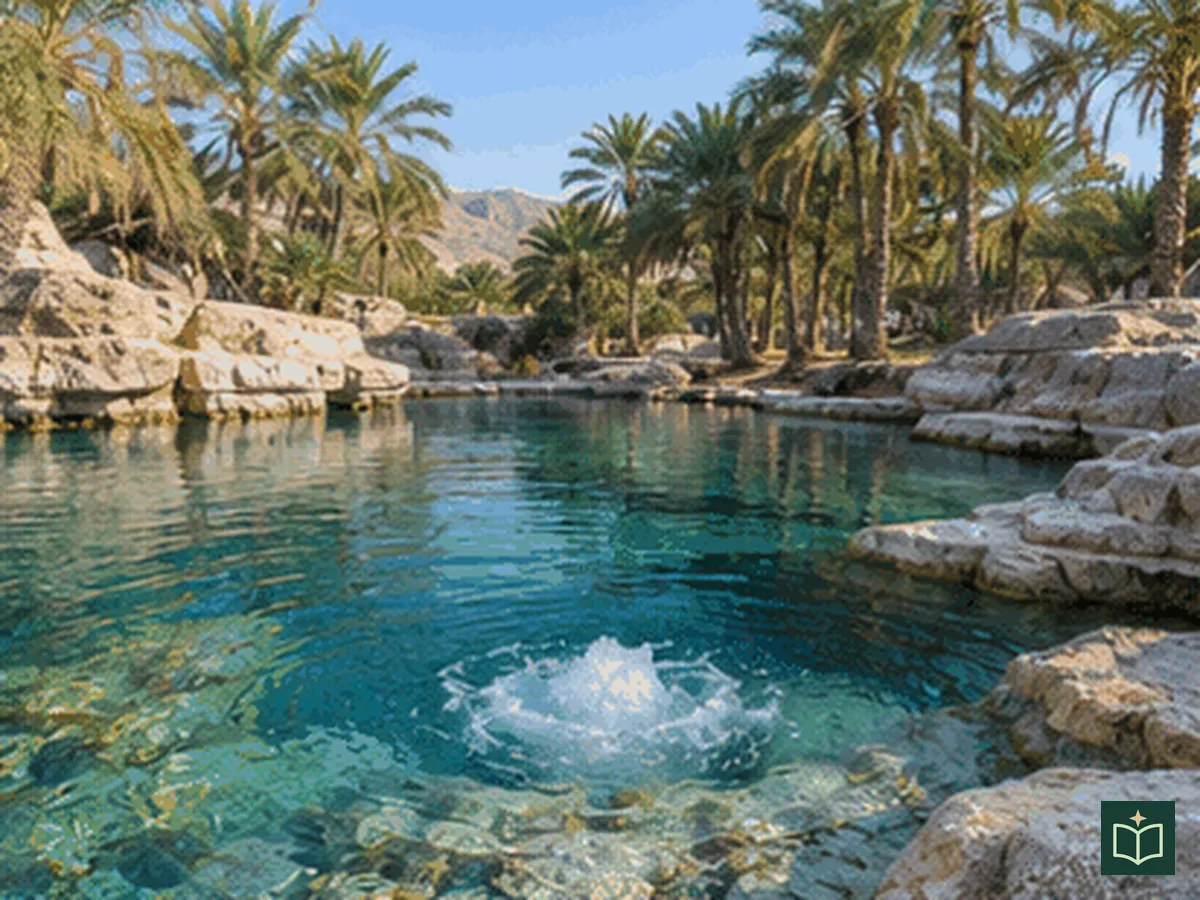
Bahrain offers one of the most remarkable cases. Groundwater in the Dammam aquifer system is thought to be recharged far to the west in the Arabian interior and flows eastward under pressure beneath the Gulf. Where it found cracks, it emerged as springs on the island, such as the famous Ain Adhari, and even on the seabed. For centuries, divers collected fresh water from submarine springs, sometimes filling leather bags or jars at the bottom. Heavy pumping in the twentieth century lowered the pressure, many springs dried up and seawater began to seep into the aquifer. Bahrain now relies largely on desalination for its drinking water.
A pressure that can be used up
Artesian water can seem limitless because it flows on its own, but the pressure that drives it is a finite resource. Every well that releases water lowers the head across the aquifer, and wells that once flowed may later need pumps. Where recharge is slow, as in deserts, the water is effectively being mined. Falling pressure can also draw salt water into coastal aquifers or cause the ground to sink. Across the Arabian Peninsula, many historic springs and flowing wells have weakened or vanished. Managing artesian water well means measuring it, sealing leaking bores and taking no more than nature can replace.
Sources & further reading
- USGS Water Science School · Artesian water and artesian wells ↗
- Australian Government DCCEEW · Great Artesian Basin ↗
Figures are rounded and widely published; check the linked organisations for the latest editions. These organisations do not endorse this website.