Forests of seaweed
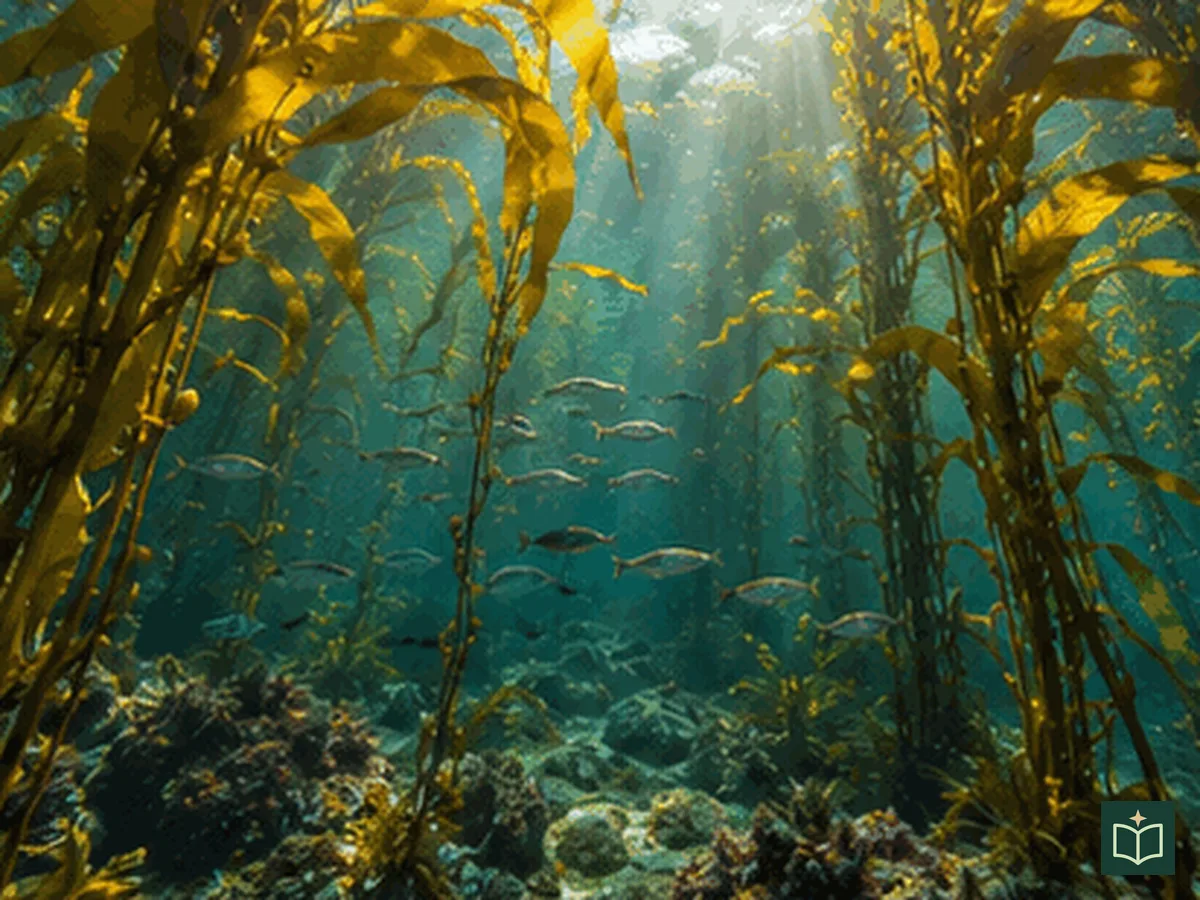
Along many cool, rocky coastlines, the shallow sea floor supports forests of kelp, large brown algae that can grow taller than most trees on land. Kelp is not a true plant: it has no roots, flowers or woody tissue. Instead it grips the rock with a root-like holdfast, rises on a flexible stalk called a stipe and spreads leaf-like blades that capture sunlight. In giant kelp, the largest species, small gas-filled bladders at the base of each blade float the fronds upwards, so they can form a dense canopy at the surface. Individual fronds can exceed 30 metres in length and continue spreading across the surface.
Why cold water matters
Kelp forests grow mainly in water cooler than about 20°C, especially where upwelling brings nutrients from the depths. The coasts of California, Chile, South Africa, southern Australia, New Zealand, Norway and Japan host major forests. Cold water holds more dissolved nutrients such as nitrate, which kelp absorbs directly through its blades. Light is the other requirement, so forests are confined to clear, shallow water, typically less than about 40 metres deep. Warm tropical seas, including the Gulf, are generally too poor in nutrients for kelp, which is why coral reefs dominate there instead. The two ecosystems play similar roles in different conditions.
Growth at record speed
In ideal conditions, giant kelp can grow about 60 centimetres in a single day, making it one of the fastest-growing organisms on Earth. Each frond lives only a few months, and storms regularly tear out whole plants, so a forest is constantly renewing itself. The broken kelp does not go to waste. Drifting rafts carry animals across the ocean, kelp washed ashore feeds beach insects and birds, and fragments sinking into deep canyons supply food to life far below. A kelp forest is therefore highly productive, turning sunlight and nutrients into living material that supports food webs well beyond its own boundaries.
Otters, urchins and balance
The health of a kelp forest depends on a delicate balance. Sea urchins graze on kelp, and when their numbers explode they can strip a forest bare, leaving a rocky “urchin barren”. Predators keep them in check. On the Pacific coast of North America, sea otters eat urchins in large numbers. When otters were hunted almost to extinction for their fur in the eighteenth and nineteenth centuries, urchins multiplied and many forests vanished. Where otters returned, kelp recovered. This chain of effects, in which a top predator shapes an entire ecosystem, is a classic example of what ecologists call a trophic cascade.
Forests under pressure
Kelp forests are sensitive to warming. A marine heatwave in the north-east Pacific between 2014 and 2016 coincided with a disease that wiped out sunflower sea stars, another key urchin predator. Purple urchin numbers soared, and northern California lost the great majority of its bull kelp canopy. Tasmania has lost most of its giant kelp as warmer currents pushed south. Pollution and sediment can also cut the light kelp needs. At the same time, forests in some colder regions are expanding. Restoration projects now remove urchins by hand, replant kelp and support the return of predators to help forests recover.
Why kelp forests matter
Kelp forests provide nurseries for fish, shelter for seals and seabirds, and food for abalone, lobster and many species that coastal communities harvest. They soften wave energy before it reaches the shore and absorb carbon as they grow. Kelp itself is harvested for food and for alginates, thickeners used in products from ice cream to toothpaste. Seaweed farming, which grows kelp on ropes in open water, is expanding rapidly, particularly in China, South Korea and Japan. Understanding why kelp needs cold, clear, nutrient-rich water and balanced food webs is essential for protecting these underwater forests as the oceans continue to change.
Sources & further reading
Figures are rounded and widely published; check the linked organisations for the latest editions. These organisations do not endorse this website.