An intuition that seems right
Drop a stone and a sheet of paper and the stone lands first. For nearly two thousand years, that everyday observation supported the view, associated with Aristotle, that heavier objects fall faster in proportion to their weight. A stone twice as heavy should fall twice as fast. It sounds reasonable and matches much of what we see. Yet it is wrong. The paper is not slowed by its lightness but by the air it must push aside. Crumple the same sheet into a tight ball and drop it beside the stone from waist height, and the two land almost together. The difference between them was never really about weight at all.
Galileo's thought experiment
Around 1600, Galileo Galilei attacked the old view with logic as well as experiment. Imagine, he argued, tying a heavy stone to a light one. If light things fall more slowly, the light stone should drag on the heavy one, so the pair falls more slowly than the heavy stone alone. But the pair is heavier than either stone, so by the same rule it should fall faster. Both cannot be true, so the rule must be wrong. Galileo also rolled balls down gentle ramps to slow the motion enough to time it, and found that falling bodies speed up steadily. The famous story of his drops from the Leaning Tower of Pisa may be a legend.
Why the masses cancel
Isaac Newton explained the result later in the seventeenth century. Gravity pulls on an object with a force proportional to its mass: a 10-kilogram ball feels ten times the pull on a 1-kilogram ball. But Newton's second law says acceleration equals force divided by mass. Ten times the force acting on ten times the mass gives exactly the same acceleration. Near Earth's surface that acceleration is about 9.8 metres per second squared. A dropped object, heavy or light, is moving at roughly 9.8 metres per second after one second and 19.6 after two, ignoring air. Modern experiments, including tests in orbit, have confirmed the cancellation to better than one part in a hundred trillion.
A test on the Moon
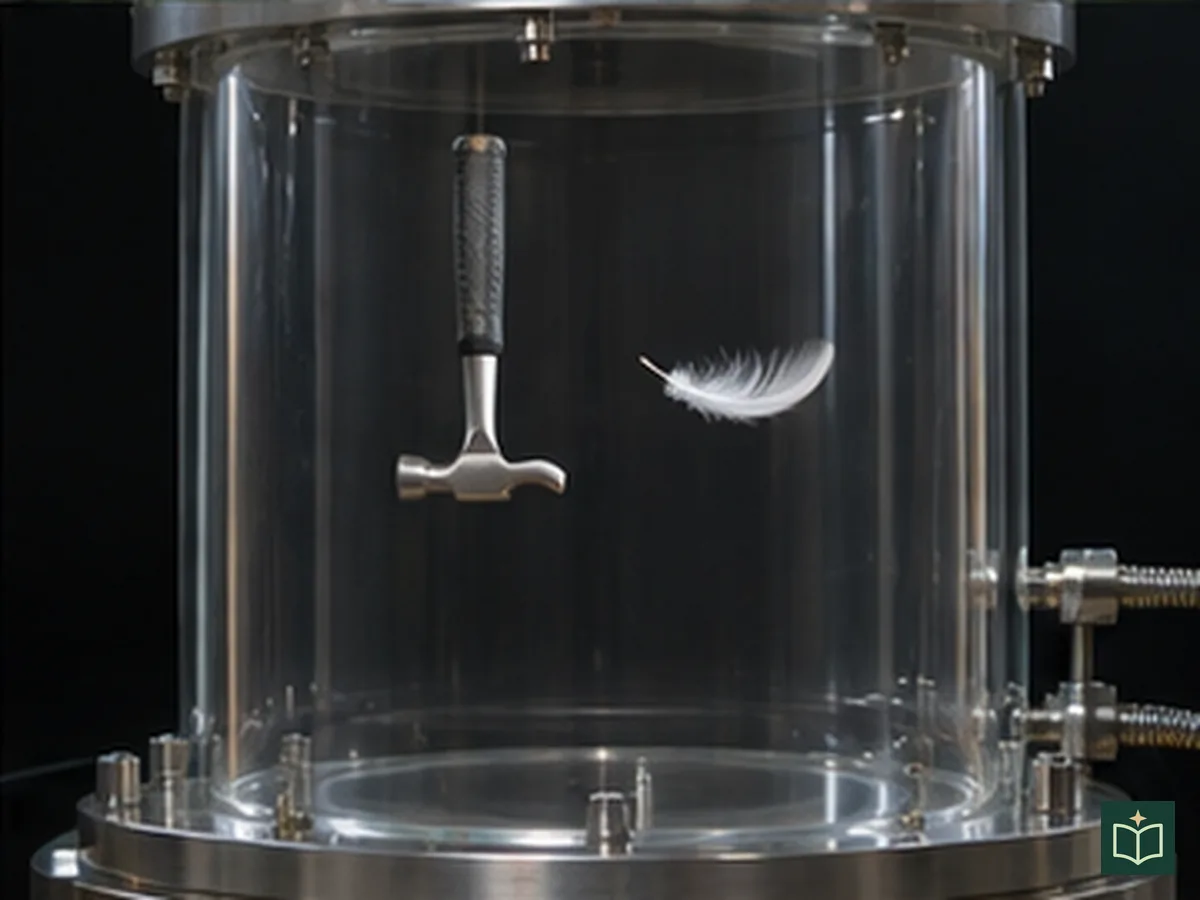
The most famous demonstration took place in 1971, near the end of the Apollo 15 mission. Standing on the airless lunar surface, astronaut David Scott held a geological hammer in one hand and a falcon feather in the other, a nod to his lunar module, named Falcon, and released them together in front of a television camera. They fell side by side and struck the dust at the same moment. Scott told viewers that Galileo had been right. On the Moon, gravity is about one-sixth as strong as on Earth, so the fall was slow: from a height of 1.5 metres, an object takes about 1.4 seconds to land, against roughly 0.55 seconds on Earth.
What air changes
On Earth, a falling object must shove air out of its way, and that drag grows rapidly with speed. Drag depends on an object's shape and the area it presents to the air, not on its weight. A feather has a large surface for very little mass, so drag soon balances its weight and it drifts down at a gentle terminal velocity. A hammer must reach a much higher speed before drag can match its larger weight. This is where weight does matter: of two balls of the same size and shape, the heavier one reaches a higher terminal speed and, over a long enough drop, lands first. A skydiver falling belly-down levels off at close to 200 kilometres an hour.
Why it matters
The equal fall of all objects is more than a classroom curiosity. Albert Einstein treated it as a deep clue to the nature of gravity: if everything falls identically, then falling might be a property of space and time rather than a force acting differently on different things. That insight became a founding principle of general relativity. The same physics explains why astronauts float inside an orbiting station, since they and their spacecraft fall together around Earth. On the ground it shapes the design of parachutes and the testing of everything from dropped phones to safety equipment. And it offers a lasting lesson: an observation can be accurate while the explanation drawn from it is wrong.
Sources & further reading
- NASA · The Apollo 15 hammer–feather drop ↗
- Britannica · Galileo Galilei ↗
- Britannica · Newton's laws of motion ↗
Figures are rounded and widely published; check the linked organisations for the latest editions. These organisations do not endorse this website.