Why atoms bond at all
An atom is a positively charged nucleus surrounded by electrons arranged in shells. The electrons in the outermost shell, called valence electrons, decide how the atom behaves. Atoms with full outer shells, such as helium, neon and argon, are stable and rarely react; these noble gases mostly exist as lone atoms. Most other atoms reach a lower-energy, more stable arrangement by gaining, losing or sharing electrons with neighbours. That rearrangement is a chemical bond. Energy is released when a bond forms and must be supplied to break it. Which kind of bond forms depends largely on electronegativity, the strength with which each atom pulls on electrons. A large mismatch gives one type; a close match gives another.
Ionic bonds: table salt
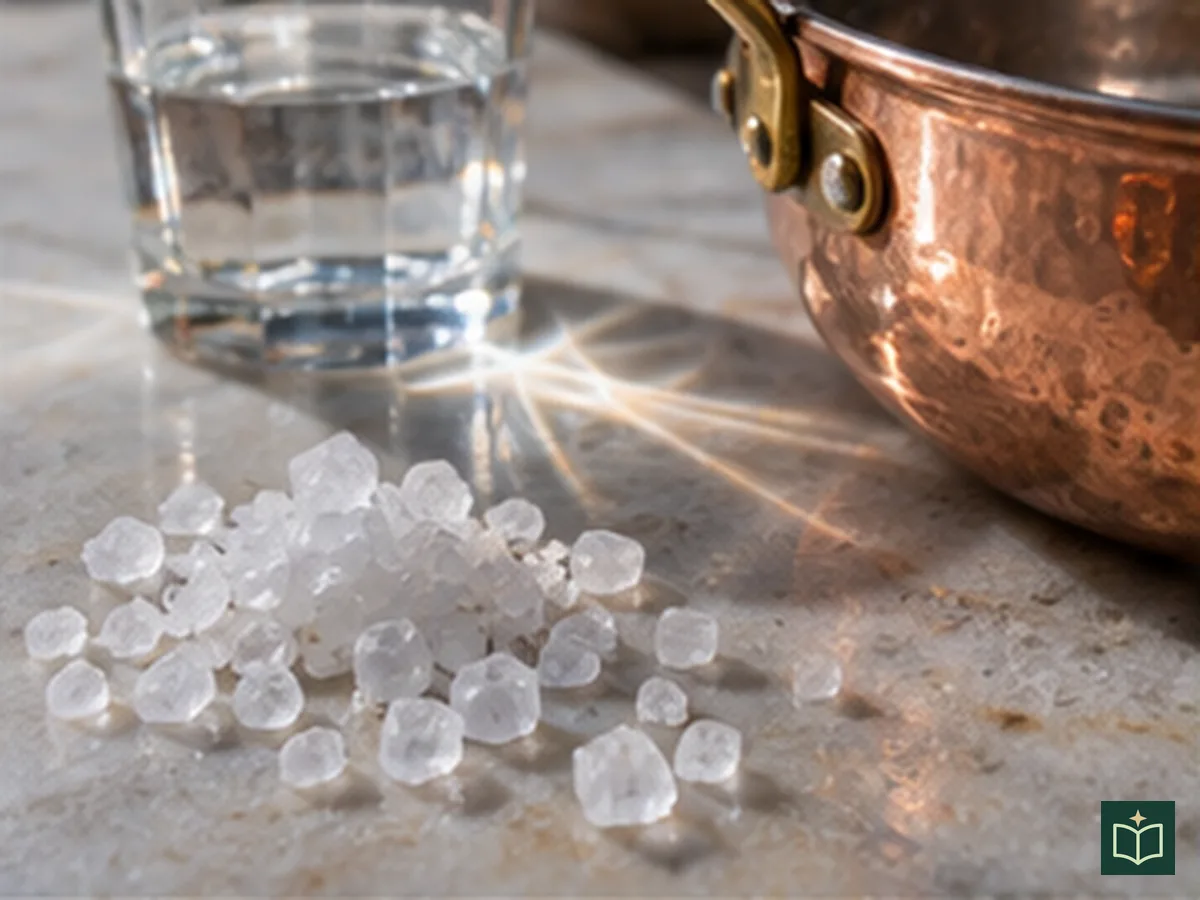
Sodium has a single electron in its outer shell and loses it easily. Chlorine is one electron short of a full shell and gains one readily. When they react, the electron moves across: sodium becomes a positive ion and chlorine a negative chloride ion. Opposite charges attract in every direction, so the ions stack into a repeating cubic crystal rather than forming separate molecules. That is why salt grains, seen under a magnifier, look like tiny cubes. The bonds are strong, giving salt its high melting point of 801°C, but the crystal is brittle: shift one layer and like charges line up, repel and crack the crystal apart. Dissolved or melted, salt's freed ions carry electric current.
Covalent bonds: water
When two atoms both pull strongly on electrons, neither gives way; instead they share. In a water molecule, an oxygen atom shares a pair of electrons with each of two hydrogen atoms. The sharing is unequal, because oxygen pulls harder, so the oxygen end carries a slight negative charge and the hydrogen ends a slight positive charge. The molecule is bent, at an angle of about 104.5 degrees. These partial charges make neighbouring water molecules cling together through weaker attractions called hydrogen bonds, which explain water's unusually high boiling point for so small a molecule. Covalent bonds also build the long carbon chains in fuels, plastics, sugars and DNA.
Metallic bonds: a sea of electrons
Metal atoms hold their outer electrons loosely. In a solid metal, those electrons drift away from individual atoms and form a shared 'sea' that moves freely through a lattice of positive ions. This arrangement explains the familiar properties of metals. Mobile electrons carry electric current and heat quickly, which is why copper wires and aluminium pans work so well. They also reflect light, giving metals their shine. Because the bonding is not tied to fixed partners, layers of atoms can slide past each other without the structure falling apart. Metals therefore bend, and can be hammered into sheets or drawn into wire, instead of shattering the way a salt crystal does.
A spectrum, not three boxes
Textbooks separate bonds into three neat categories, but real bonds sit along a spectrum. The bond in hydrogen chloride is covalent yet strongly polar, with its electrons pulled towards chlorine. Many compounds, including some oxides used in ceramics, have bonds with both ionic and covalent character. Chemists use the difference in electronegativity between two atoms as a rough guide: a large gap leans ionic, a small one covalent. Another common misconception is that bonds are physical sticks, as in a ball-and-stick model. They are really regions where electron density concentrates between nuclei, governed by quantum mechanics and best pictured as clouds of probability rather than rigid links.
Why bonding matters
Bonding is the hinge between atoms and the materials we use. It explains why salt dissolves in water but oil does not, why some solids are hard, why metals conduct and plastics insulate. Industries in the Gulf manipulate bonds every day. Refineries and petrochemical plants break and rebuild covalent bonds in hydrocarbons to make fuels and plastics. Aluminium smelters in the UAE and Bahrain spend vast amounts of electricity breaking the strong bonds between aluminium and oxygen in alumina. Desalination plants separate water from dissolved salt ions. Understanding how and why atoms hold together turns chemistry from a list of facts into a set of predictable patterns.
Sources & further reading
Figures are rounded and widely published; check the linked organisations for the latest editions. These organisations do not endorse this website.