A mammal that grazes the sea
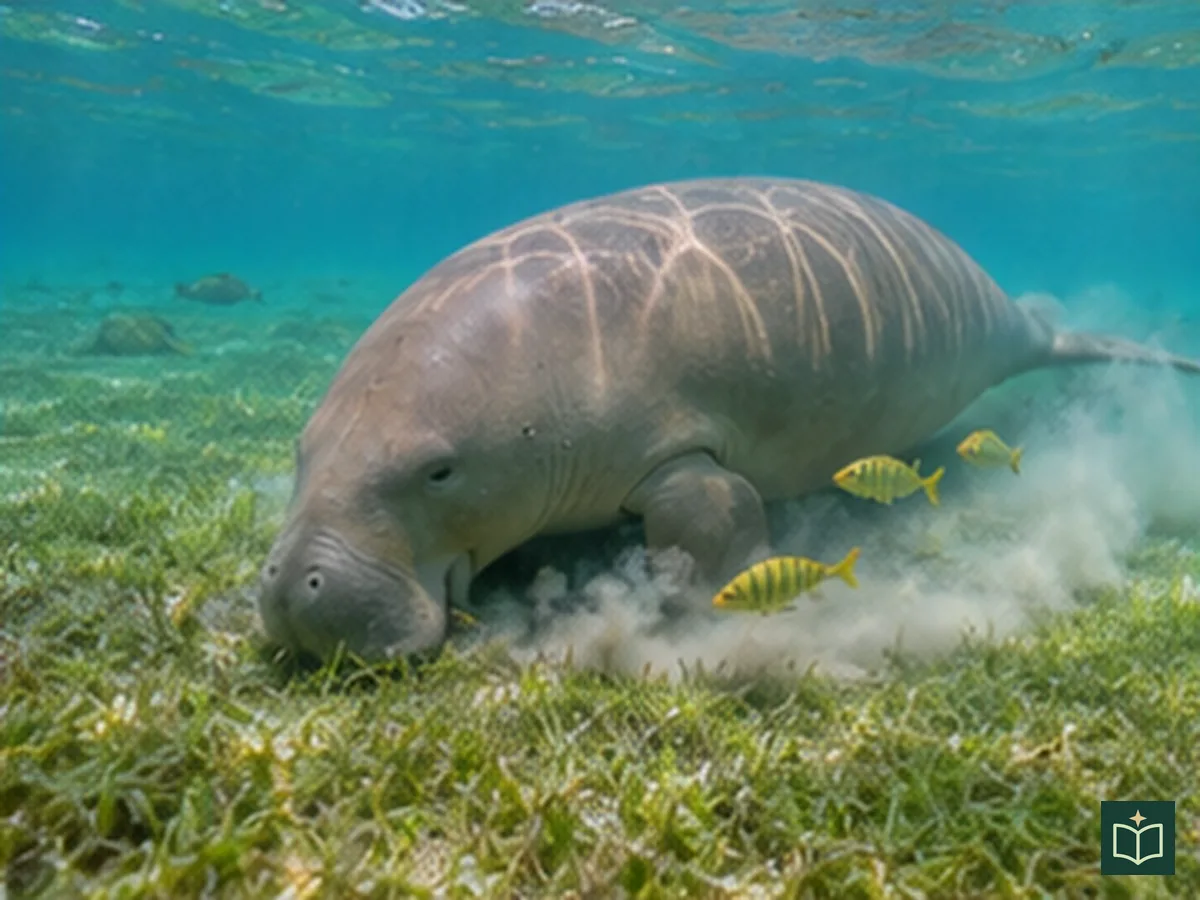
The dugong is a large, grey-brown marine mammal with a rounded body, paddle-like flippers and a fluked tail similar to a dolphin's. Adults typically reach about three metres in length and can weigh more than 400 kilograms. Unlike whales and dolphins, which hunt, the dugong is a grazer. It is the only living mammal that is both strictly marine and feeds almost entirely on plants. It lives in warm, shallow coastal waters from East Africa across the Red Sea, the Gulf and South Asia to the Pacific islands and northern Australia. Its gentle, grazing habits earned it the nickname 'sea cow', and it may have inspired some old sailors' tales of mermaids.
Life in the seagrass meadows
Seagrasses are flowering plants that grow on sandy seabeds in shallow, sunlit water, and dugongs depend on them almost completely. Using a broad, downturned snout with a sensitive, bristled lip, a dugong uproots whole plants, including the nutritious roots, and leaves tell-tale trails across the meadow. An adult can eat 30 to 40 kilograms of seagrass a day. Dugongs must surface to breathe, typically every few minutes, and they rarely feed deeper than about 10 metres because their food needs light. Their grazing helps keep meadows productive, much as grazing animals do on land. In turn, the meadows shelter young fish and shrimp and lock away carbon in the sediment.
Cousins of the elephant
The dugong's closest living relatives are not seals or whales but elephants. Dugongs and manatees form an order called Sirenia, which shares a common ancestor with elephants and with the small, rabbit-like hyraxes. Fossils show that the earliest sirenians, about 50 million years ago, were four-legged animals that waded in shallow water. Over millions of years their hind limbs disappeared, the front limbs became flippers, and their bones grew dense and heavy, acting as ballast for grazing on the bottom. Like elephants, dugongs have tusks, though these usually erupt only in males and older females. Both are long-lived, slow-breeding animals, and both are herbivores that shape the landscapes they feed in.
A Gulf stronghold
The Gulf, with its broad, shallow shelf and extensive seagrass beds, is one of the dugong's most important strongholds. Surveys suggest that several thousand dugongs live in the Gulf, the largest population outside Australia. About 3,000 are estimated in Abu Dhabi's waters alone, concentrated around the Marawah Marine Biosphere Reserve and the islands of the western region, with other important herds off Qatar and Bahrain. Aerial surveys have recorded groups of several hundred animals together off Qatar, among the largest gatherings seen anywhere. The Gulf's dugongs live near the limits of what the species can tolerate, coping with summer water above 30°C and salinity high enough to stress many marine animals.
Slow to breed, easy to lose
Dugongs can live for about 70 years, but they reproduce slowly. Females typically do not give birth until they are around ten years old, carry a single calf for about 13 months and then nurse it for a year or more, leaving several years between births. Populations therefore recover very slowly from losses. The main threats are entanglement in fishing nets, collisions with boats, coastal development that buries or clouds seagrass, and marine heatwaves that kill meadows. The International Union for Conservation of Nature lists the dugong as vulnerable worldwide. A much larger relative, Steller's sea cow of the North Pacific, was hunted to extinction within three decades of its discovery in 1741.
Protecting the herds
Gulf states have made dugong conservation a priority. The UAE protects dugongs by law and has restricted the drifting fishing nets that most often entangle them, and Abu Dhabi has designated large marine protected areas covering key seagrass beds. Abu Dhabi also hosts the secretariat of an international agreement on dugong conservation under the UN's Convention on Migratory Species, linking dozens of countries across the animal's range. Scientists monitor herds through aerial surveys and satellite tags, and map seagrass health from boats and space. The biggest long-term question is how meadows will cope with warming seas. The fate of the Gulf's sea cows depends, above all, on the grass beneath them.
Sources & further reading
Figures are rounded and widely published; check the linked organisations for the latest editions. These organisations do not endorse this website.