Two kinds of humidity
Weather reports usually quote relative humidity, the percentage of the water vapour that air could hold at its current temperature. A more telling number is the dew point: the temperature at which the air would become saturated and form dew. Dew point measures how much moisture is actually present. In much of the world a summer dew point above 20°C feels oppressive. On the Gulf coast in July and August, dew points of 25 to 30°C are routine, and brief readings above that are not unusual. That is why stepping out of an air-conditioned building in Dubai or Doha can instantly fog a pair of glasses.
A bathtub of warm water
The Gulf is shallow, averaging only a few dozen metres deep, and almost enclosed, with limited exchange through the Strait of Hormuz. Under a high summer sun, little water is available to spread the heat downwards, so the surface warms far beyond typical ocean temperatures. Warm water evaporates rapidly, and warmer air can hold more vapour: roughly 6 to 7 per cent more for every extra degree. The result is a thick layer of very moist air sitting over the sea. Hot, dry winds from the surrounding deserts actually speed evaporation further, adding still more vapour to the air above the water.
The afternoon sea breeze
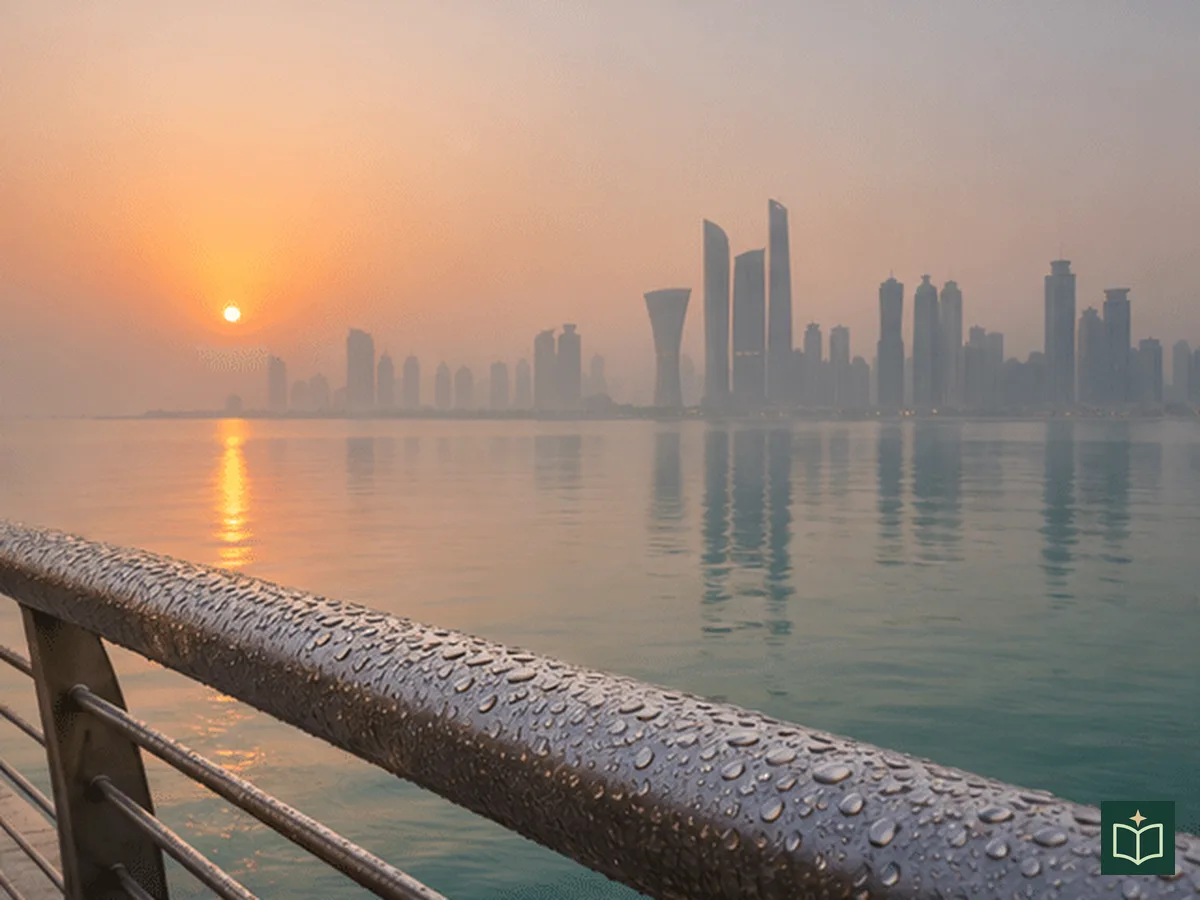
On most summer days, land heats faster than water during the day, so by late morning air over the desert rises and air from the sea flows in to replace it. This sea breeze carries the moisture-laden marine air onto the coast, often reaching 30 to 50 kilometres inland before it weakens. At night the pattern can reverse, but by then the coastal air is already loaded with water. As night-time temperatures fall towards the dew point, relative humidity climbs, which is why early mornings on the coast can feel like a steam room and why parked car windscreens drip with condensation at dawn.
Working the numbers
Take a coastal afternoon at 35°C with a dew point of 28°C. Using the standard formula linking temperature and saturation, the relative humidity works out at about 67 per cent. Now compare an inland afternoon at 45°C with a dew point of only 10°C. It is ten degrees hotter, yet relative humidity is roughly 13 per cent. Sweat evaporates easily in the second case, cooling the skin, while in the first it barely evaporates at all. Records illustrate the extreme: in July 2003 Dhahran, on the Saudi Gulf coast, reported a dew point near 35°C, among the highest ever measured anywhere.
Why inland feels different
Al Ain, Liwa and the interior of the Arabian Peninsula sit beyond the usual reach of the sea breeze. There the summer air comes mainly from the desert, so it is hotter by day but much drier, with large swings between day and night. Visitors often describe inland heat as an oven and coastal heat as a sauna, and the dew point explains the difference. Nights inland can feel almost pleasant by comparison. Mountains add another twist: the Hajar range sometimes squeezes moist air upwards on summer afternoons, building isolated thunderstorms over the peaks while the coast below stays humid but rainless.
Why it matters for health
The human body cools itself by evaporating sweat. When the dew point is high, that cooling fails, so heat stress builds even at temperatures that would be bearable in dry air. Scientists track this using the wet-bulb temperature, which combines heat and humidity. Studies of the Gulf and South Asia have flagged them as regions where rising sea temperatures could push wet-bulb readings closer to the limits of safe outdoor work. That helps explain midday outdoor work bans across the Gulf in summer, shaded bus stops, and why public advice on hydration and rest matters more on the coast than raw thermometer readings suggest.
Sources & further reading
- NOAA National Weather Service · Dew point vs humidity ↗
- Britannica · Persian Gulf ↗
- NASA Earth Observatory ↗
Figures are rounded and widely published; check the linked organisations for the latest editions. These organisations do not endorse this website.