Farming a slope
On a steep hillside, rain does two kinds of damage. It runs off quickly instead of soaking in, and it carries soil downhill as it goes. Plough the slope and the problem worsens, because loosened soil washes away even faster. Terracing, one of the oldest forms of landscape engineering, solves both problems at once. Farmers cut the slope into a series of level steps, each supported by a wall of stone or packed earth. On each flat step, water slows, spreads and sinks into the ground. Soil stays put, and crops can be planted, irrigated and harvested on what was once land too steep to use.
How terraces work
Building a terrace means cutting soil from the upper part of each step and filling it behind a retaining wall at the lower edge. Steeper slopes demand narrower terraces and taller walls, so the effort rises quickly with gradient. Many systems are also irrigation networks: water enters at the top and is passed from one level to the next through small channels or gaps in the walls. Flooded rice terraces in Asia work this way, each paddy spilling gently into the one below. Terraces also create small differences in temperature and moisture between levels, letting farmers grow different crops on the same hillside.
Rice on the mountains
The best-known terraces are in rice-growing Asia. The Ifugao terraces in the northern Philippines and the Hani terraces of Yunnan in southern China are both World Heritage sites, their mud-walled paddies stepping up mountainsides fed by forest streams above. In Bali the subak system shares water between terraces through a network of canals managed by communities and temples. In the Andes, the Inca built stone terraces called andenes, filling them with layers of gravel and soil to drain well and resist erosion, and some are still farmed today. Terraces also cover vineyards along Portugal’s Douro valley and the Mediterranean coast.
Oman’s Green Mountain
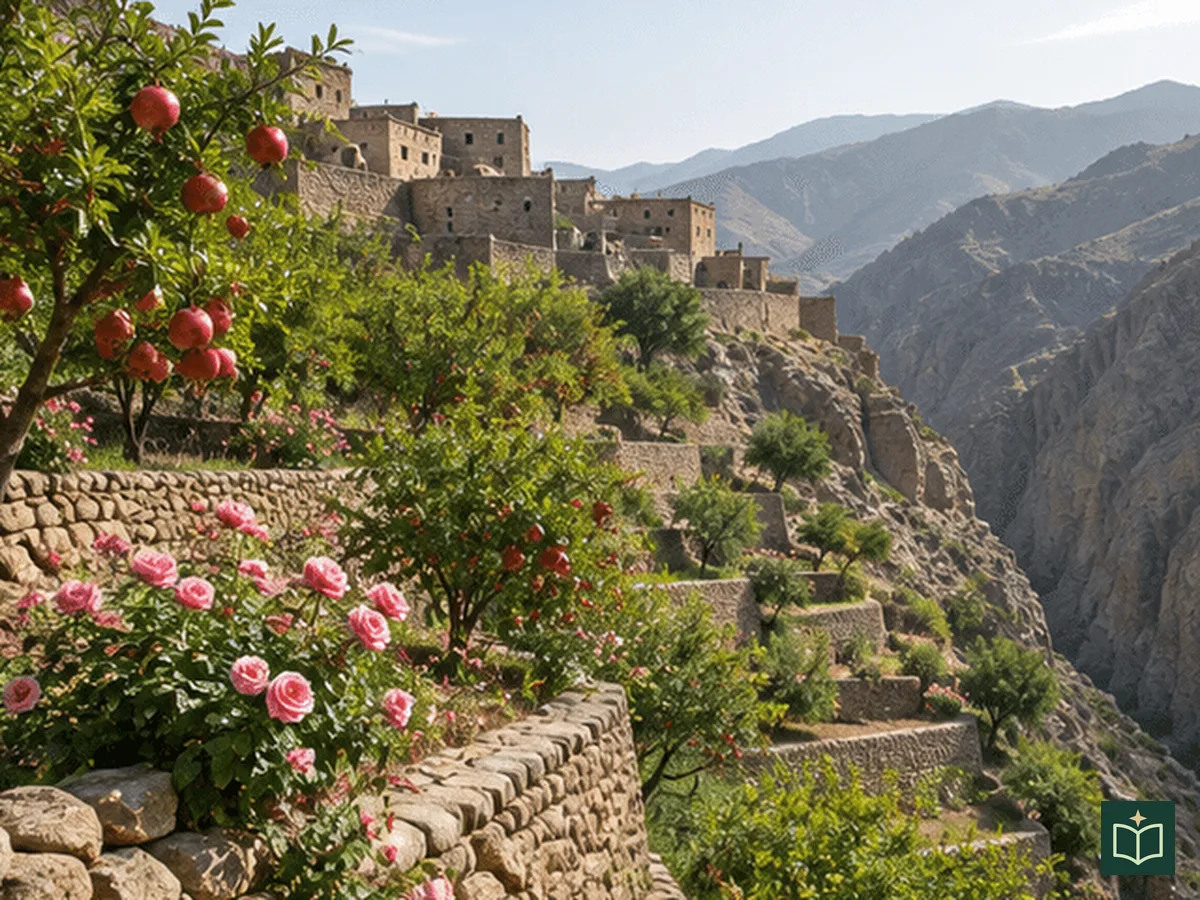
Jebel Akhdar, meaning Green Mountain, rises above the Omani interior in the Hajar range. Around the Saiq Plateau, at roughly 2,000 metres, villages perch above deep gorges with terraces stepping down beneath them. The altitude makes the climate far cooler than the plains, cool enough for crops rarely grown in Arabia: pomegranates, walnuts, apricots, peaches and Damask roses. Water comes from springs and aflaj, the channels that carry it by gravity to each level in turn. In spring the rose terraces bloom, and villagers distil the petals into rosewater, a craft that has drawn growing numbers of visitors to the mountain.
Heavy work, shared rules
Terraces are not built once and forgotten. Storms knock down walls, channels silt up and roots loosen stones, so the system needs constant repair. Many terraced landscapes therefore come with rules on who maintains which wall and how water is shared, often enforced by village institutions. When young people leave for cities, maintenance lapses and terraces can collapse within a few years, sometimes causing more erosion than if they had never been built. Researchers studying abandoned terraces in the Mediterranean and Asia have found that neglected walls can trigger landslides and gullies, so the decision to stop farming has consequences down the slope.
Why terraces still matter
Terraces are a reminder that farming is shaped by landscape as much as by technology. They let communities grow food in mountains where flat land is scarce, they slow floods and they keep soil where it formed. Agricultural agencies still promote modern terraces and contour bunds on eroding slopes in Africa and Asia. Heritage landscapes such as the Ifugao and Hani terraces draw tourists, which can fund repairs but can also strain water and labour. On Jebel Akhdar, as elsewhere, the future of the terraces depends on whether farming them remains worthwhile enough for people to keep the walls standing.
Sources & further reading
- UNESCO World Heritage · Rice Terraces of the Philippine Cordilleras ↗
- FAO · Globally Important Agricultural Heritage Systems ↗
- Britannica · Terracing ↗
Figures are rounded and widely published; check the linked organisations for the latest editions. These organisations do not endorse this website.