From pink to green
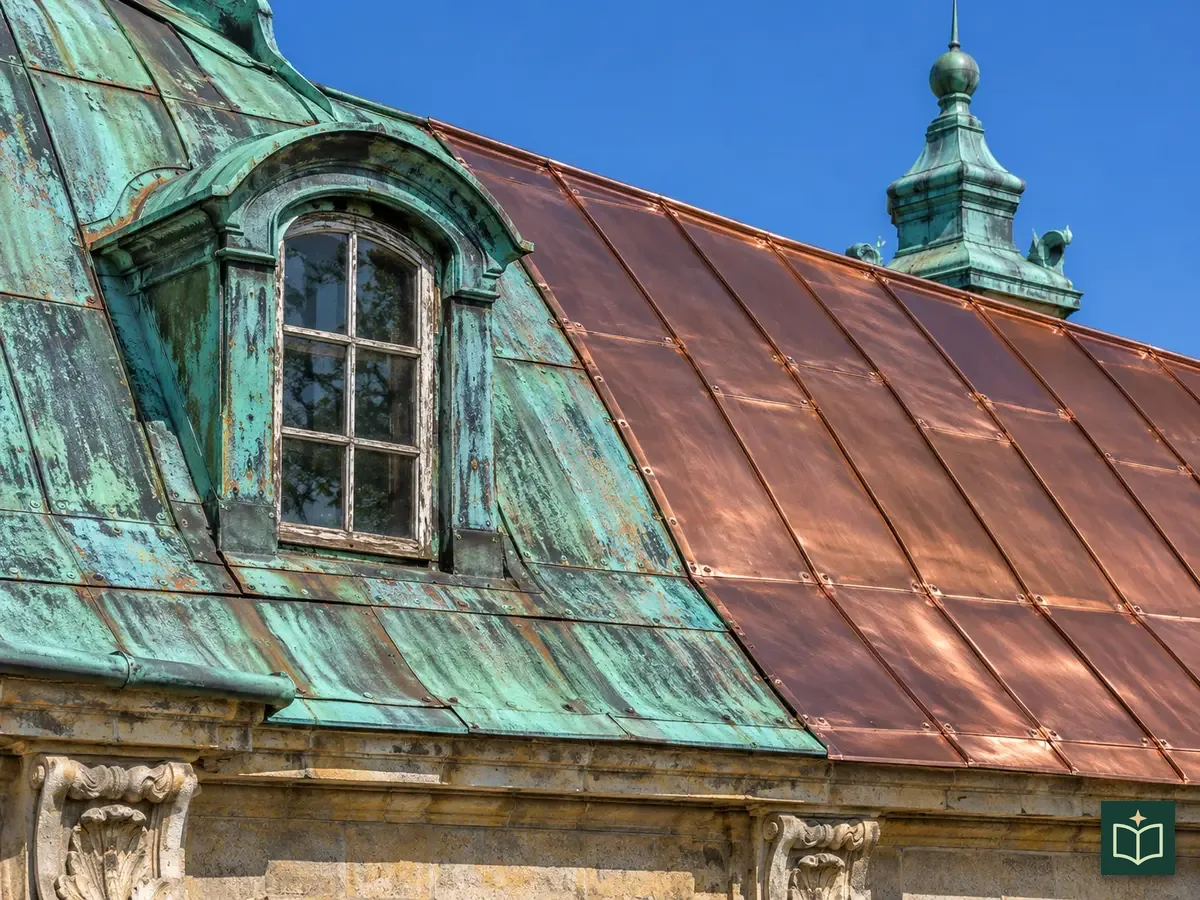
Freshly cut or polished copper has a distinctive salmon-pink shine. Exposed to air, it begins to change almost immediately. Within weeks or months, a thin layer of copper oxide forms, giving the surface a darker, more orange-brown tone. Over the next few years, that layer thickens and darkens towards chocolate brown and sometimes nearly black. Only after many years outdoors does the familiar blue-green colour appear, starting in patches where rainwater runs or collects and spreading gradually across the surface. The full change can take anything from several years to several decades, depending on climate, pollution and exposure. The result is called a patina, and it is the reason old copper roofs look green.
What the green is made of
The green layer is not a single substance. In most urban and industrial environments, its main component is a basic copper sulphate, a mineral called brochantite, formed as copper oxide reacts with sulphur compounds in the air and with water. Basic copper carbonates, chemically related to the mineral malachite, can also form. Near the sea, chloride from salt spray produces copper chlorides such as atacamite, often with a slightly different green or blue tinge. These compounds are relatively insoluble and adhere firmly to the surface. That is why patina is often described as protective: once established, it greatly slows further corrosion, allowing copper roofs and statues to last for centuries.
Not like rust
It is tempting to think of patina as copper’s version of rust, but the two behave very differently. Rust on iron and steel is porous and flaky. It tends to crack and fall away, exposing fresh metal underneath to attack, so corrosion continues until the object is weakened or destroyed. Copper’s patina, by contrast, forms a thin, dense, tightly bonded layer that seals the surface. The metal beneath remains largely intact. This difference explains why architects have long used copper for roofs, domes, gutters and cladding on prestigious buildings, accepting, and often welcoming, the change in colour. Some even buy copper sheets that are pre-patinated chemically, to achieve the green effect immediately.
The most famous example
The Statue of Liberty in New York, dedicated in 1886, is the world’s best-known example of copper patina. Its outer skin consists of copper sheets roughly 2.4 millimetres thick, about the thickness of two coins, hammered into shape and attached to an internal iron framework. When it was unveiled, the statue was a shiny copper-brown. Over roughly the following three decades, exposure to the harbour’s air and salt spray turned it green. When officials considered painting it in the early twentieth century, the proposal met strong public objection, and the patina was left alone. It has since protected the thin copper skin remarkably well, despite more than a century of weather.
Verdigris and green fingers
A few related green effects are often confused with patina. Verdigris, historically used as a pigment by artists, is mainly copper acetate, traditionally made by exposing copper to vinegar fumes; it forms more quickly and is not the same as atmospheric patina. A similar process explains why cheap copper-containing rings sometimes leave a green mark on fingers: sweat and skin acids react with the metal to form copper salts, which stain the skin. The stain is generally harmless and washes off. In museums, conservators also watch for so-called bronze disease, an active corrosion caused by chlorides, which shows as powdery light-green spots and can slowly damage ancient objects.
Climate and care
Local climate strongly influences how copper ages. In humid, polluted cities, patina may form within a decade or two. In very dry desert air, inland surfaces can stay brown for far longer, while salty coastal air, such as along much of the Gulf shoreline, tends to favour chloride compounds and can produce uneven colours. Owners who prefer copper’s original shine must clean and lacquer it regularly, accepting extra maintenance. Others let nature take its course. Either way, the colour tells a story about the surrounding air. Because patina formation depends on sulphur in the atmosphere, cleaner modern air has even slowed the greening of new copper roofs in some cities.
Sources & further reading
Figures are rounded and widely published; check the linked organisations for the latest editions. These organisations do not endorse this website.