Why kitchens prize copper
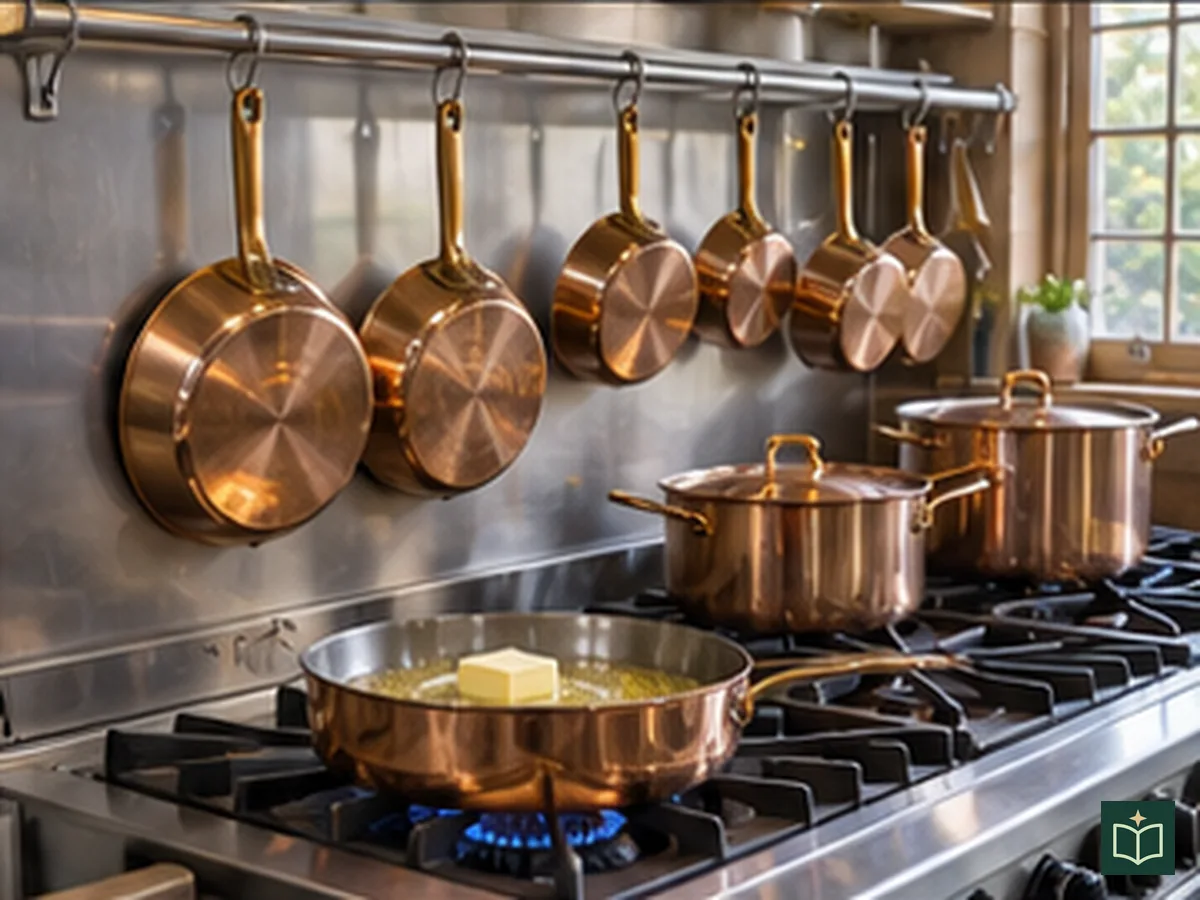
Hanging copper pans have long been a sign of a serious kitchen, from French restaurant brigades to grand country houses. The appeal is practical as much as decorative. Copper is the best heat conductor among affordable metals, beaten only by silver. A good copper pan heats evenly across its base and up its sides, and it responds almost immediately when the cook turns the heat up or down. That matters for delicate tasks such as sugar work, sauces that split if they overheat, and searing that needs steady, uniform contact. Many professionals say a copper pan feels as though it answers the hand.
What conduction does
A burner does not heat a pan evenly. A gas ring delivers heat in a circle, and an electric element may have hotter zones. The pan's job is to spread that energy sideways before it reaches the food. Thermal conductivity measures how readily a material passes heat along. Copper is roughly 400 watts per metre per kelvin, against about 235 for aluminium, 50 to 80 for cast iron and around 16 for stainless steel. In a copper base, heat flows quickly from the hot ring to the cooler edges, so the cooking surface stays close to one temperature and food browns uniformly.
Responsive, not just hot
Even heating is half the story. Copper also changes temperature quickly because heat moves through it fast, so a pan follows the burner closely. Cast iron behaves very differently. It conducts heat poorly but is heavy, storing a great deal of energy, which makes it good at holding a steady sear once hot but slow to heat and slow to cool. Aluminium sits in between: light, cheap and a good conductor, which is why it is the core of many clad pans. Thickness matters too. Copper pans of about two to three millimetres are commonly recommended for stovetop cooking; very thin ones are mostly decorative.
Why the lining matters
Bare copper reacts with acidic foods such as tomatoes, wine and vinegar, and dissolved copper in large amounts can cause stomach upset. For that reason most copper cookware is lined. The traditional lining is tin, wiped on by hand, which is naturally fairly non-stick but melts at about 232 °C and wears through over years, so pans need re-tinning. Modern pans more often use a thin layer of stainless steel bonded to the copper. It lasts indefinitely and tolerates high heat, though food sticks a little more. Unlined copper survives for special jobs, such as jam pans and bowls for whisking egg whites.
The trade-offs
Copper has drawbacks. It is expensive, heavy and needs polishing if the owner wants it to stay rosy; left alone, it darkens to a brown patina that does not affect cooking. Most copper pans do not work on induction hobs, which need a magnetic base, unless they include a steel disc. Linings, especially tin, need gentle treatment and wooden or silicone utensils. For many home cooks, a pan with an aluminium or copper core clad in stainless steel offers much of the evenness at lower cost. Cast iron remains the better choice for high, steady heat over long searing or baking.
Copper and the egg-white trick
One old kitchen habit shows copper's chemistry at work. Cooks have long whisked egg whites in unlined copper bowls, claiming a more stable foam. Food scientists have explained why: a tiny amount of copper ions binds to one of the egg-white proteins, conalbumin, making it more resistant to unfolding. The foam is less likely to over-whip into dry, grainy clumps, giving more time to fold it into a soufflé or meringue. A pinch of cream of tartar, an acid, achieves a similar result in glass or steel bowls. It is a small example of how copper's reactivity can be useful.
Sources & further reading
Figures are rounded and widely published; check the linked organisations for the latest editions. These organisations do not endorse this website.