A metal named for a goddess
Vanadium is a hard, silvery-grey metal that few people ever see as a pure element. It was first identified in 1801 by Andrés Manuel del Río in Mexico, but he was persuaded his discovery was a mistake. In 1830 the Swedish chemist Nils Sefström found it again and named it after Vanadís, a name of the Norse goddess Freyja, because its compounds come in many beautiful colours. Those colours, violet, green, blue and yellow, reflect the different numbers of electrons vanadium can lose. That chemical flexibility turns out to be the key to its newest use, while its affinity for carbon explains its oldest.
Small additions, strong steel
Around nine-tenths of the world's vanadium goes into steel, usually added as ferrovanadium. Typical additions are tiny, often around a tenth of a percent. During rolling and cooling, vanadium combines with carbon and nitrogen to form extremely fine particles of vanadium carbonitride. These particles pin the boundaries between steel grains, keeping the grains small, and they obstruct the movement of defects in the crystal. The result is steel that is stronger and tougher without needing much more carbon, which would make it brittle and hard to weld. Such microalloyed grades let engineers use less steel for the same load.
From car axles to rebar
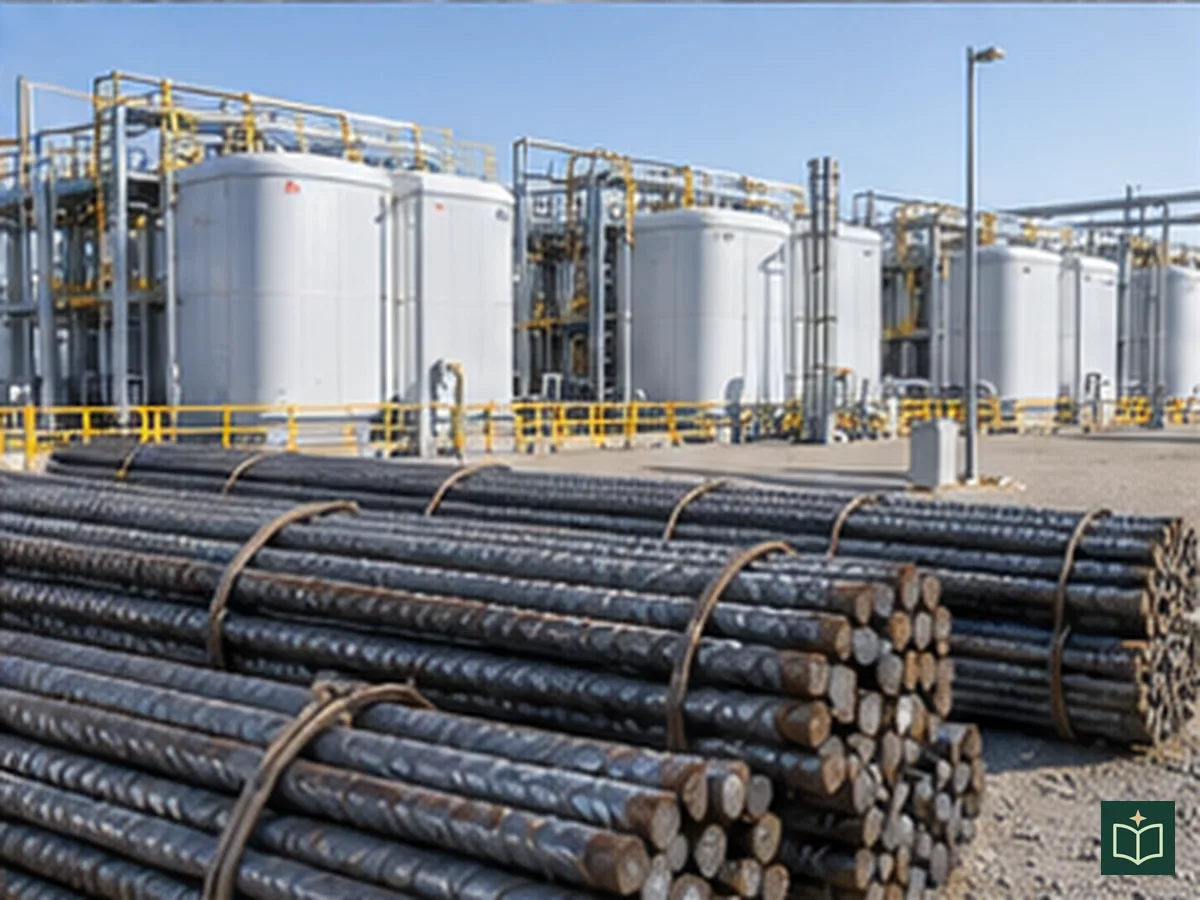
Vanadium steel has a long industrial history. Henry Ford's Model T, launched in 1908, used vanadium steel for parts that needed to be light and strong. Today a major use is reinforcing bar, the ribbed steel inside concrete. Higher-strength rebar lets builders use less steel in columns and slabs, and it performs better in earthquakes. When China tightened its rebar standards in 2018, demand for vanadium rose sharply. Tool steels and high-speed cutting steels also contain vanadium because its hard carbides resist wear. Smaller amounts go into titanium alloys for aircraft, where a common grade contains about 4% vanadium.
Where vanadium comes from
Vanadium is not rare in the Earth's crust, but it is spread thinly. Most supply comes as a co-product of iron-rich titanomagnetite ores, especially in China, Russia, South Africa and Brazil. When these ores are smelted for iron, vanadium collects in the slag, which is then processed to recover it. Some also comes from uranium ores, oil residues and the ash of burning heavy fuel oil, since crude oils from some regions, including parts of the Middle East and Venezuela, contain vanadium. Because supply depends partly on steelmaking, vanadium prices have historically swung widely when steel or battery demand shifts.
How a flow battery works
A vanadium redox flow battery stores energy in two tanks of vanadium dissolved in acid. One tank holds vanadium in the +2 and +3 states, the other in the +4 and +5 states. Pumps push both liquids past a membrane in a cell stack, where electrons move through an external circuit as the ions change state. Because both sides use the same element, ions that leak across the membrane do not permanently contaminate the battery. The chemistry was developed at the University of New South Wales in the 1980s. The electrolyte does not wear out quickly, so these batteries can manage many thousands of cycles.
Power and energy, decoupled
The design separates two quantities that are fixed together in a lithium-ion cell. Power depends on the size of the cell stack, while stored energy depends on the volume of electrolyte. Consider a 10-megawatt system with four hours of storage, holding 40 megawatt-hours. To stretch it to eight hours, an operator adds more electrolyte and larger tanks, reaching 80 megawatt-hours with the same stacks. The drawback is low energy density: the liquids are bulky and heavy, so flow batteries suit fixed grid sites rather than vehicles. Their future depends on cost, vanadium supply and competition from other storage technologies.
Sources & further reading
Figures are rounded and widely published; check the linked organisations for the latest editions. These organisations do not endorse this website.