Glass that conducts
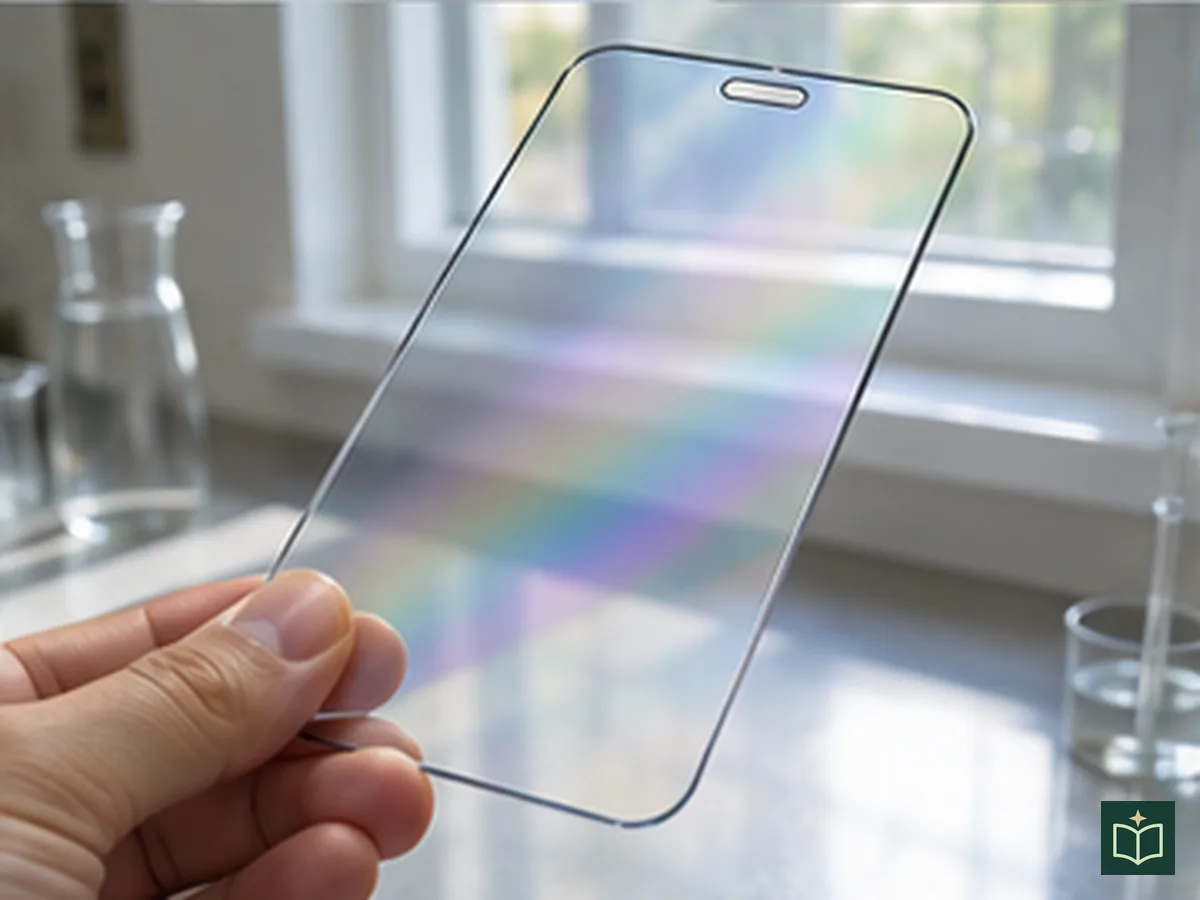
Most materials that conduct electricity are opaque, and most transparent materials are insulators. Displays need something that is both. A touchscreen must sense a finger through the glass, and every pixel in a liquid-crystal or OLED panel needs an electrode on the viewing side that light can pass through. The material that has done this job for decades is indium tin oxide, usually shortened to ITO. It is applied as an invisible film on glass or plastic, and it is found in phones, tablets, televisions, laptop screens, many solar cells and the heated anti-fog layers on some aircraft windows.
How ITO works
Indium oxide on its own is a transparent ceramic with a wide band gap, meaning visible light does not have enough energy to be absorbed by its electrons. Replacing a small share of indium atoms with tin, typically by mixing in about 10% tin oxide by weight, adds extra electrons that are free to move. Missing oxygen atoms contribute more. The result conducts electricity reasonably well while still letting most visible light through. Manufacturers usually deposit it by sputtering, bombarding a solid ITO target in a vacuum so that atoms land on the glass, building a layer often around a hundred nanometres thick.
How little is used
A single screen contains very little indium. Take a coating 100 nanometres thick over 100 square centimetres, roughly a phone's display area. That is a volume of 0.001 cubic centimetres. At a density of about 7.1 grams per cubic centimetre, the film weighs around 7 milligrams, of which roughly three-quarters, about 5 milligrams, is indium. Real devices vary, and some layers are patterned or repeated. The larger losses happen in the factory: much of a sputtering target never reaches the glass, so the leftover target material is routinely collected and recycled. That manufacturing loop supplies a large share of indium in use.
A by-product metal
Indium was discovered in 1863 by Ferdinand Reich and Hieronymus Richter in Freiberg, Germany, who named it after the indigo-blue line it produces in a spectroscope. It is about as scarce in the Earth's crust as silver, but it rarely forms its own ores. Instead it occurs in trace amounts within zinc minerals, especially sphalerite, and is recovered from residues when zinc is refined. China produces more than half of the world's refined indium, with South Korea, Japan and Canada among other producers. Because indium rides on zinc, supply cannot respond quickly when demand for screens rises.
Limits of a brittle film
ITO has weaknesses beyond supply. It is a ceramic, so it cracks when bent repeatedly, a problem for foldable phones and flexible displays. Its conductivity is good for touch sensing but modest for large panels and solar cells, where resistance wastes energy. Depositing it requires vacuum equipment, adding cost. Concern about indium supply has also led several governments, including the United States and the European Union, to treat indium as a critical or strategic raw material. These pressures have encouraged a steady search, in universities and industry alike, for transparent conductors that are cheaper, more flexible or made from more abundant elements.
What could replace it
Several alternatives already exist in niches. Fluorine-doped tin oxide coats much architectural and solar glass. Aluminium-doped zinc oxide uses common elements but is less stable in humid conditions. Fine metal meshes and silver nanowire networks are flexible and conduct well, and are used in some large touch panels. Graphene and carbon nanotube films promise flexibility but have struggled to match ITO's balance of clarity and conductivity at scale. Conductive polymers are cheap but less durable. For now, ITO remains the industry default because factories are built around it, and recycling of indium from production scrap continues to improve.
Sources & further reading
Figures are rounded and widely published; check the linked organisations for the latest editions. These organisations do not endorse this website.