A geological oddity
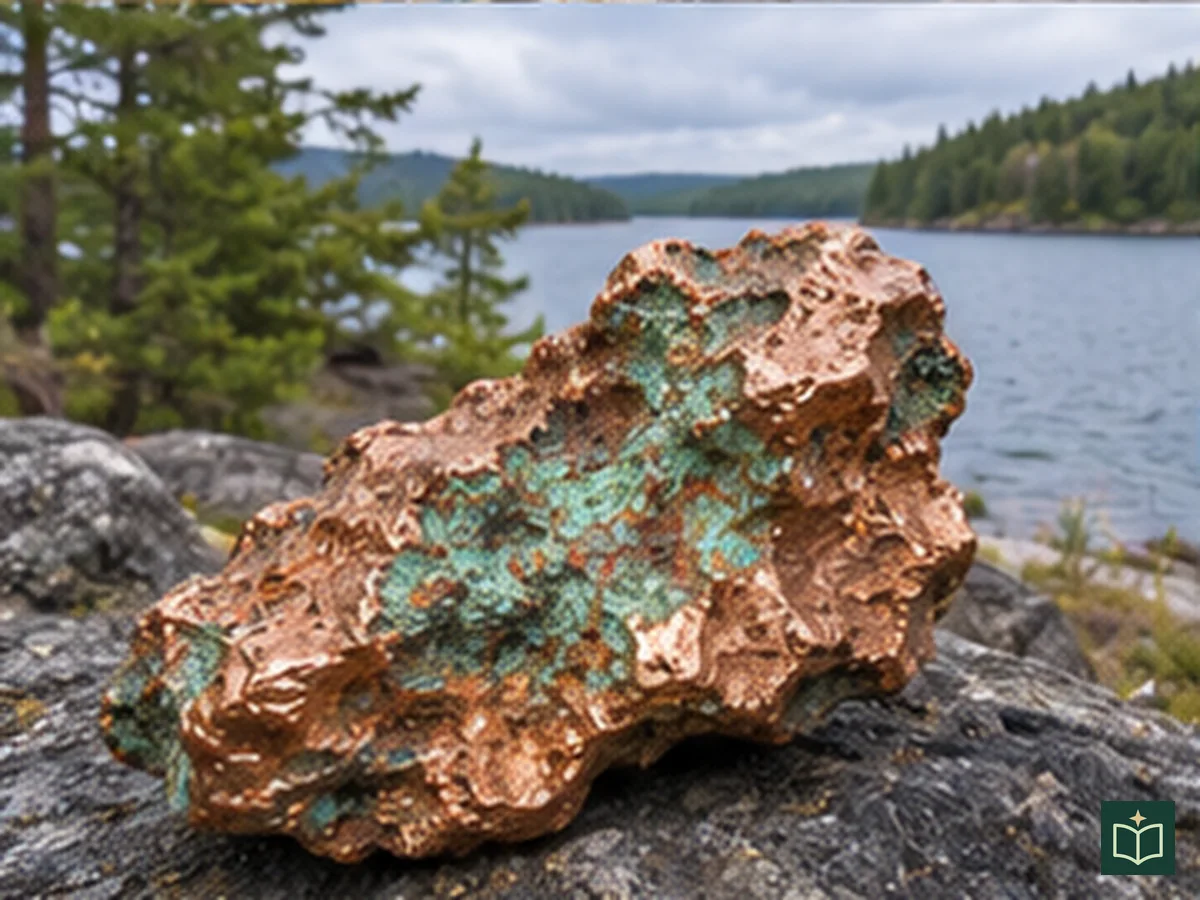
Almost all the world's copper is mined as compounds, mostly sulphide minerals that must be crushed, concentrated and smelted to release the metal. Native copper, the pure metal found as nature left it, is usually a scientific curiosity in small quantities. The Keweenaw Peninsula, which juts into Lake Superior from Michigan's Upper Peninsula, is the great exception. Its rocks contained native copper on an industrial scale, from flakes and wires to slabs weighing many tonnes. No other district has produced so much pure metallic copper, and that unusual geology shaped thousands of years of human history around the lake.
How the copper got there
About 1.1 billion years ago, North America began to split apart along what geologists call the Midcontinent Rift. Enormous volumes of basalt lava poured out, layer upon layer, interbedded with gravels washed from the rift's sides. The tops of the lava flows were riddled with gas bubbles, and the gravels were porous. Later, hot fluids carrying dissolved copper moved through these rocks. Because the fluids contained very little sulphur, the copper did not form sulphide minerals. Instead it crystallised as metal, filling gas holes, cementing gravels and lining fractures. In places native silver grew alongside it, separate and unmixed.
Seven thousand years of working copper
Indigenous peoples around Lake Superior were working this copper thousands of years before Europeans arrived, with the oldest dated artefacts commonly placed at around 7,000 years old or more. Archaeologists call these traditions the Old Copper Complex. People pried copper from outcrops and shallow pits, often using fire and water to crack the rock and stone hammers to break it free. Because the metal was pure, it could be shaped by cold hammering and gentle heating, without smelting. They made knives, awls, spear points and fishhooks. Copper from the region travelled along trade routes far across eastern North America.
The great masses
Some finds were astonishing. The Ontonagon Boulder, a mass of about 1.7 tonnes long known to local Ojibwe people, was hauled away in 1843 and ended up in the Smithsonian Institution. Underground, miners met far larger masses. One found at the Minesota Mine in 1857 weighed roughly 500 short tons, and cutting it into pieces small enough to lift took workers many months with chisels. Such masses were spectacular but awkward: they could not be blasted easily because copper bends rather than shatters. Most of the district's output came instead from millions of small grains in rock that was crushed and washed.
America's first copper boom
A survey by Michigan's state geologist, Douglass Houghton, published in 1841, drew prospectors north, and by the late 1840s a rush was under way. Through much of the mid-nineteenth century the Keweenaw was the leading copper source in the United States, feeding the age of the telegraph and electrical wiring. Towns, railways and immigrant communities from Cornwall, Finland and elsewhere grew up around deep shafts that eventually reached more than a mile along the dipping lode. Larger sulphide deposits in Montana and Arizona later overtook it, and the last major native-copper mines closed in the twentieth century.
What remains today
Waste rock piles, shaft houses and stamp mills still dot the peninsula, and much of this heritage is protected by the Keweenaw National Historical Park, established in 1992. Mineral collectors prize the region's specimens, including crystallised copper and pieces where copper and silver are intergrown, known locally as halfbreeds. Isle Royale, in the lake, preserves ancient mining pits. For geologists, the Keweenaw remains a reference case for how fluid chemistry controls the form a metal takes. The same element that is usually locked in sulphides elsewhere simply grew here as metal, waiting to be found by people with nothing more than stone hammers and patience.
Sources & further reading
- US National Park Service · Keweenaw National Historical Park ↗
- Smithsonian National Museum of Natural History ↗
- Britannica · Copper ↗
Figures are rounded and widely published; check the linked organisations for the latest editions. These organisations do not endorse this website.