A dry country, with exceptions
The UAE is one of the driest countries on Earth, with an average of roughly 100 millimetres of rain a year. That figure hides large differences. Parts of the south-western desert near Liwa may receive half that, while the Hajar mountains in the north-east receive noticeably more. Rainfall also varies hugely from year to year: a few heavy storms can deliver most of a year’s total in hours, and some years are almost completely dry. Behind these patterns lie two quite different weather machines, one active mainly in the cooler months and the other in the heat of summer, plus the occasional visitor from the Arabian Sea.
The winter source
Most rain in the UAE falls between November and March. In these months the subtropical high-pressure belt that dominates summer weakens and shifts south, opening the door to weather systems from the west. Troughs of low pressure, linked to disturbances that cross the Mediterranean and the Middle East, move over Arabia and the Gulf. As they approach, southerly winds draw in moisture, and cloud bands spread across the country. When an upper-level trough deepens or stalls, rain can become heavy and widespread, affecting coastal cities such as Abu Dhabi and Dubai as well as the interior. These systems often bring strong winds, rough seas and occasional hail.
The summer source
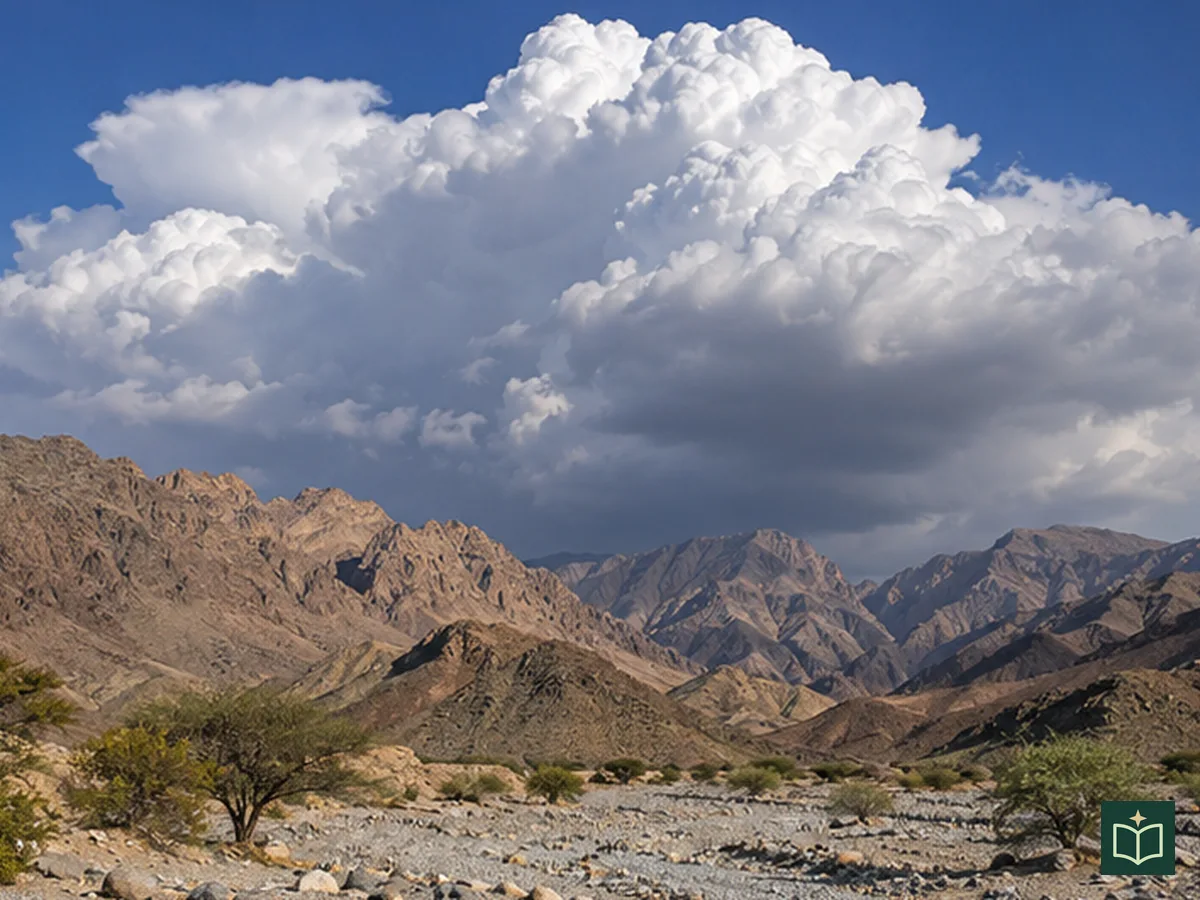
In summer, the coasts are hot and humid but usually rainless. The mountains tell a different story. Between June and September, intense sunshine heats the rocky slopes of the Hajar, and moist air, carried by sea breezes and by easterly and south-easterly winds, is forced to rise. As it climbs, it cools and condenses into towering cumulus clouds by early afternoon. These can grow into thunderstorms over Al Ain, Fujairah and inland Ras Al Khaimah, sometimes drifting west over the desert. Such storms are local and short-lived, but they can drop intense bursts of rain on steep ground, which is why mountain wadis can flood suddenly on summer afternoons.
Visitors from the Arabian Sea
A third, rarer source is the tropical cyclone. Storms forming over the Arabian Sea usually head towards Oman, Yemen, India or Pakistan, but a few come close enough to affect the UAE. Cyclone Gonu in 2007 struck Oman and brought rain and high seas to the UAE’s east coast. In 2021, Cyclone Shaheen made landfall in northern Oman, and its outer bands caused heavy rain and flooding around Al Ain. These events are infrequent, but they can produce some of the highest rainfall totals ever recorded in the region. They also highlight how close the UAE’s eastern coast is to the cyclone tracks of the northern Indian Ocean.
A record-breaking deluge
In April 2024, an unusually intense weather system brought the heaviest rain in the UAE since national records began in 1949. According to the National Center of Meteorology, Khatm Al Shakla near Al Ain recorded about 255 millimetres in less than 24 hours, more than twice the country’s average annual total. Cities built for a dry climate struggled to drain the water, and roads, homes and airports were disrupted. The event showed how the winter and spring trough pattern, when it brings deep moisture and slow-moving storms, can deliver extraordinary totals. Scientists continue to study how a warming climate may change the frequency of such extremes in the region.
Why the pattern matters
Understanding where rain comes from helps the UAE plan for both scarcity and flood. Winter rain recharges shallow aquifers, especially beneath gravel plains at the foot of the mountains, while summer storms test drainage and wadi crossings. Forecasters at the National Center of Meteorology track approaching troughs and watch for afternoon cloud growth over the Hajar. The UAE has also run a cloud seeding programme since the 1990s, which targets suitable convective clouds, mainly over the mountains, to encourage them to release more rain; its overall effect remains an area of research. For residents, the lesson is simple: in a desert, rain is rare, but when it arrives, it can arrive all at once.
Sources & further reading
- National Center of Meteorology (UAE) ↗
- World Bank Climate Change Knowledge Portal · United Arab Emirates ↗
Figures are rounded and widely published; check the linked organisations for the latest editions. These organisations do not endorse this website.