A handful of plants
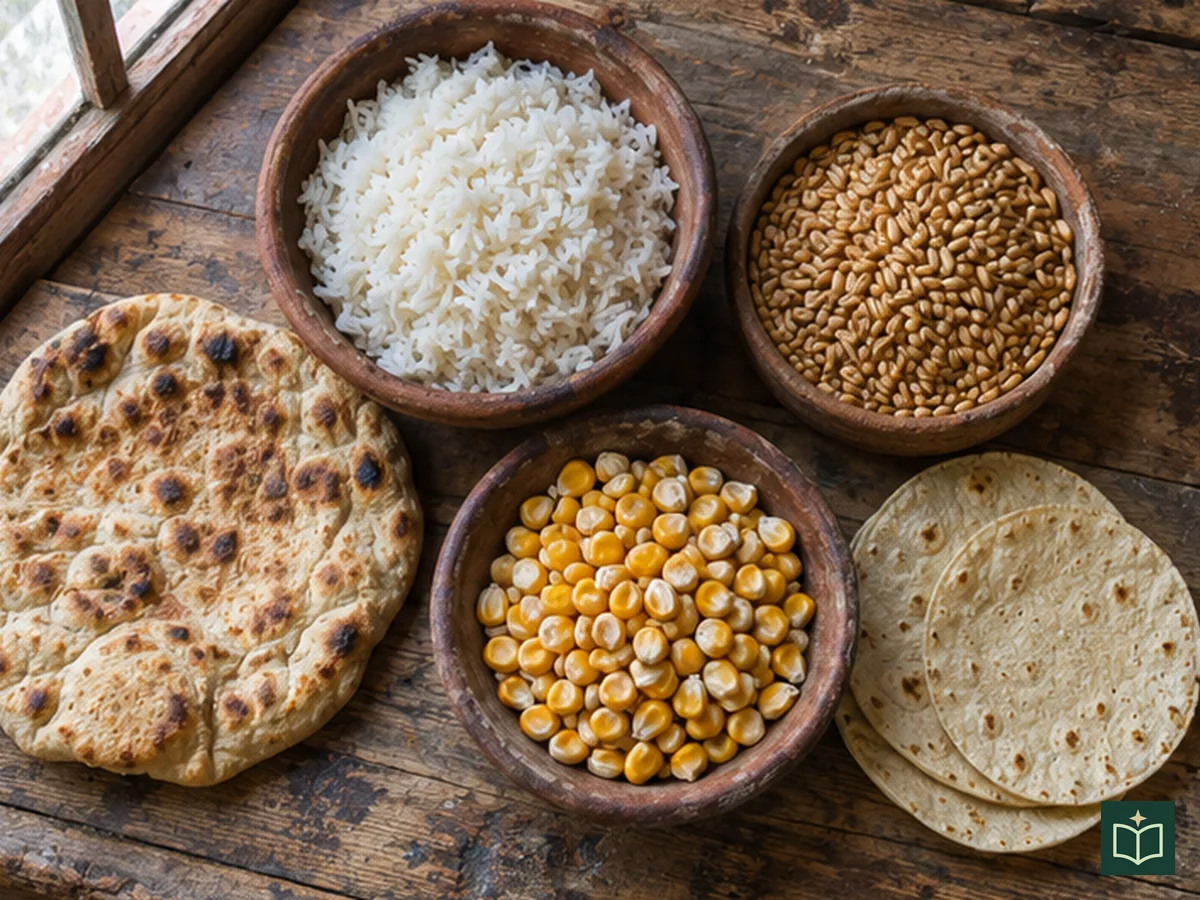
Humans can eat tens of thousands of plant species, yet a small number provide most of our food. According to the UN Food and Agriculture Organization, about 15 crops supply 90 per cent of the world’s food energy, and just three of them, rice, maize and wheat, account for roughly two-thirds of that. Add root crops such as cassava, potatoes and yams, and grains such as sorghum and millet, and you have the foundation of almost every cuisine. Each of these staples has a preferred climate. Over thousands of years, those preferences drew lines across the map that still decide whether a meal centres on bread, rice, tortillas or a starchy porridge.
The wheat belt
Wheat grows best where winters are cool and summers are warm but not humid, with moderate rainfall. It was first domesticated in the Fertile Crescent of the Middle East and spread across Europe, North Africa, Central Asia, northern India and northern China. Later it became the main crop of the plains of North America, Argentina and Australia. Because wheat contains gluten, its flour can be kneaded and leavened, which is why these regions are bread cultures: from French baguettes and Arab khubz to Indian chapatis and Chinese noodles and steamed buns. Russia, Ukraine, the European Union, India, China and the United States are among the largest producers.
The rice lands
Rice dominates where summers are hot and water is plentiful. It was domesticated in China’s Yangtze valley and spread across South and South-East Asia, where monsoon rains fill fields during the growing season. China and India together grow more than half of the world’s rice, and Bangladesh, Indonesia, Vietnam and Thailand are other major producers. In China, a well-known divide follows the Qinling Mountains and Huai River: to the south, wetter land favours rice; to the north, drier plains favour wheat and noodles. Gulf cuisine is a notable case of rice without paddies: machboos and biryani rely on rice imported for centuries through trade with India and Persia.
Maize and the Americas
Maize was domesticated in southern Mexico about 9,000 years ago from a wild grass called teosinte. It spread through the Americas and became the staple of Mesoamerican and Andean societies. Maize tolerates heat and grows quickly, but eaten alone it can lack available niacin, a B vitamin. Mesoamerican cooks solved this by soaking the grain in an alkaline solution of lime, a process called nixtamalisation, which releases niacin and makes the dough used for tortillas and tamales. When maize spread to Europe and Africa without that technique, diets heavily dependent on it sometimes led to pellagra. Today much of the world’s maize feeds livestock rather than people directly.
Roots, tubers and drylands
Where neither wheat nor rice thrives, other staples take over. Cassava, originally from South America, is now a key staple in much of sub-Saharan Africa because it tolerates poor soils and drought and can stay in the ground until needed; Nigeria is the world’s largest producer. Yams are central in West Africa, potatoes in the Andes where they were first grown, and taro and sweet potatoes in the Pacific. In the semi-arid Sahel and parts of India, sorghum and millet, which need less water, form the basis of porridges and flatbreads. These crops are often overlooked in global discussions, yet they feed hundreds of millions of people.
Lines that are blurring
Trade and urbanisation are softening these old boundaries. Wheat bread and noodles are now everyday foods in rice-growing Asia, and rice is common in Europe and the Americas. Gulf countries, with little farmland, import nearly all their staples, making them sensitive to global supply and prices. Dependence on so few crops also carries risks: a drought, pest or disease affecting one major grain can ripple across the world. Researchers and governments are therefore paying renewed attention to hardy, less-traded staples such as millet and sorghum. Still, the old geography lingers on every plate, shaped by the rain and warmth of distant fields.
Sources & further reading
Figures are rounded and widely published; check the linked organisations for the latest editions. These organisations do not endorse this website.