A seam around the planet
The longest mountain range on Earth is almost entirely hidden. The mid-ocean ridge system runs for about 65,000 kilometres, winding through the Atlantic, Indian, Pacific and Arctic oceans like the seam on a tennis ball. Its crest typically lies around 2,500 metres below the sea surface and rises one to three kilometres above the surrounding ocean floor. Along much of its length runs a central valley, or rift, where the crust is being pulled apart. The ridge is not a single continuous wall: it is broken into segments offset by fractures called transform faults, giving it a zigzag pattern on maps of the sea floor.
How the sea floor is made
Mid-ocean ridges are divergent plate boundaries. As two plates move apart, hot rock from the mantle rises to fill the gap. Because pressure drops as it rises, part of that rock melts, producing magma that erupts or cools just below the surface as basalt. This forms new oceanic crust, which then moves away from the ridge on both sides like two conveyor belts. As the crust ages, it cools, becomes denser and sinks, so the ocean deepens away from the ridge. Eventually, far from where it formed, oceanic crust sinks back into the mantle at subduction zones. This is why no ocean floor is older than about 200 million years.
Slow and fast spreading
Ridges spread at different speeds. The Mid-Atlantic Ridge is slow, widening the Atlantic by roughly two to five centimetres a year, about the pace fingernails grow. At 2.5 centimetres a year, that adds 25 kilometres in a million years. Over the roughly 180 million years since the Atlantic began to open, an average of under three centimetres a year is enough to build an ocean around 5,000 kilometres wide. The East Pacific Rise spreads much faster, in places over 15 centimetres a year. Slow ridges tend to have deep, rugged central valleys; fast ridges form smoother, broader swells with less pronounced rifts.
The ridge on the Gulf’s doorstep
The nearest active spreading centres to the Gulf lie to its south-west. The Red Sea and the Gulf of Aden are young oceans formed as the Arabian Plate pulled away from Africa over the past 30 million years or so. Their spreading axes connect with the Carlsberg Ridge in the Arabian Sea and the wider Indian Ocean ridge system. This movement helps push Arabia north-east towards Eurasia, the same collision that raised Iran’s Zagros mountains. In a sense, the Red Sea is a very early-stage version of the Atlantic: a narrow ocean that may one day widen into a large basin, if the forces driving it continue.
Peaks above the waves
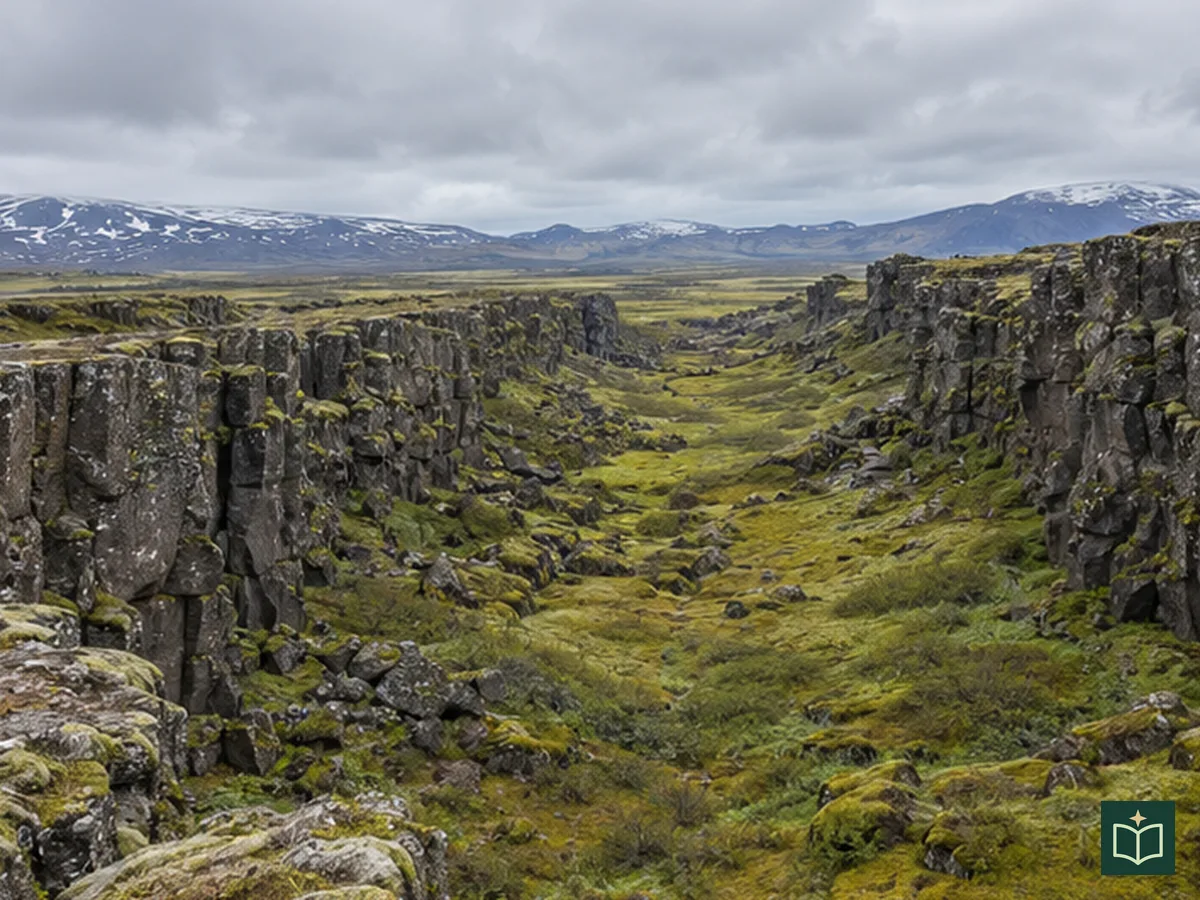
In a few places the ridge reaches the surface. Iceland is the most dramatic example: the Mid-Atlantic Ridge runs across the island, where a hotspot beneath adds extra magma, and the gap between the North American and Eurasian plates can be seen in rift valleys at Thingvellir. The Azores, Ascension Island and Tristan da Cunha also sit on or near the ridge. Most of the system, though, remains deep and dark. Hydrothermal vents along it, discovered in 1977, release mineral-rich water heated by magma. They support communities of tube worms, clams and microbes that rely on chemical energy rather than sunlight.
Discovering the hidden range
The ridge’s scale was revealed only in the twentieth century. Echo sounders used in the 1950s allowed Marie Tharp and Bruce Heezen to map the Atlantic floor, and Tharp recognised a rift valley running down its centre. In the early 1960s, Harry Hess proposed that sea floor spreads from the ridges. Soon after, magnetic surveys found matching stripes of rock on either side of the ridges, recording reversals of Earth’s magnetic field as new crust formed. These findings became central evidence for plate tectonics. Today, most of the ridge has still not been mapped in high detail, and exploring it remains a major goal of ocean science.
Sources & further reading
Figures are rounded and widely published; check the linked organisations for the latest editions. These organisations do not endorse this website.