Spices are geography in a jar
Most of the spices in a Gulf kitchen are imports, and many come from surprisingly small home regions. Spices are the dried seeds, bark, buds, roots or stigmas of plants, and many of the most prized evolved in humid tropical forests or on dry, sunny plateaus. For centuries those regions held near monopolies, because the plants were hard to grow elsewhere and the seeds or cuttings were guarded. That scarcity made spices valuable enough to cross oceans. Their geography explains why traders, empires and later colonial powers fought over specific islands and coasts, and why the Gulf, sitting between India and the Mediterranean, became a natural crossroads of the spice trade.
Pepper and cardamom: India's monsoon hills
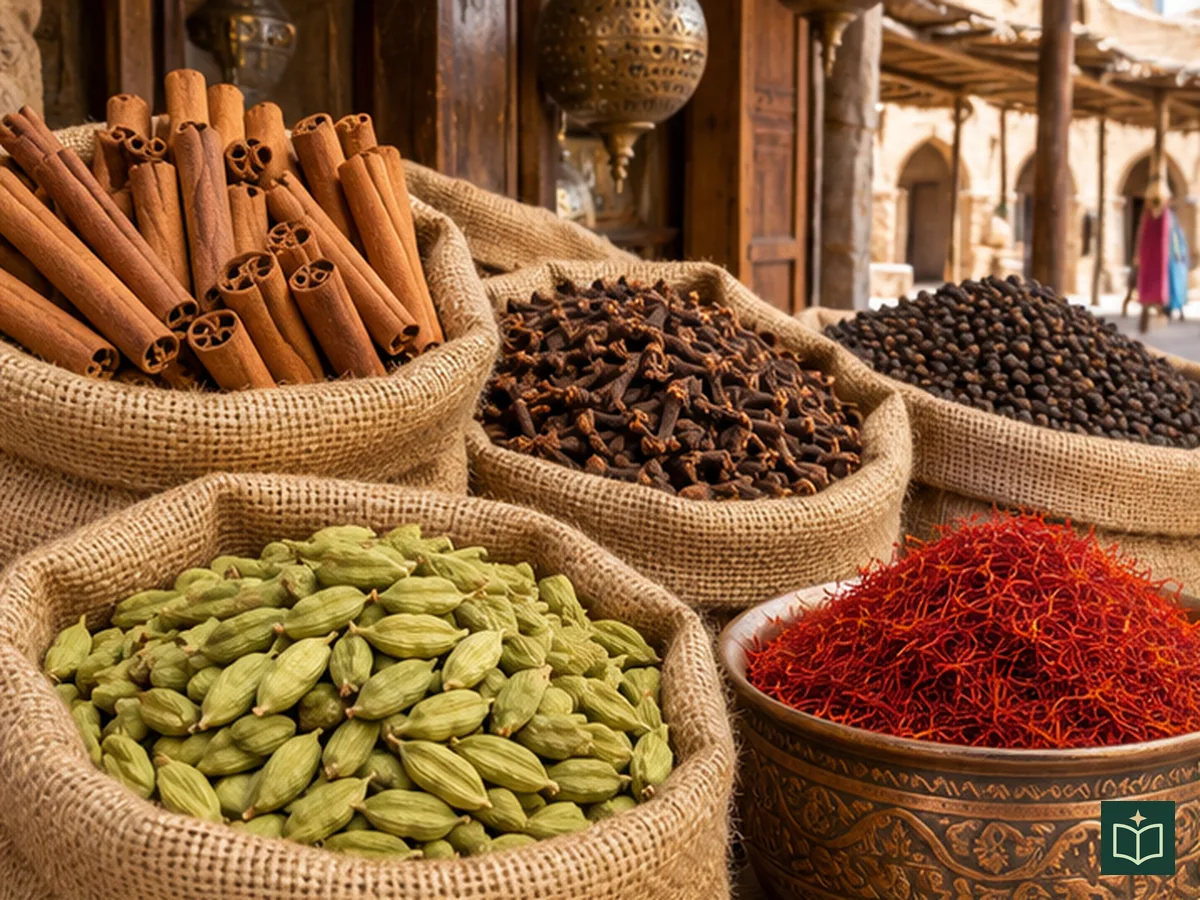
Black pepper is the dried fruit of a climbing vine native to the Malabar Coast of south-west India, in today's Kerala. It needs heavy monsoon rain, warmth all year and shade from taller trees. Green cardamom comes from the same region, from a ginger-like plant growing in the shaded, damp forests of the Western Ghats, where one range is still called the Cardamom Hills. Arab, Persian and Indian sailors carried both across the Arabian Sea on the monsoon winds for thousands of years. Production has since spread: Vietnam is now a leading grower of pepper, and Guatemala of cardamom, both introduced there in modern times.
Cinnamon and cloves: islands of spice
True cinnamon is the inner bark of a tree native to Sri Lanka, peeled and rolled into thin, layered quills. Much of what is sold as cinnamon worldwide is in fact cassia, a related, coarser bark from southern China, Vietnam and Indonesia. Cloves are the dried flower buds of a tree that originally grew only on a handful of islands in Indonesia's Maluku group, the original Spice Islands. Their control drew Portuguese and then Dutch fleets. In the nineteenth century, Oman's rulers, who then governed Zanzibar, promoted clove plantations there, and Zanzibar and nearby Pemba became for a time the world's leading clove producers.
Saffron: a highland crocus
Saffron grows in a very different setting. It is the dried stigma of the saffron crocus, a plant suited to hot, dry summers and cold winters on well-drained soils, such as the plateaus of Iran, Kashmir and Spain. Iran grows the large majority of the world's saffron. Every flower yields just three thin red stigmas, picked by hand in a short autumn season. With roughly 150,000 flowers needed for one kilogram, that is about 150,000 times three, or 450,000 threads. The labour explains the price. A pinch is enough to colour and scent a large dish, which is why saffron perfumes Gulf rice, sweets and coffee.
How they shaped Gulf cooking
The Gulf grew few of these spices itself, yet its cooking is built on them, a direct result of its position on Indian Ocean trade routes. Arabic coffee, gahwa, is flavoured with cardamom and often saffron. Machboos, the region's spiced rice with meat or fish, uses blends that may include pepper, cinnamon, cloves, cardamom and dried black lime, the last a local touch from Oman. Spice mixtures known as bzar vary from family to family. Indian, Persian and East African influences arrived with merchants and sailors, and the souks of Dubai, Muscat and Manama still trade spices from the same regions that supplied them centuries ago.
Myths and modern shifts
A popular claim is that medieval Europeans used spices to hide spoiled meat. Historians largely reject this: spices were costly luxuries, and anyone who could afford them could usually afford fresh food. Spices were prized for flavour, status, medicine and perfume. Another misconception is that spices still come mainly from their places of origin. Plantations spread spice plants around the tropics, and modern production is concentrated in a few large exporters, sometimes far from the plant's ancestral home. Climate change, crop diseases and water scarcity threaten some growing regions, including saffron fields affected by drought, so the geography of spice continues to shift.
Sources & further reading
Figures are rounded and widely published; check the linked organisations for the latest editions. These organisations do not endorse this website.