A white plain in the sky
On Bolivia's Altiplano, a high plateau between two ranges of the Andes, lies the Salar de Uyuni, a white plain of salt covering roughly 10,600 square kilometres at around 3,650 metres above sea level. It is the largest salt flat on Earth, and also one of the flattest natural surfaces anywhere. Across its whole expanse, the height of the surface varies by only about a metre. On clear days the horizon blurs, and travellers lose all sense of scale, a quality photographers exploit for trick images. In the dry season the surface cracks into a mosaic of polygons, while in the wet season it can vanish under a thin sheet of water.
Born from vanished lakes
The salar is the dried bed of former lakes. The Altiplano has no outlet to the sea, so rain and meltwater flowing into it can leave only by evaporating, concentrating dissolved minerals. During wetter periods of the last ice age, large lakes filled the basin; the most recent, often called Lake Tauca, covered a huge area until roughly ten to fifteen thousand years ago. As the climate dried, the lakes shrank, leaving salt crust several metres thick in places, layered with mud and lake sediments. Beneath the crust lies a brine rich in dissolved salts, including lithium, which makes the salar one of the largest lithium resources in the world.
Why it stays so level
The flatness is not just inherited from the old lake floor. It is renewed every year. In the wet season, roughly from December to March, rain floods parts of the salar to a depth of a few centimetres. That water dissolves the salt on any raised patches and spreads it into the lower ones. As the sun evaporates the water, new crystals settle evenly, smoothing the crust. To put the flatness in perspective, a one-metre rise spread over about 100 kilometres is a gradient of one in 100,000. That equals about one millimetre of height change for every 100 metres walked, flatter than many engineered floors.
A ruler for satellites
That evenness makes the salar valuable to science. Satellites that measure the height of ice, oceans and land with radar or lasers need known, stable targets to check their readings. Uyuni's large, flat, bright and cloud-free surface is ideal. NASA's ICESat missions and other altimetry satellites have used it to calibrate instruments, and researchers have mapped it with GPS to centimetre precision. The surface reflects sunlight strongly, which also helps check instruments that measure brightness. A shiny, level plain high in dry air turns out to be one of the best natural measuring sticks on the planet, much like a calibration table for an entire orbiting observatory.
The great mirror
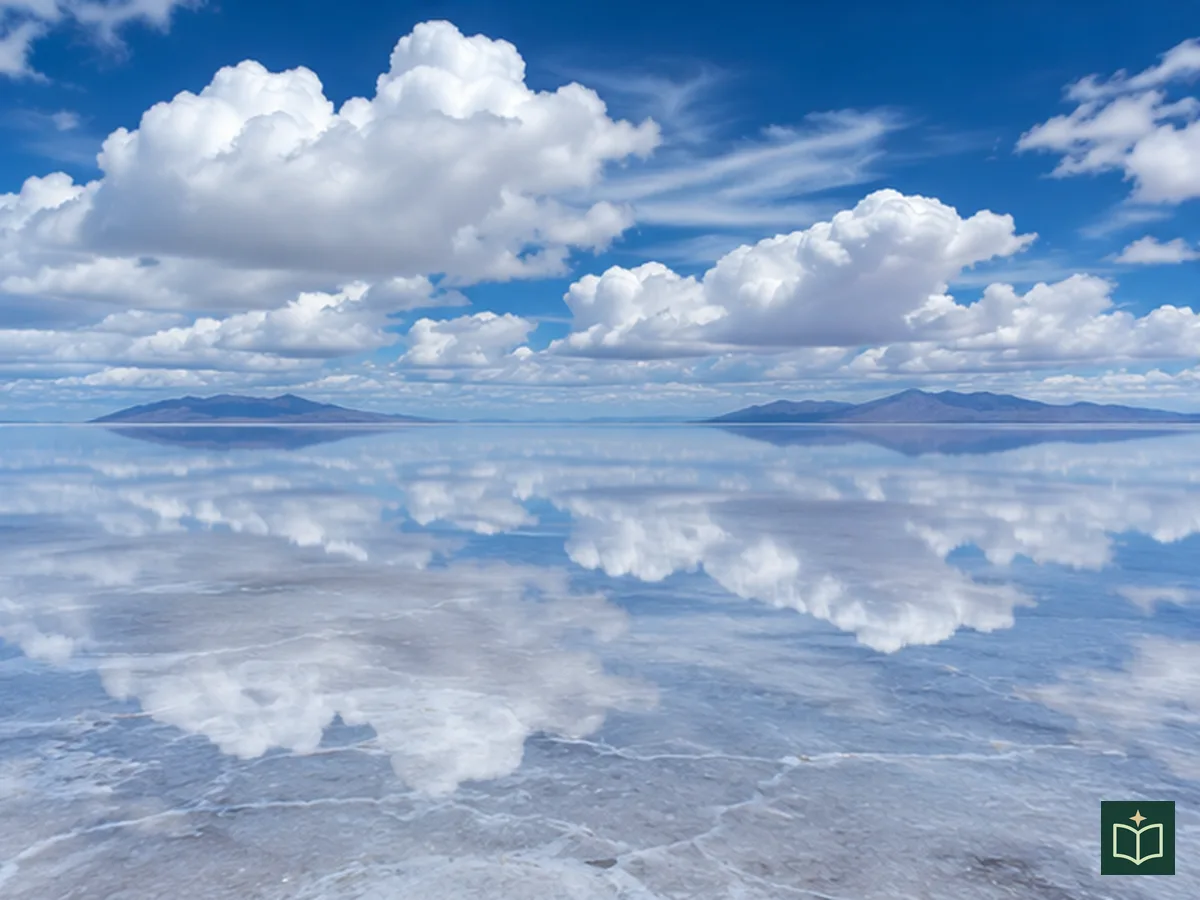
When rain leaves a film of water only a few centimetres deep across the salt, and the wind drops, the salar becomes a giant mirror. Clouds, sky and people are reflected so cleanly that the horizon disappears. The effect depends on flatness: on a bumpy surface, water would gather in pools and leave dry patches, breaking the reflection. Here it spreads in an almost uniform sheet across many square kilometres. Tourism in the nearby town of Uyuni peaks around these months. A misconception is that the mirror covers the whole salar every year. In practice its extent depends on rainfall, and in dry years it is patchy or brief.
Salt, lithium and pressures
The salar has long supported local communities who cut blocks of salt for building and sale. Hotels near its edge are built partly from salt bricks. More recently, attention has turned to the lithium in its brine, used in rechargeable batteries. Extracting lithium from brine usually involves pumping it into evaporation ponds, which uses water in an already dry region and could alter the salar's delicate hydrology. Bolivia has pursued development carefully and slowly, and its plans have shifted over time. The future of the salar will depend on balancing tourism, local livelihoods, mineral wealth and the natural processes that keep it so remarkably flat.
Sources & further reading
Figures are rounded and widely published; check the linked organisations for the latest editions. These organisations do not endorse this website.