Neither river nor sea
An estuary is a partly enclosed body of water where a river meets the sea and fresh water mixes with salt. The result is brackish water, saltier than a river but less salty than the ocean, which averages about 35 grams of salt per kilogram of water. Conditions shift constantly. Salinity rises on a flood tide and falls on the ebb, and it changes again with the seasons as river flow swells or shrinks. Famous estuaries include the Thames in England, Chesapeake Bay in the United States and the Río de la Plata between Argentina and Uruguay, about 220 kilometres wide at its mouth. Each is shaped by the same contest of waters.
Four ways to make one
Geographers group estuaries by origin. The most common are drowned river valleys, flooded when sea levels rose after the last ice age; Chesapeake Bay and the Thames are examples. Bar-built estuaries form behind sand barriers and spits that partly close off a river mouth, creating lagoons such as North Carolina's Pamlico Sound. Tectonic estuaries occupy land that has sunk along faults, like San Francisco Bay. Fjords, deep valleys carved by glaciers and then flooded, are the fourth type. Distinct from all of these are deltas, where rivers build new land outward into the sea; an estuary is instead a river mouth that the sea has partly invaded.
How the waters layer and mix
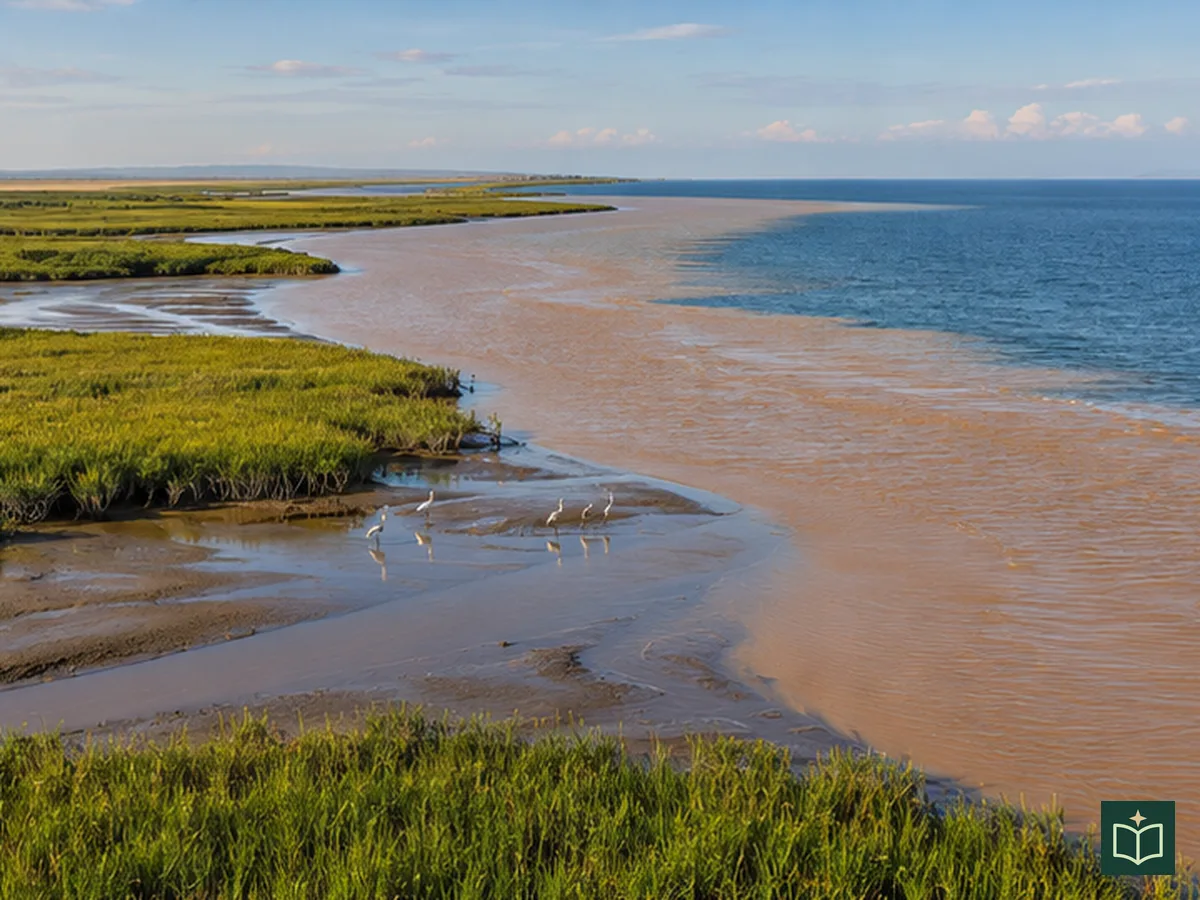
Fresh water is less dense than seawater, so it tends to ride over the top. In estuaries with strong river flow and small tides, this creates a salt wedge: a tongue of seawater creeping upstream along the bottom beneath the outflowing river, as in the lower Mississippi. Where tides are stronger, turbulence mixes the layers partly or completely, so salinity changes gradually from mouth to head. Where the two waters meet, fine clay particles clump together and sink, creating a cloudy zone of high sediment called the turbidity maximum. Nutrients from the land and the sea collect here too, fuelling growth of plankton at the base of the food web.
Nurseries of the coast
That abundance makes estuaries among the most productive ecosystems on Earth. Salt marshes, seagrass beds, mudflats and, in warm regions, mangroves fringe their shores. Many commercially important fish and shellfish spend their early lives in estuaries, sheltered from large predators in shallow, food-rich water, before moving out to sea. Migratory birds rely on estuary mudflats to feed. Estuaries also filter pollutants and sediment before they reach the open ocean, and their marshes buffer coasts against storm surges. Oysters in Chesapeake Bay were once so numerous that they were thought to filter the bay's entire volume in a matter of days.
The Gulf's great estuary
The Gulf's largest estuary is the Shatt al-Arab, formed where the Tigris and Euphrates meet in southern Iraq and flow about 200 kilometres to the sea, joined by Iran's Karun River. It carries fresh water, silt and nutrients into the northern Gulf, supporting fisheries and the date groves that line its banks around Basra. Upstream dams and irrigation have reduced its flow, and in dry years seawater has pushed further inland, raising salinity in water used by people and farms. Elsewhere in the Gulf, features such as Dubai Creek and the khors of Abu Dhabi are tidal inlets of seawater with no river feeding them, so they are not true estuaries.
Pressures and what to watch
Estuaries have long attracted ports and cities, from London to New York and Shanghai, because they offer sheltered water and access inland. That concentration brings pressure. Dredging, land reclamation and sea walls remove marshes and mudflats. Fertiliser runoff can overload estuaries with nutrients, causing algal blooms and low-oxygen dead zones, a recurring problem in Chesapeake Bay. Reduced river flow lets salt intrude further upstream, while sea-level rise squeezes marshes against hard defences. Restoration projects now replant seagrass, rebuild oyster reefs and reconnect floodplains. Watching an estuary's salinity, oxygen and wildlife offers an early signal of the health of both its river and its coast.
Sources & further reading
- NOAA Ocean Service · What is an estuary? ↗
- US EPA · Basic information about estuaries ↗
- Britannica · Estuary ↗
Figures are rounded and widely published; check the linked organisations for the latest editions. These organisations do not endorse this website.