Not a mirage, a window
In stories, an oasis is a pool surrounded by palms in an endless sea of sand. Real oases are less random. They appear where water stored underground reaches, or comes very close to, the surface. That water may have fallen as rain thousands of years ago, or recently on mountains many kilometres away, before seeping into porous rock, gravel or sand. Geology then decides where it emerges. Oases range from a few hectares around a single spring to vast farmed landscapes supporting cities. The Arabian Peninsula has some of the world's most important examples, each illustrating a different way that water can rise to meet the desert.
Springs along faults
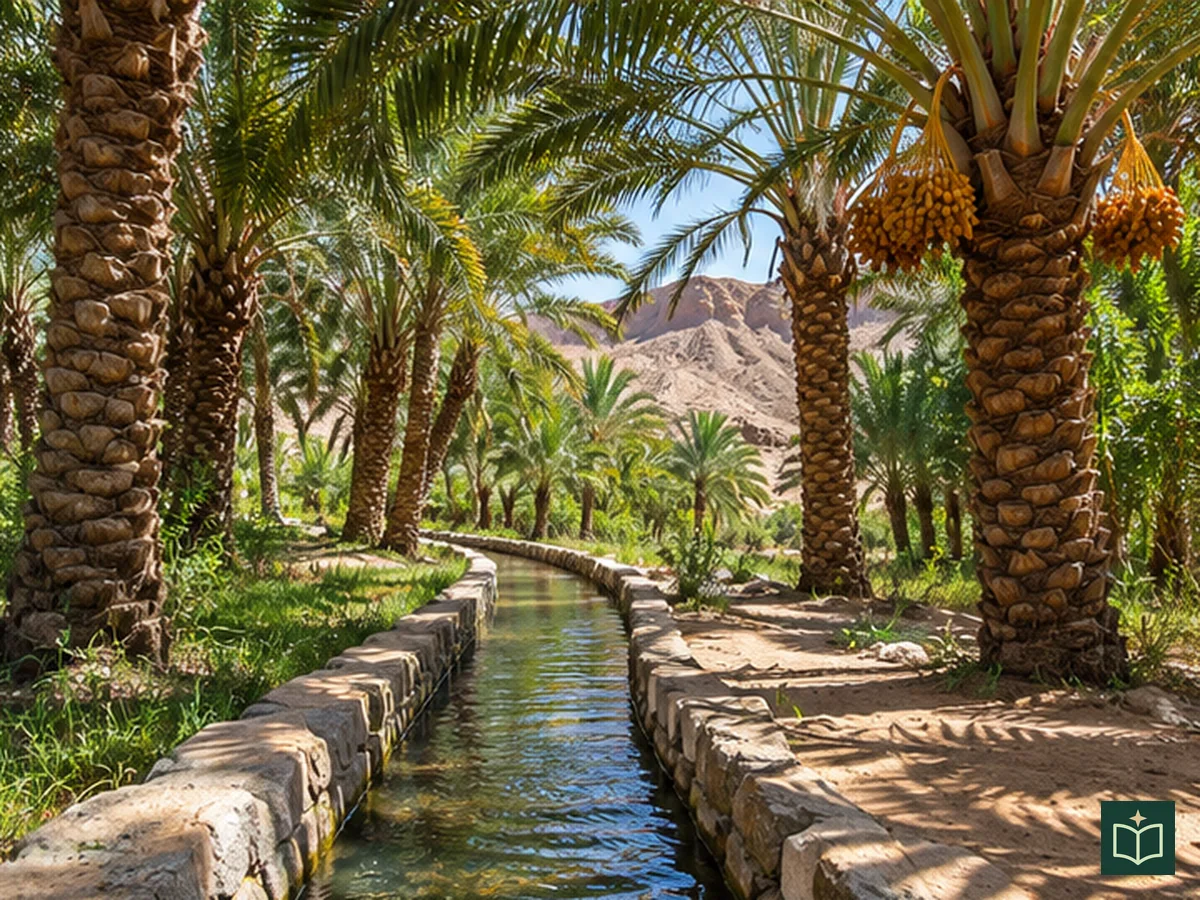
Faults are fractures where blocks of rock have moved. They can act as pipes, letting groundwater under pressure in a deep aquifer escape upward. Al-Ahsa in eastern Saudi Arabia is the classic case. For thousands of years, artesian springs fed by large aquifers beneath the region flowed freely, some warm, watering a landscape of palm groves, canals and villages. UNESCO inscribed the Al-Ahsa Oasis as a World Heritage Site in 2018, describing some 2.5 million date palms. Heavy pumping in recent decades has lowered water pressure, and many natural springs have dried up, so wells and managed irrigation now supply much of the oasis.
Mountain water at Al Ain
Al Ain, on the border between Abu Dhabi and Oman, depends on the Hajar Mountains. Rain falling on the mountains soaks into gravel fans and fractured rock along their edge, then flows underground towards the plain. Long before modern pumps, people tapped this water with aflaj, gently sloping tunnels and channels that carry groundwater by gravity to the surface and on to the gardens. The Al Ain Oasis, now a UNESCO-listed cultural site, covers about 1,200 hectares and holds roughly 147,000 date palms. It shows how an oasis can be partly natural and partly engineered, with human channels completing what geology began.
Liwa: water floating under dunes
Liwa, on the edge of the Rub' al Khali in western Abu Dhabi, works differently again. Here, an arc of settlements sits in hollows between some of the tallest dunes on Earth. Rare rainfall soaks quickly into the sand instead of evaporating, and over time forms a lens of fresher water that floats on top of saltier groundwater below. In the low ground between dunes, that water lies close enough to the surface for palms to reach it with their roots and for people to dig shallow wells. Such a lens is fragile. Pumping too hard can draw up the salty water beneath, spoiling wells and stressing palm groves.
Depressions and the Sahara
Elsewhere, oases sit in hollows where erosion has lowered the land to meet the water table. Egypt's Western Desert holds a chain of such depressions, including Siwa, Kharga and Dakhla. Siwa lies below sea level, and its springs and salt lakes are fed from the vast Nubian Sandstone aquifer. Wind has scoured these hollows over millions of years. A common misconception is that oasis water always comes from nearby rain. In much of the Sahara and Arabia, the water is mostly ancient, recharged when the climate was wetter, and replenished only slowly today. Using it faster than it refills effectively mines a finite resource.
Why oases matter
Oases have anchored life in the desert for millennia. They fed caravans, sheltered towns and supported the date palm agriculture that sustained Arabia. They remain biodiversity refuges for birds, insects and plants that cannot survive in open desert. Their future depends on careful water management. Falling water tables, salinity and urban growth threaten several Gulf oases, and authorities now monitor groundwater levels, restore aflaj and promote more efficient irrigation. Seen from the air, an oasis is a vivid green patch against sand or gravel. Seen from below, it is the surface expression of a hidden water system that geography and people must keep in balance.
Sources & further reading
- UNESCO World Heritage · Al-Ahsa Oasis ↗
- UNESCO World Heritage · Cultural Sites of Al Ain ↗
- Britannica · Oasis ↗
Figures are rounded and widely published; check the linked organisations for the latest editions. These organisations do not endorse this website.