Several cradles of farming
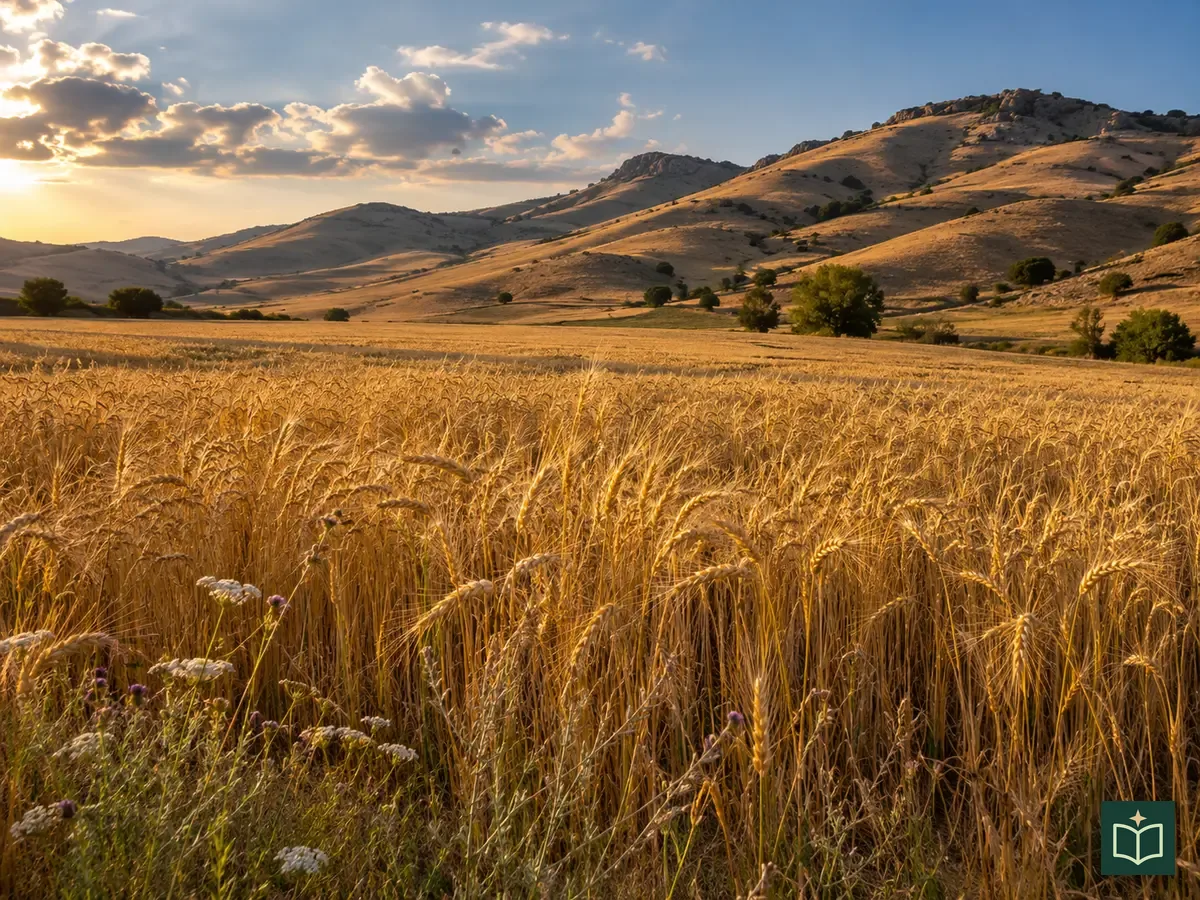
Farming did not begin in one place. Archaeologists have identified several regions where people independently domesticated plants after the end of the last ice age. The earliest well-documented centre is the Fertile Crescent, an arc from the Levant through south-east Turkey to the Zagros Mountains, where wheat, barley, lentils, peas, chickpeas and flax were domesticated from around 11,000 years ago. In China, rice was domesticated in the Yangtze valley and millets along the Yellow River. Mesoamerica gave maize, beans and squash; the Andes gave potatoes and quinoa; and parts of Africa, New Guinea and eastern North America developed crops of their own.
How a wild plant becomes a crop
Domestication was a gradual process rather than a single invention. Wild cereals scatter their seeds when ripe, which helps them survive but makes harvesting difficult. When people cut stalks and replanted part of the harvest, plants whose seeds stayed attached were more likely to be collected and sown again. Over generations, this largely unintended selection produced non-shattering grains, larger seeds and more even ripening. Maize offers a dramatic example: it descends from teosinte, a wild grass of Mexico whose small ears hold only a few hard kernels, and was transformed over thousands of years into the large cobs familiar today.
Dates and the Gulf
South-west Asia and Arabia also contributed one of the most important crops of the desert, the date palm. Charred date stones found on Dalma Island, off the coast of Abu Dhabi, are roughly 7,000 years old and are among the earliest known evidence of dates being eaten in the region. Over time, farmers learned to propagate the best varieties from offshoots and to pollinate female trees by hand, practices still used today. Dates, rich in sugar and easy to store, sustained oasis communities and long-distance travellers, and the palm became central to the agriculture, economy and culture of the Gulf and North Africa.
Vavilov’s centres
In the 1920s and 1930s, the Russian botanist Nikolai Vavilov travelled widely to collect crop seeds and proposed that each crop had a centre of origin where its genetic diversity was greatest. He identified several such centres, including the Near East, the Mediterranean, Ethiopia, Central Asia, India, China, Mesoamerica and the Andes. Later research has refined his ideas: some crops were domesticated more than once, and the centre of diversity is not always the place of origin. But his insight that wild relatives and traditional varieties form a genetic treasure remains central to plant breeding, and his collection in St Petersburg became one of the world’s first major seed banks.
Crops on the move
Crops spread with migrating farmers, traders and empires. Wheat and barley reached Europe, Egypt and South Asia within a few thousand years. Rice moved across Asia, while bananas, sugarcane and citrus travelled along trade routes, including those of the Indian Ocean and the Gulf. After 1492, the Columbian Exchange carried maize, potatoes, tomatoes, chillies and cacao from the Americas to the rest of the world, while wheat, sugar, coffee and livestock went the other way. Research suggests that most countries now depend heavily on crops that originated elsewhere, so the world’s food supply is deeply interconnected across regions. Few national cuisines rely only on native plants.
Why origins still matter
Knowing where crops came from helps protect global food security. Wild relatives growing in their places of origin often carry genes for resistance to drought, heat, pests and disease, which breeders can use to adapt crops to a changing climate. Many of these regions face pressure from land-use change and conflict. Gene banks safeguard seeds, and the Svalbard Global Seed Vault in Norway, opened in 2008, stores duplicate samples from collections worldwide. In 2015 the vault returned seeds to researchers who had lost access to their gene bank in Syria, showing how ancient crop diversity can still matter very much in the present.
Sources & further reading
Figures are rounded and widely published; check the linked organisations for the latest editions. These organisations do not endorse this website.