An old idea at a new scale
People have reclaimed land from water for centuries. In the Netherlands, communities built dykes and drained lakes and marshes to create polders, low-lying land protected from flooding; a large share of the country lies below sea level, and some of it was once seabed. Venice, Mumbai and Boston all grew partly on reclaimed marshes and shallows. Modern dredging technology has expanded the scale dramatically. Today, reclamation creates airports, ports, industrial zones, housing and resorts in coastal cities worldwide, especially where flat land is scarce and expensive. Hong Kong’s airport at Chek Lap Kok and much of Singapore’s coastline stand on reclaimed land.
How new land is made
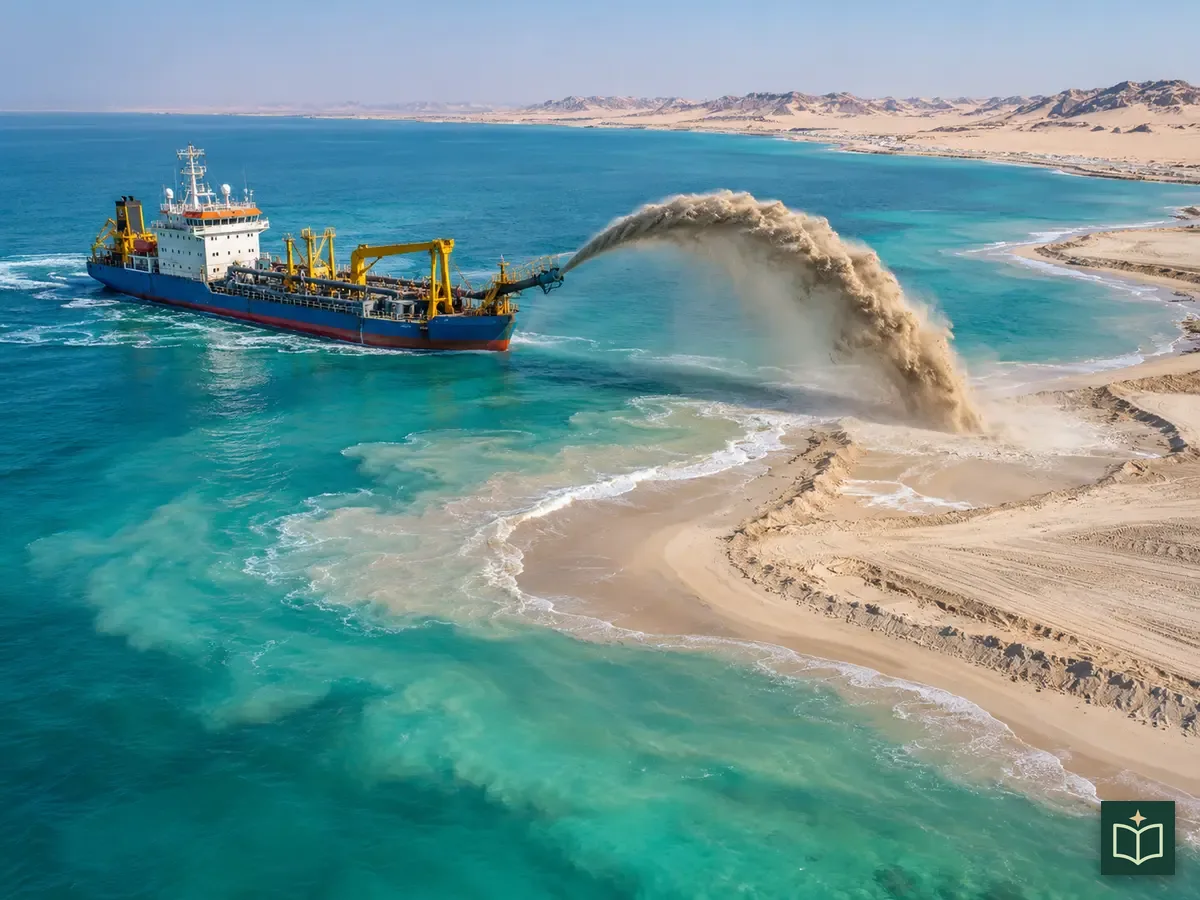
Most modern reclamation uses sand dredged from the seabed. Large trailing suction hopper dredgers draw up sand and water through long pipes, then carry it to the site. There, the sand is dumped, pumped through pipelines or sprayed in a high arc, a technique called rainbowing. The fill is raised above the expected high-water level and then compacted, often using vibrating probes inserted into the ground, to reduce future settling and the risk of liquefaction during earthquakes. Edges are protected with rock revetments or breakwaters. Desert sand is generally less suitable, because its fine, wind-rounded grains do not compact as well as marine sand.
Palms and islands of the Gulf
The Gulf has become a showcase for large-scale reclamation. Palm Jumeirah in Dubai, built in the early 2000s, is the best-known example: its trunk and fronds were formed from tens of millions of cubic metres of sand dredged from the Gulf seabed and protected by a crescent-shaped breakwater built from millions of tonnes of rock. The shallow, sheltered waters of the southern Gulf make such projects easier than on exposed ocean coasts. Bahrain has added substantial land through reclamation over recent decades, and Abu Dhabi, Doha and other cities have built islands for housing, tourism, ports and industry, reshaping their coastlines.
Singapore and Hong Kong
Singapore offers the most sustained example. Since the 1960s it has increased its land area by around a quarter, from roughly 580 to more than 720 square kilometres, using reclaimed land for its port, Changi Airport, the industrial complex on Jurong Island and parts of its downtown. As sand became harder to obtain and some neighbouring countries restricted exports, Singapore began developing a polder at Pulau Tekong, borrowing Dutch methods that need less fill. Hong Kong has reclaimed land since the nineteenth century for its harbour districts and airport. These cases show how reclamation can support economic growth where geography leaves little room.
Environmental costs
Reclamation alters the marine environment. Dredging stirs up sediment that can smother coral reefs and seagrass beds, and removing seabed sand destroys habitats at the source. New landforms change currents and wave patterns, sometimes causing erosion or sediment build-up on nearby shores, and enclosed lagoons may suffer from poor water circulation. In the Gulf, where corals and seagrass already face high temperatures and salinity, these pressures add to existing stress. Many projects now require environmental impact assessments, monitoring and mitigation such as relocating corals or creating artificial reefs, though outcomes vary. Rising global demand for sand has also raised concerns about unsustainable extraction.
Building for rising seas
Reclaimed land is usually low-lying and must be designed with future sea levels in mind. Engineers set ground heights, drainage and defences based on projections of sea-level rise and storm surges, and some authorities now require higher platforms for new reclamation. The Netherlands’ long experience of managing land below sea level, and its shift towards working with natural processes, is studied worldwide. Some coastal cities are exploring floating structures or nature-based defences as alternatives. Reclamation will continue where land is scarce, but its long-term success depends on careful planning, sustainable sand sources and respect for the coastal systems it reshapes.
Sources & further reading
Figures are rounded and widely published; check the linked organisations for the latest editions. These organisations do not endorse this website.