Stepping stones on the sea
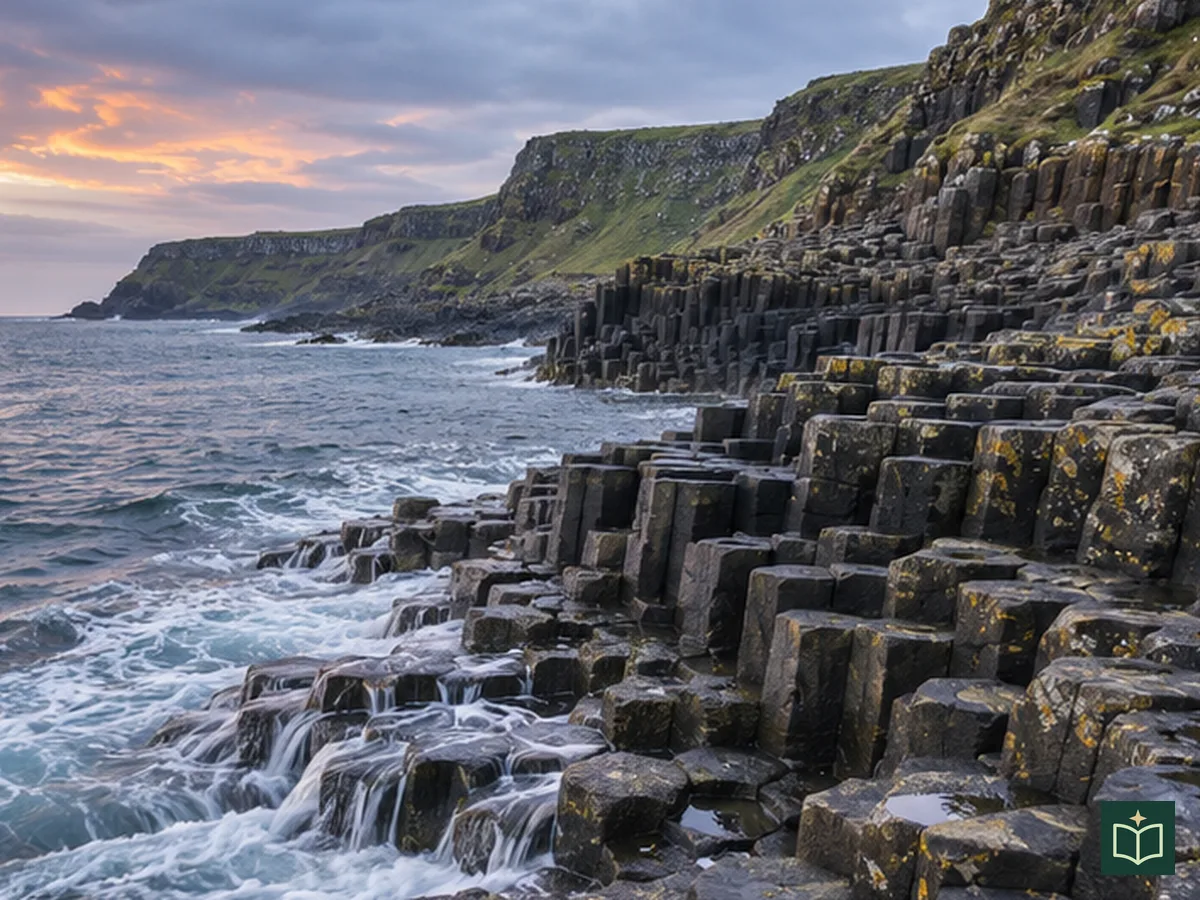
On the north coast of County Antrim in Northern Ireland, around 40,000 dark stone columns step down into the sea. Most have five, six or seven sides, and many fit together so tightly that they look like paving laid by hand. Some stand up to about 12 metres tall in the cliffs. Legend says the giant Finn McCool built the causeway to cross to Scotland and challenge a rival. The real explanation is volcanic. The Giant’s Causeway and Causeway Coast became a UNESCO World Heritage site in 1986, recognised both for its striking form and for its role in the history of geology.
Lava from an opening ocean
About 50 to 60 million years ago, the North Atlantic began to open as Europe and Greenland drifted apart. Huge volumes of basalt lava poured from fissures across what is now Northern Ireland, western Scotland, the Faroe Islands and Greenland. At the Causeway, several lava flows lie stacked on top of one another. Between them are red bands of weathered rock, formed when the land surface lay exposed to a warm, humid climate for long periods between eruptions. The columns occur in flows that were especially thick, probably where lava ponded in a valley or depression. That depth allowed the rock to cool slowly and evenly.
Why the cracks form
Like most materials, rock shrinks as it cools. In a thick sheet of lava, the outer surfaces cool first, while the interior remains hot. As the cooling layer contracts, it is pulled in tension and eventually cracks. The most efficient way to relieve this stress across a surface is a network of cracks meeting at roughly 120 degrees, which naturally produces mostly hexagonal shapes, similar to cracks in drying mud. As cooling advances inward from the top and the bottom of the flow, the cracks follow, extending downward and upward into long columns. Where the two cooling fronts meet near the middle, the columns can be offset or irregular.
Reading the columns
The shape of the columns records how the lava cooled. Slow, steady cooling produces broad, regular columns, such as the lower colonnade of a flow. Faster or uneven cooling, perhaps where water flooded the surface, produces thinner, curved or chaotic columns known as the entablature. Columns always grow at right angles to the cooling surface, so where a lava flow cooled against a curved valley wall, they fan out or bend. Many columns at the Causeway are also divided into stacked segments with concave and convex ends, like ball-and-socket joints, created as the cracks advanced in small steps. Experiments with drying cornstarch reproduce similar patterns in miniature.
Fingal’s Cave and beyond
The same volcanic province built Staffa, a small island off western Scotland. There, sea waves have hollowed out Fingal’s Cave between walls of tall basalt columns. The cave’s echoing sounds inspired the composer Felix Mendelssohn’s Hebrides Overture in the nineteenth century. Columnar basalt appears elsewhere too: at Reynisfjara beach in Iceland, along the coast of Jeju Island in South Korea, at Devils Postpile in California and in the Garni Gorge in Armenia. The famous Devils Tower in Wyoming shows similar columns, though it formed from magma that cooled underground rather than from lava flowing at the surface. The principle in every case is the same.
A landmark in geological debate
The Causeway played a part in one of geology’s great arguments. In the eighteenth century, scholars disagreed over whether rocks such as basalt had formed from minerals crystallising in ancient oceans or from molten material. Careful study of the Antrim basalts helped convince many that basalt was volcanic in origin. Today, the site welcomes large numbers of visitors each year and is managed to protect both the formations and the coastal wildlife. Visitors are asked not to remove stones. Waves continue to erode the columns slowly, a reminder that even this neat geometry is part of an ongoing story of building up and wearing down.
Sources & further reading
Figures are rounded and widely published; check the linked organisations for the latest editions. These organisations do not endorse this website.