A Dutch idea, improved
In 1608 spectacle makers in the Netherlands applied for a patent on a device that made distant objects appear closer. News spread quickly, and in 1609 Galileo Galilei, a professor of mathematics at Padua, built his own. Through trial and error he learned to grind better lenses, combining a convex lens at the front with a concave eyepiece. His first instrument magnified about three times; within months he had made ones that magnified about twenty. They were difficult to use, with a tiny field of view and blurred edges, but they were the best in Europe. Galileo first promoted them to Venice's rulers as tools for spotting ships at sea.
Mountains on the Moon
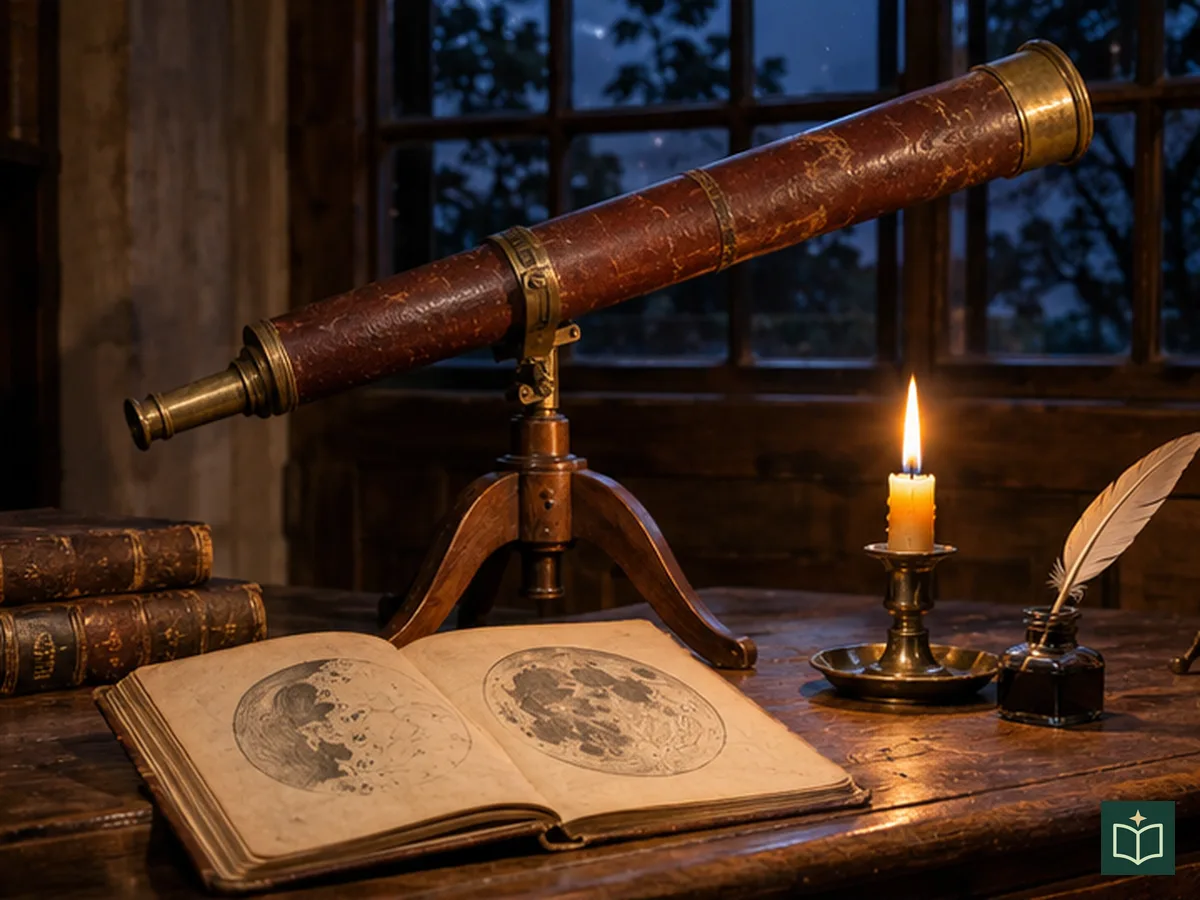
When Galileo turned his telescope to the Moon in late 1609, he saw that it was not a smooth, perfect sphere, as the traditional view of the heavens held. Along the line between its lit and dark halves, bright points appeared in the shadow and grew, just as sunlight catches mountain peaks on Earth before dawn reaches the valleys. From the length of the shadows, he estimated that some lunar mountains were several kilometres high. He also saw countless stars invisible to the naked eye, and found that the Milky Way was a dense mass of individual stars rather than a glowing cloud. Each finding expanded the known universe.
Moons around Jupiter
In January 1610 Galileo noticed three small 'stars' in a line beside Jupiter. Over the following nights they moved, sometimes appearing on one side of the planet, sometimes on the other, and a fourth appeared. He concluded that they were moons orbiting Jupiter. This was a serious problem for the Earth-centred system of Ptolemy, in which everything circled the Earth. It also answered a common objection to the Sun-centred system of Copernicus: if the Earth moved, how could it keep its Moon? Jupiter clearly kept four. Galileo published these findings in March 1610 in Sidereus Nuncius, the Starry Messenger, and named the moons after the Medici family.
The phases of Venus
Later in 1610 Galileo began to observe Venus. Over several months it showed a full sequence of phases, like the Moon, from a small, nearly full disc to a large, thin crescent. In Ptolemy's system Venus always stays between the Earth and the Sun, so it could never appear nearly full. In a system where Venus orbits the Sun, the whole sequence is expected, with the planet appearing small and full when it is on the far side of the Sun and large and crescent-shaped when it is close to us. This was the strongest piece of evidence from his telescope against the Ptolemaic model.
What the telescope could not prove
Galileo's observations did not settle the debate by themselves. The Danish astronomer Tycho Brahe had proposed a compromise in which the planets orbit the Sun while the Sun orbits a stationary Earth, and that system fitted the phases of Venus too. Galileo also observed sunspots and the strange shape of Saturn, which looked to him like a planet with two companions; the rings were identified later. His confident support for Copernicus brought him into conflict with the Church. In 1633 he was tried by the Roman Inquisition, forced to recant and placed under house arrest, where he continued to work until his death in 1642.
Why it mattered
Galileo's telescope marked a shift in how astronomy was done. Instead of relying chiefly on ancient authorities and naked-eye measurements, scientists could now gather new evidence by building better instruments. The Sun-centred system gained ground through the seventeenth century, especially after Kepler showed that planets move in ellipses and Newton explained why. Telescopes grew steadily larger, and the same logic leads to the great observatories and space telescopes of today. The four moons Galileo saw, Io, Europa, Ganymede and Callisto, are still called the Galilean moons, and they remain major targets for space missions studying the outer solar system and its oceans.
Sources & further reading
Figures are rounded and widely published; check the linked organisations for the latest editions. These organisations do not endorse this website.