Two worlds, one physics
For two thousand years, Western thought followed Aristotle in treating the heavens and the Earth as different realms. On Earth, objects fell or rose towards their natural places; in the sky, planets moved in perfect circles of a special substance. By the seventeenth century this picture was cracking. Copernicus had put the Sun at the centre, Kepler had shown that planets move in ellipses, and Galileo had studied how objects fall and roll on Earth. But no one had explained what kept the planets on their paths. Isaac Newton, a young scholar at Cambridge, would argue that the answer was the same force that makes things fall.
The apple and the plague years
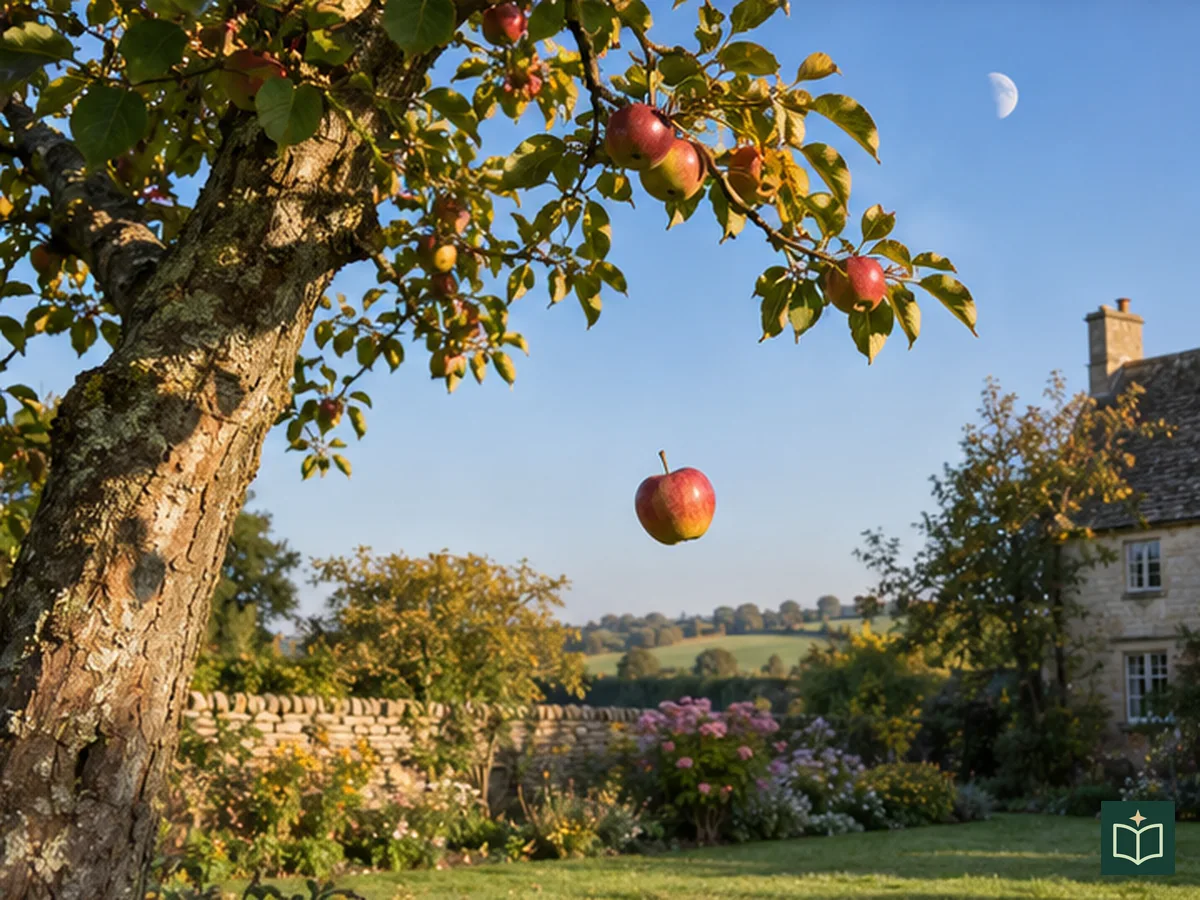
In 1665 and 1666 Cambridge closed because of plague, and Newton returned to his family's farm at Woolsthorpe in Lincolnshire. In this period he made early progress on calculus, light and gravity. Late in life he told several people, including his biographer William Stukeley, that the idea of gravity reaching up to the Moon came to him after seeing an apple fall. The story is probably simplified, but it captures the key idea: if Earth's pull reaches the top of a tree, why not much further? The question was whether it could reach the Moon, and how strong it would be at that distance.
The Moon test
Newton proposed that gravity weakens with the square of the distance. The Moon is about 60 times further from Earth's centre than we are, so gravity there should be about 60 × 60, or 3,600, times weaker. Near the ground a dropped object falls about 4.9 metres in its first second. Divided by 3,600, that gives about 1.4 millimetres. Newton calculated how far the Moon must 'fall' towards the Earth each second, bending away from a straight line, to stay in its orbit. The answer came out at roughly the same small figure. Gravity on Earth and the Moon's orbit were the same phenomenon.
Halley and the Principia
For years Newton kept much of this work to himself. In 1684 the astronomer Edmond Halley visited him in Cambridge and asked what path a planet would follow if attracted to the Sun by a force that fell off with the square of the distance. Newton replied that it would be an ellipse, and that he had calculated it. Halley urged him to publish and paid for the printing himself. The result, Philosophiae Naturalis Principia Mathematica, appeared in 1687. Alongside his three laws of motion, it set out the law of universal gravitation and used it to derive Kepler's laws, explain the tides and calculate the paths of comets.
What the law could and could not do
The Principia's law, that the force between two masses depends on the product of the masses divided by the square of the distance, proved astonishingly successful. Halley used it to predict the return of the comet that now bears his name, which reappeared in 1758, after both men had died. In 1846 astronomers found Neptune by calculating where an unseen planet must be to disturb the orbit of Uranus. Yet Newton could not say what gravity was or how it acted across empty space, and he declined to speculate. Small discrepancies, such as in Mercury's orbit, were explained only by Einstein's general relativity in 1915.
Still steering spacecraft
Newton's gravity remains remarkably useful. Engineers planning satellite orbits, rocket launches and journeys to other planets still rely mainly on his law, adding Einstein's corrections where precision demands it, as with satellite navigation clocks. The strength of gravity itself, the constant in Newton's formula, was first measured in a laboratory by Henry Cavendish in 1798, allowing the mass of the Earth to be calculated. More broadly, the Principia set a model for modern science: a few general laws, expressed in mathematics, tested against careful observation and used to make predictions. That approach shaped physics, astronomy and engineering for the centuries that followed.
Sources & further reading
Figures are rounded and widely published; check the linked organisations for the latest editions. These organisations do not endorse this website.