A find in a garden
In 1938 a man named Isaiah Anozie was digging a cistern in his compound at Igbo-Ukwu, a town in today's Anambra State in south-eastern Nigeria, when he found a collection of bronze objects. Some reached colonial officials and museums. Between 1959 and 1964 the archaeologist Thurstan Shaw carried out systematic excavations at three sites nearby, known after the landowners as Igbo-Isaiah, Igbo-Richard and Igbo-Jonah. Radiocarbon dates placed the material around the ninth and tenth centuries AD. That made it older than the more famous bronze and brass sculptures of Ife and Benin, and surprised many who had assumed such skill must have arrived later.
What was found
The three sites appear to have had different purposes. Igbo-Isaiah seems to have been a store for ritual and ceremonial objects, including bowls, staff ornaments, pendants and vessels. Igbo-Richard was a burial chamber, where a person of high status had been placed in a seated position, dressed in regalia including a crown, a beaded collar and other ornaments, with elephant tusks and a great many beads. Igbo-Jonah appears to have been a pit where objects were deliberately placed or discarded. Together they suggest a society with ritual leaders and a sophisticated religious and political structure, possibly linked to institutions that still exist in the region.
Mastery of lost wax
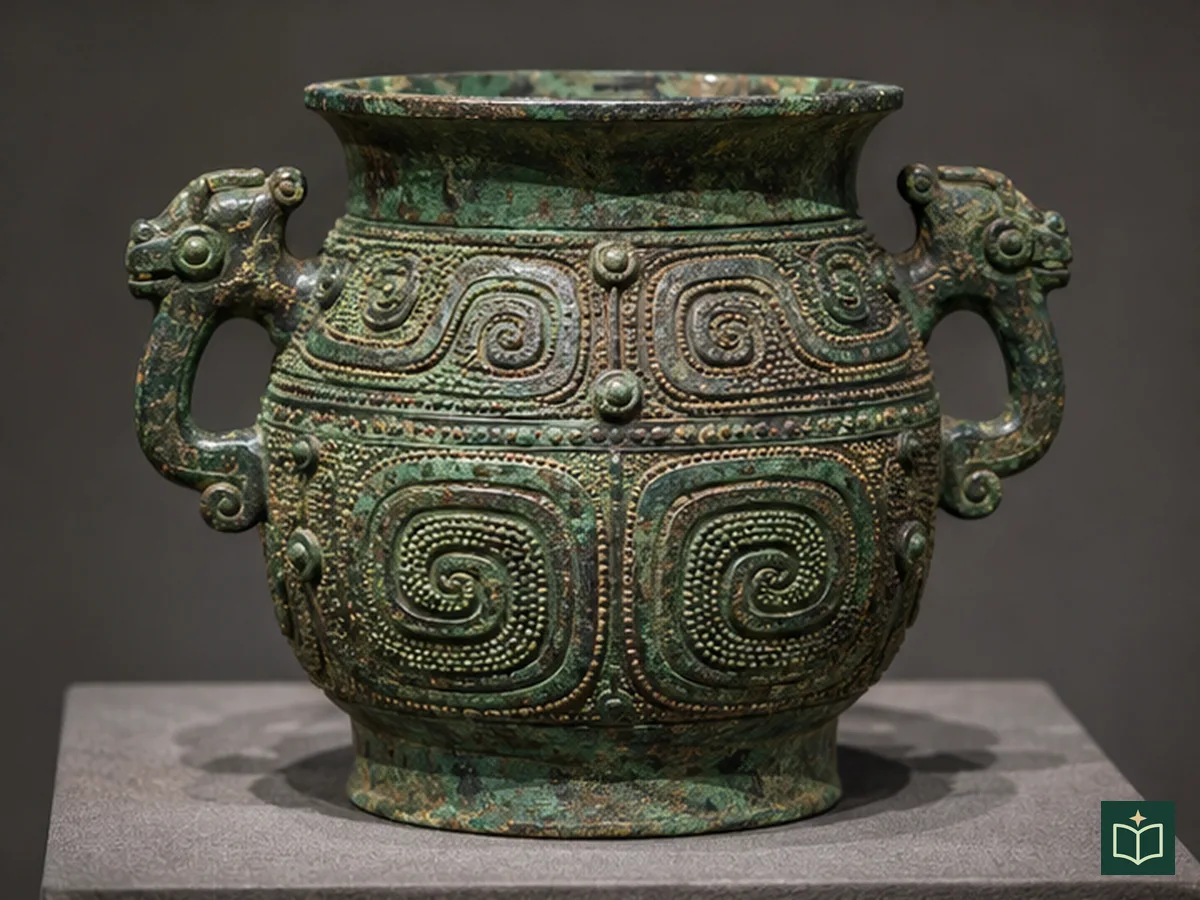
The Igbo-Ukwu objects were made by lost-wax casting, a method in which each mould can be used only once. What sets them apart is their detail. Surfaces are covered with fine raised lines, tiny granules, spirals and representations of insects such as flies and beetles, sometimes resting on the surface of a shell or vessel. One famous piece is a water pot enclosed in a cast net of rope, all in metal. Another is a bowl in the shape of a snail shell. Producing such thin walls and intricate decoration in a single pour demanded careful control of wax, clay and molten metal.
Local metal, local tradition
The objects are made of leaded bronze, an alloy of copper, tin and lead, as well as some copper worked by hammering and twisting. For a time it was suggested that the metal must have been imported across the Sahara. Chemical and isotope analyses published in the 2010s indicated instead that the copper and lead came from ores in south-eastern Nigeria, in the area of the Benue Trough. This points to a local metalworking tradition that mined, smelted, alloyed and cast its own materials. The styles of decoration also have no close parallels elsewhere, supporting the view that Igbo-Ukwu art developed independently rather than copying foreign models.
Beads from far away
If the metal was local, the beads tell a story of long-distance connections. Among the more than 165,000 beads recovered, many were made of glass and some of carnelian and other stones. Analysis of their chemical composition suggests that many of the glass beads were made far away, with sources proposed in Egypt, the Middle East and possibly South Asia, and reached the forest region of West Africa through trade networks linked to the trans-Saharan routes. What was exchanged in return is uncertain; ivory, enslaved people, forest products and other goods have all been suggested. Either way, Igbo-Ukwu was connected to a much wider world.
Why it matters
Igbo-Ukwu challenges older assumptions that complex art and social organisation in West Africa were late developments or came from outside. Its craftsmen worked with skill comparable to the best metalworkers of their age anywhere, and they did so with materials from their own region. The finds also show how much remains to be learned: only a few sites have been excavated, and the society that produced them left no written records. Many of the objects are held in Nigeria's national museums, and they remain a source of pride and identity, especially for Igbo communities, as evidence of a deep and creative past.
Sources & further reading
Figures are rounded and widely published; check the linked organisations for the latest editions. These organisations do not endorse this website.