Gold country
The Akan peoples live in the forests and coastal lands of what is now Ghana and eastern Côte d'Ivoire. The region was one of the world's major sources of gold, washed from rivers and dug from shallow pits. From the fifteenth century this gold drew traders from two directions: Mande-speaking merchants from the north, linked to the trans-Saharan routes, and from 1471 Portuguese ships on the coast, followed by Dutch, English and others. Europeans called the shoreline the Gold Coast. Within the region itself, gold dust became the standard medium for significant payments, from market purchases to taxes, fines and gifts.
How the weighing worked
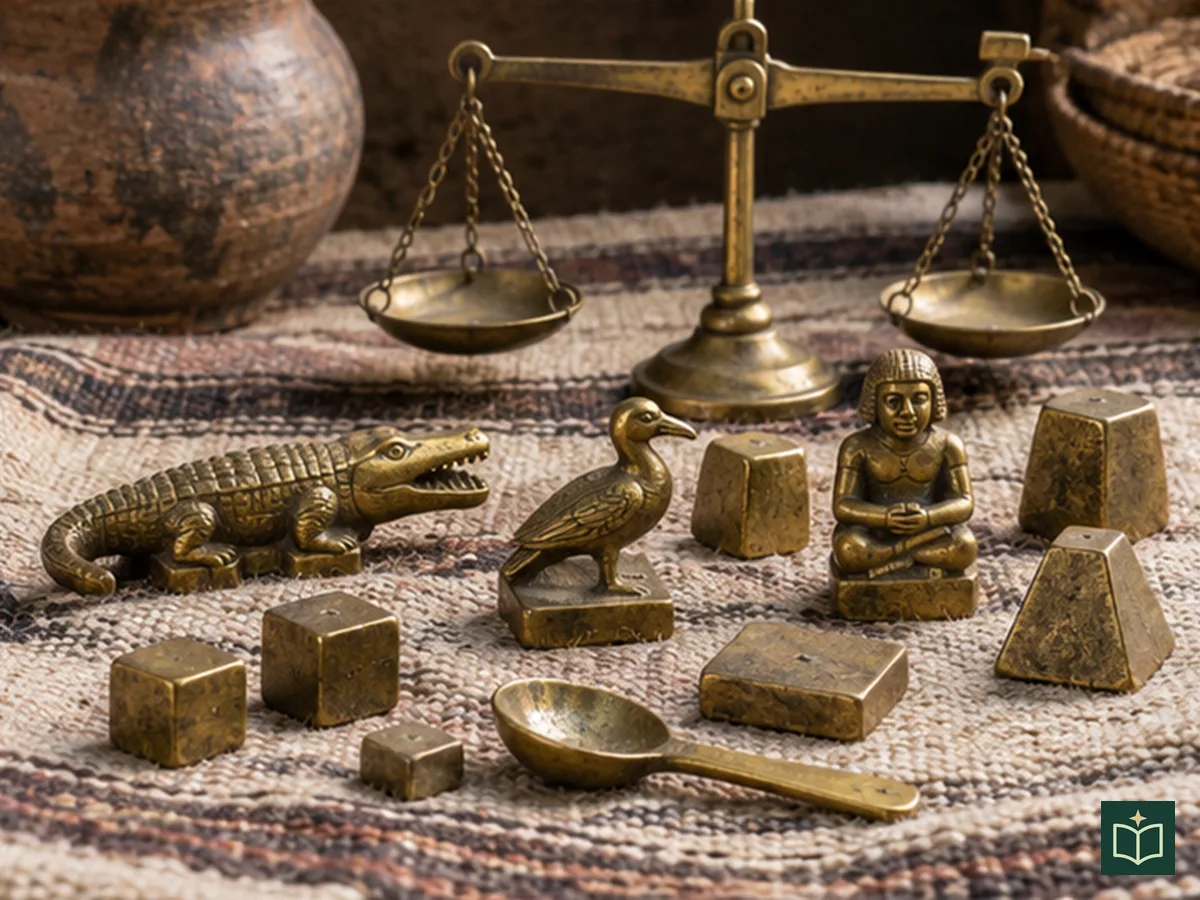
Unlike coins, gold dust has no fixed value per piece, so every payment had to be weighed. Traders carried a small balance scale, a set of brass weights, little spoons and shovels for handling dust, and boxes to store it, often wrapped together in a cloth bundle. To make a payment, gold dust was placed on one pan and weights on the other until they balanced. Each weight corresponded to a value in the local system. Both parties often had their own sets, and arguments over weights could arise. The units drew on both the Islamic weight standards of the north and the European units of the coastal trade.
Cast in brass
The weights, known in the Twi language as mrammuo, were made of brass or bronze using the lost-wax method. A craftsman modelled the shape in beeswax, covered it with clay, then heated it so the wax melted out and molten metal could be poured in. Each weight was therefore unique. Smiths adjusted the weight by adding or removing small amounts of metal, sometimes cutting off a leg or adding a lump. Much of the brass came from Europe as manillas, basins and other trade goods, which local smiths melted down. Hundreds of thousands of weights were made, and many survive in museum collections around the world.
From patterns to proverbs
Researchers usually divide the weights into two broad periods. Earlier ones, from roughly the fifteenth to the seventeenth century, are mostly geometric: small blocks, pyramids and discs marked with lines, spirals and crosses. Later ones, especially from the eighteenth and nineteenth centuries, are often figurative, showing people at work, warriors, musicians, chiefs, animals, plants and everyday objects. Many illustrate proverbs. A bird looking backwards is linked with the idea that it is no shame to go back for what you have forgotten. Two crocodiles sharing a single stomach yet struggling over food express the folly of quarrelling over what is held in common.
Gold and the Asante state
From around 1700 the Asante kingdom, centred on Kumasi, became the most powerful Akan state. Gold was central to its authority. The Golden Stool, said to have descended from the sky, symbolised the unity of the nation, and royal regalia were lavishly decorated with gold. The state collected taxes and tribute in gold dust, and officials of the royal treasury handled weighing with great care. Gold also had rules: gold dust dropped on the ground in the Kumasi market was traditionally said to belong to the state. A trader's set of weights was therefore not just a practical tool but part of a system of law and power.
The end of gold dust
Gold weights fell out of use when British colonial rule imposed coins and banknotes in the late nineteenth and early twentieth centuries. Many weights were then sold, collected by Europeans or melted down. Today they are prized by museums and collectors for their variety and humour, and studied by historians for what they reveal about trade, measurement and Akan thought. They also remind us that money can take many different forms. For centuries in this part of West Africa, value was measured not by counting coins but by balancing a scale, with a little brass proverb sitting on the other side.
Sources & further reading
Figures are rounded and widely published; check the linked organisations for the latest editions. These organisations do not endorse this website.