The missing mass
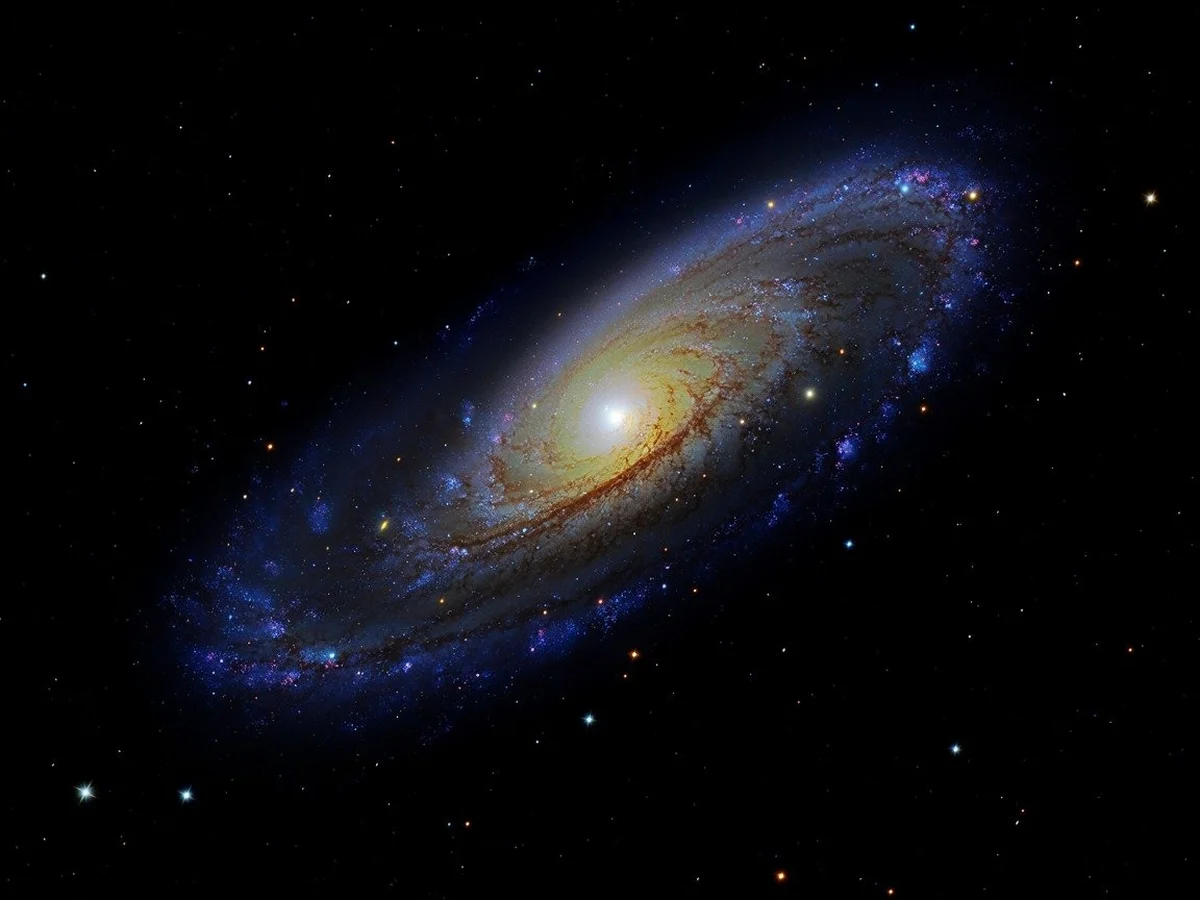
When astronomers measure how fast stars and gas orbit in galaxies, or how fast galaxies move in clusters, they find something strange. Given the visible matter, objects at the edges should move more slowly, just as outer planets orbit the Sun more slowly than inner ones. Instead, they move as if extra unseen mass is providing much more gravity. This hidden mass is called dark matter because it does not shine or reflect light.
Zwicky's clue
The first strong evidence came in 1933, when Swiss astronomer Fritz Zwicky studied the Coma Cluster of galaxies. He calculated that the galaxies were moving so fast that the cluster should fly apart unless it contained far more mass than the visible galaxies suggested. He called the missing material dunkle Materie, German for dark matter. For decades, many scientists treated his finding as a curiosity rather than a fundamental problem.
Vera Rubin's rotation curves
In the 1970s, American astronomer Vera Rubin, working with Kent Ford, measured how fast stars orbit at different distances from the centres of spiral galaxies. They found that orbital speeds stayed almost constant far out into the galaxies' edges, instead of dropping. This meant each galaxy was surrounded by a vast halo of invisible mass. Rubin's work convinced many astronomers that dark matter was real, and a major observatory in Chile now bears her name.
Bending light
Dark matter can also be detected through gravitational lensing. According to Einstein's general relativity, mass bends the path of light. When light from distant galaxies passes near a massive cluster, it is bent and distorted, creating arcs and multiple images. By measuring these distortions, astronomers can map where mass is located, including dark matter. Such maps show dark matter forming a vast cosmic web connecting galaxies across the universe.
The Bullet Cluster
One famous piece of evidence comes from the Bullet Cluster, two clusters of galaxies that collided. Observations published in 2006 showed that the hot gas, which contains most of the normal matter, slowed down and piled up in the middle during the collision. But lensing maps showed that most of the mass had passed straight through, along with the galaxies. This separation strongly suggested that most of the mass is a different kind of matter that rarely interacts.
How much there is
Measurements of the cosmic microwave background, the faint glow left over from the early universe, have allowed scientists to estimate the universe's ingredients. Results from the European Space Agency's Planck satellite suggest that about 5% of the universe is normal matter, about 27% is dark matter and about 68% is dark energy, a mysterious influence causing the universe's expansion to speed up. In other words, dark matter outweighs normal matter by roughly five to one.
What could it be?
Nobody knows what dark matter is made of. Most physicists think it consists of particles not yet discovered. Candidates include weakly interacting massive particles, known as WIMPs, and very light particles called axions. It cannot be ordinary matter hidden in dim stars or gas, because measurements of the early universe limit how much normal matter exists. A small group of scientists explore alternative ideas that modify the laws of gravity instead.
The hunt
Experiments around the world are searching for dark matter. Some, such as the LZ experiment deep underground in the United States, use large tanks of liquid xenon, shielded from cosmic rays, waiting for a rare collision between a dark matter particle and an atom. Others look for signs of dark matter in space or try to create it in particle accelerators like CERN's Large Hadron Collider. So far, none has made a confirmed detection.
Mapping the dark universe
Space telescopes are now mapping dark matter on enormous scales. The European Space Agency's Euclid telescope, launched in 2023, is surveying billions of galaxies to measure how dark matter and dark energy have shaped the universe over time. The Vera C. Rubin Observatory in Chile is also carrying out a huge survey of the sky. Solving the mystery of dark matter would be one of the greatest discoveries in modern physics.
Sources & further reading
General information; figures are approximate and research is ongoing. Photograph: original AI-generated illustration (Adobe Firefly). Reference organisations do not endorse this website.