Combustion in brief
Fire is a chemical reaction called combustion, in which a fuel combines rapidly with oxygen and releases energy as heat and light. Most everyday fuels, from wood and candle wax to natural gas, are made largely of carbon and hydrogen. When they burn completely, the main products are carbon dioxide and water vapour. Firefighters summarise the requirements as the fire triangle: fuel, heat and oxygen. Remove any one and the fire goes out. Water cools the fuel, a blanket or foam cuts off oxygen, and clearing vegetation removes fuel ahead of a wildfire. Many modern descriptions add a fourth element, the chemical chain reaction itself.
Inside a candle flame
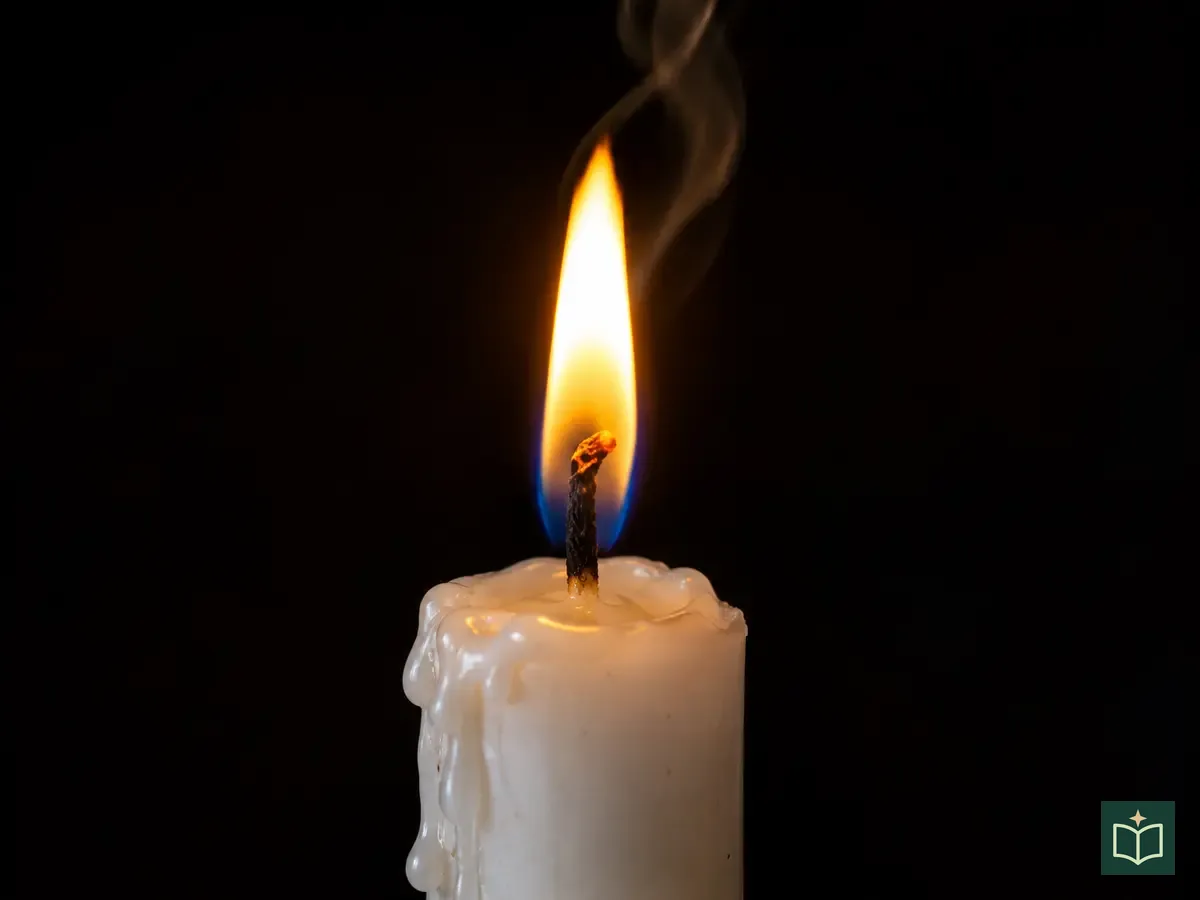
A candle is a beautifully simple machine. The flame’s heat melts wax near the wick, and the liquid is drawn up the wick by capillary action. Near the top, the heat vaporises the wax, and it is this vapour that burns. The flame has distinct zones. Close to the wick sits a dark region of unburned vapour. Around it, a bright yellow zone is where fuel breaks down and tiny particles of carbon, or soot, form and glow. At the outer edge, where oxygen is plentiful, a thin, faint blue layer marks the hottest region. Michael Faraday famously used the candle to teach chemistry in lectures given in 1848.
Why flames are yellow or blue
The yellow glow of a candle or wood fire comes mainly from soot particles heated to well over 1,000°C, glowing in the same way as the filament of an old light bulb. Blue light comes from a different source: certain molecules and fragments created during combustion are excited into higher energy states and release light at specific blue and violet wavelengths. A gas cooker burner, which mixes gas with air before it burns, produces little soot and so looks blue. Close the air inlet on a laboratory Bunsen burner and the flame turns yellow and smoky. Specific metals add their own colours, which is how fireworks produce reds, greens and blues.
Why flames point upwards
On Earth, hot combustion gases are less dense than the surrounding air, so they rise. Fresh air flows in at the base, bringing oxygen, and the flame stretches into its familiar teardrop shape. This flow depends on gravity. In experiments aboard the International Space Station, where buoyancy has almost no effect, candle flames form small, dim, blue spheres. Without rising hot air, oxygen reaches the flame only slowly by diffusion, so less soot forms and burning is gentler. Such experiments help engineers understand combustion more precisely, improve fire safety on spacecraft and design cleaner, more efficient burners for use on the ground.
Smoke, soot and safety
Incomplete combustion, when there is not enough oxygen, produces soot, smoke and carbon monoxide, a colourless, odourless gas that prevents blood from carrying oxygen. This is why charcoal grills, generators and gas heaters should never be used in enclosed spaces, and why carbon monoxide alarms are recommended in homes with fuel-burning appliances. A common misconception is that smoke is just harmless water vapour; in reality, it contains fine particles and toxic gases, and in building fires smoke inhalation causes many of the deaths. In hot, dry and windy conditions, including desert summers, outdoor fires can spread quickly, so local rules on barbecues and campfires should be respected.
Why fire matters
Controlling fire was one of humanity’s defining achievements. Evidence of controlled fire use stretches back hundreds of thousands of years, and fire allowed early humans to cook, keep warm, ward off predators and later smelt metals and fire pottery. Combustion still supplies much of the world’s energy, burning oil, gas and coal in power stations, vehicles and industry, though this releases carbon dioxide that drives climate change. Understanding flames helps engineers design more efficient turbines and engines, and develop cleaner alternatives such as hydrogen combustion. It also underpins fire science, which shapes building codes, firefighting methods and the materials used in homes, aircraft and vehicles.
Sources & further reading
Figures are rounded and widely published; check the linked organisations for the latest editions. These organisations do not endorse this website.