Across the North Atlantic in stages
The Norse, the seafaring Scandinavians often called Vikings, reached North America by island-hopping across the North Atlantic. Settlers from Norway colonised Iceland from around AD 870. In the 980s Erik the Red, exiled from Iceland, led settlers to the south-west coast of Greenland, where they founded farming communities that would last more than four centuries. Greenland lies close to North America: the crossing from its west coast to Baffin Island is only a few hundred kilometres at the narrowest. Once Norse farmers were living in Greenland, it was only a matter of time before ships, blown off course or sent to explore, sighted the lands further west.
What the sagas say
Two Icelandic sagas, written down in the thirteenth century from older oral traditions, describe these voyages: the Saga of the Greenlanders and Erik the Red’s Saga. They tell of a sailor, Bjarni Herjólfsson, who glimpsed unknown coasts, and of Leif Erikson, Erik’s son, who sailed west around the year 1000. Leif named three lands: Helluland, “flat-stone land”, probably Baffin Island; Markland, “forest land”, probably Labrador; and Vinland, a land of grapes or vines further south. The sagas also describe later expeditions, including families who tried to settle, and encounters, trade and fighting with local people, whom the Norse called Skrælings. For centuries historians debated whether these stories were true.
Proof at L’Anse aux Meadows
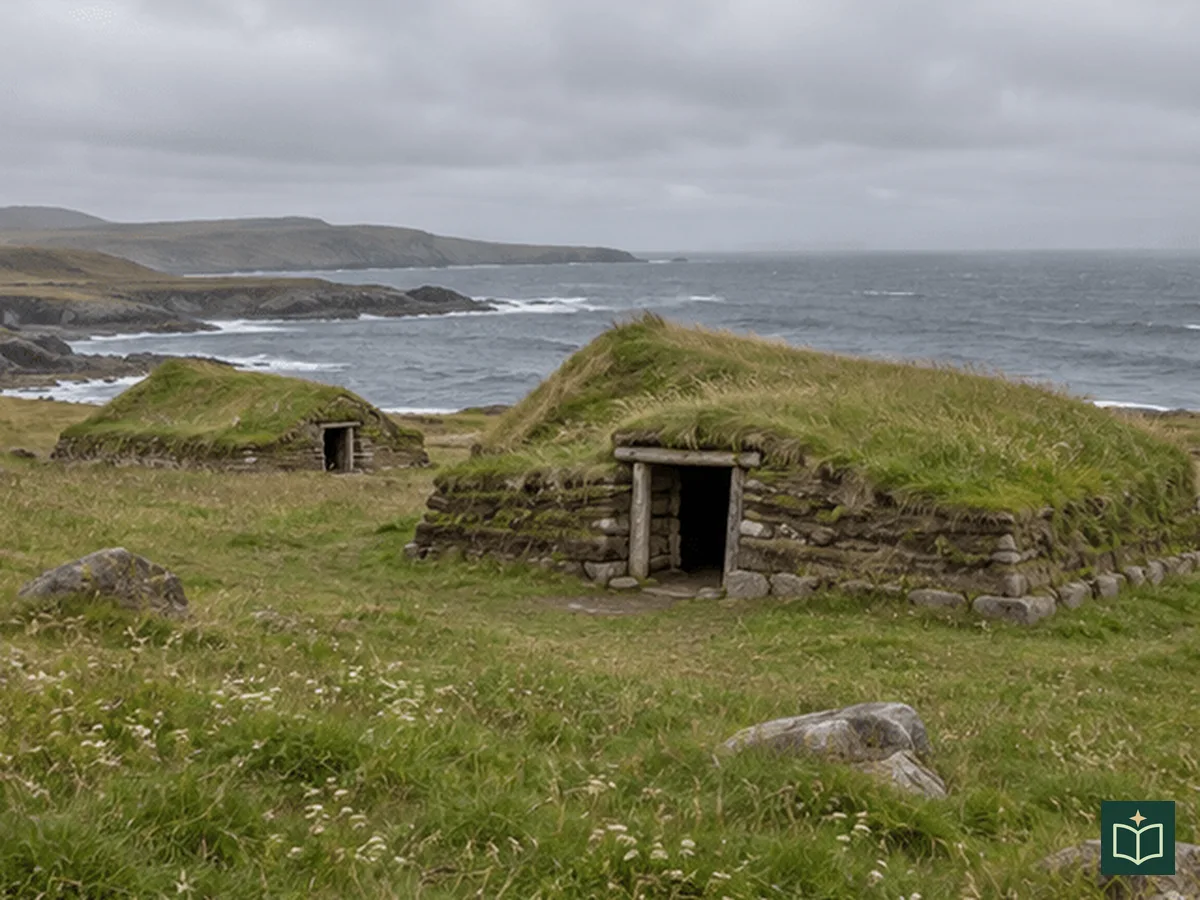
The debate was settled in 1960, when the Norwegian explorer Helge Ingstad and the archaeologist Anne Stine Ingstad, guided by a local resident, identified grassy mounds at L’Anse aux Meadows, on the northern tip of Newfoundland in Canada. Excavations in the 1960s and 1970s uncovered the remains of eight buildings of timber and turf, including three large halls, in a typical Norse style. Finds included iron rivets for boat repair, a smithy where bog iron had been smelted, a bronze cloak pin and a spindle whorl used for spinning yarn. It remains the only confirmed Norse site in North America. UNESCO listed it as a World Heritage Site in 1978.
Dating it to the year
Radiocarbon dates placed the site around the year 1000, but a study published in 2021 made it far more precise. Tree rings record a spike in radiocarbon caused by a burst of cosmic radiation that hit Earth in AD 993. Researchers found that spike in pieces of wood at L’Anse aux Meadows that had been cut with metal blades, a tool the local Indigenous peoples did not use, and counted the rings out to the bark. All three pieces had been felled in 1021. That is 471 years before Columbus reached the Caribbean in 1492, and the earliest securely dated European presence in the Americas.
A gateway, not a colony
L’Anse aux Meadows seems to have been a base camp rather than a permanent farming settlement. It had no barns or animal pens, and its buildings could house perhaps several dozen people at a time. Remains of butternuts, which do not grow that far north, show that the Norse travelled further south, probably to the Gulf of St Lawrence, where wild grapes also grow. The base was likely used for a few years as a place to repair ships and process timber and other goods before shipping them back to Greenland. The occupants then left, apparently in an orderly way, taking most of their possessions with them.
Why it did not last
Several reasons explain the short stay. Greenland’s Norse population was small, a few thousand at most, and could not spare many people for a distant colony. The voyages were long and dangerous, and Greenland itself offered farmland and hunting grounds closer to home. The sagas describe hostile encounters with Indigenous peoples, who were far more numerous. Norse Greenlanders probably continued occasional voyages to Labrador for timber; Icelandic annals record a ship returning from Markland in 1347. The Greenland settlements themselves were abandoned during the fifteenth century. The Norse reached America first among Europeans, but it was later voyages that permanently linked the continents.
Sources & further reading
- UNESCO World Heritage · L’Anse aux Meadows National Historic Site ↗
- Parks Canada · L’Anse aux Meadows National Historic Site ↗
Figures are rounded and widely published; check the linked organisations for the latest editions. These organisations do not endorse this website.