Roads for an army
Rome built roads first for its legions. The earliest great highway, the Via Appia, was begun in 312 BC by the censor Appius Claudius Caecus to link Rome with Capua during wars in southern Italy, and was later extended to Brundisium, today’s Brindisi, on the Adriatic coast. As Rome expanded, roads followed its armies into Gaul, Spain, Britain, the Balkans, Anatolia, the Levant and North Africa. They let troops march quickly to trouble spots, carried officials and messages, and helped trade. At its height the empire had roughly 80,000 kilometres of paved main roads, and a far larger network of gravel and local roads.
Surveying a straight line
Roman roads are famous for running straight, and that began with surveyors. Using an instrument called a groma, a cross on a pole with weighted cords hanging from each arm, they could sight straight lines and right angles. Fires or smoke on high points helped align longer stretches between hills. A long wooden levelling table called a chorobates, with a water channel along the top, helped set gentle gradients. Roads were not straight at any cost, though. Engineers chose practical routes, kept to dry, higher ground where possible, and made bends or zigzags on steep slopes. Long straight stretches were common simply where the terrain allowed.
Layer by layer
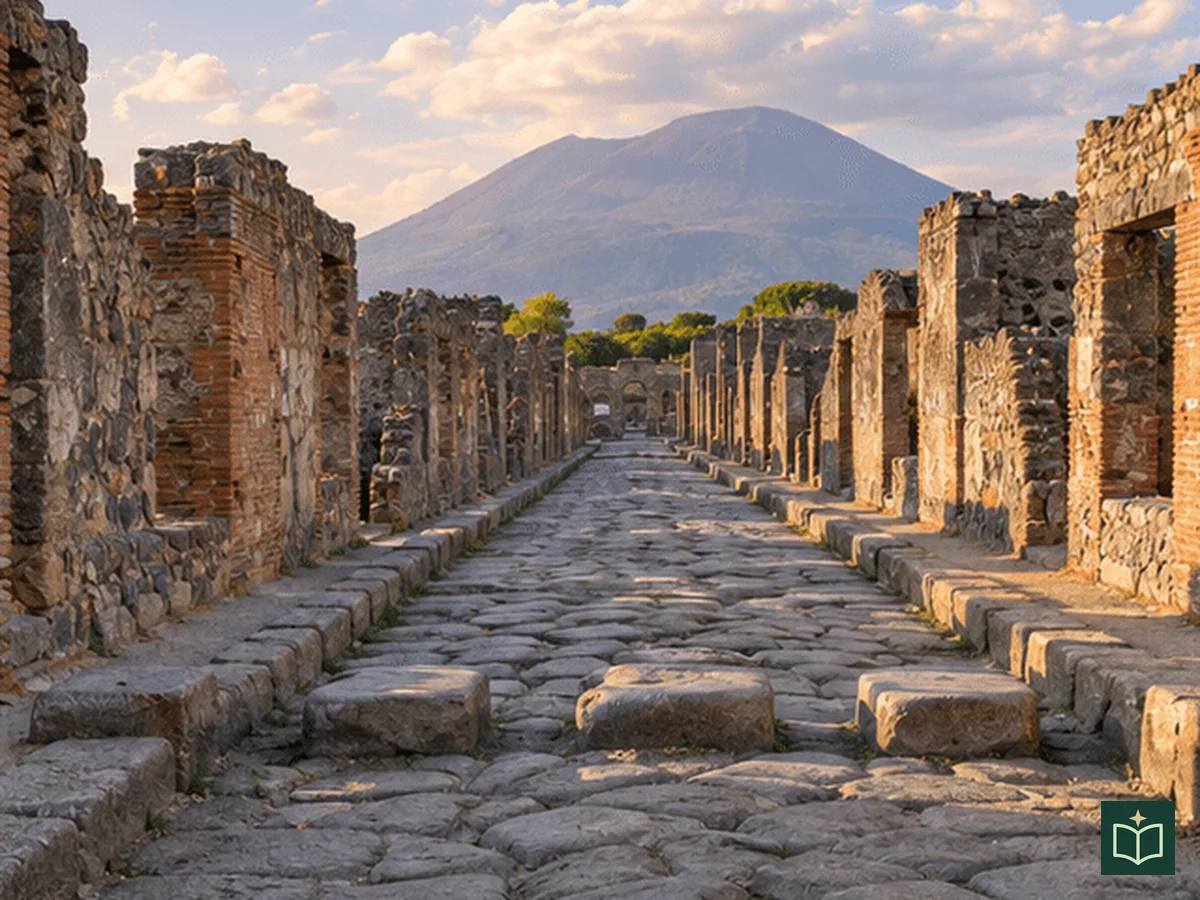
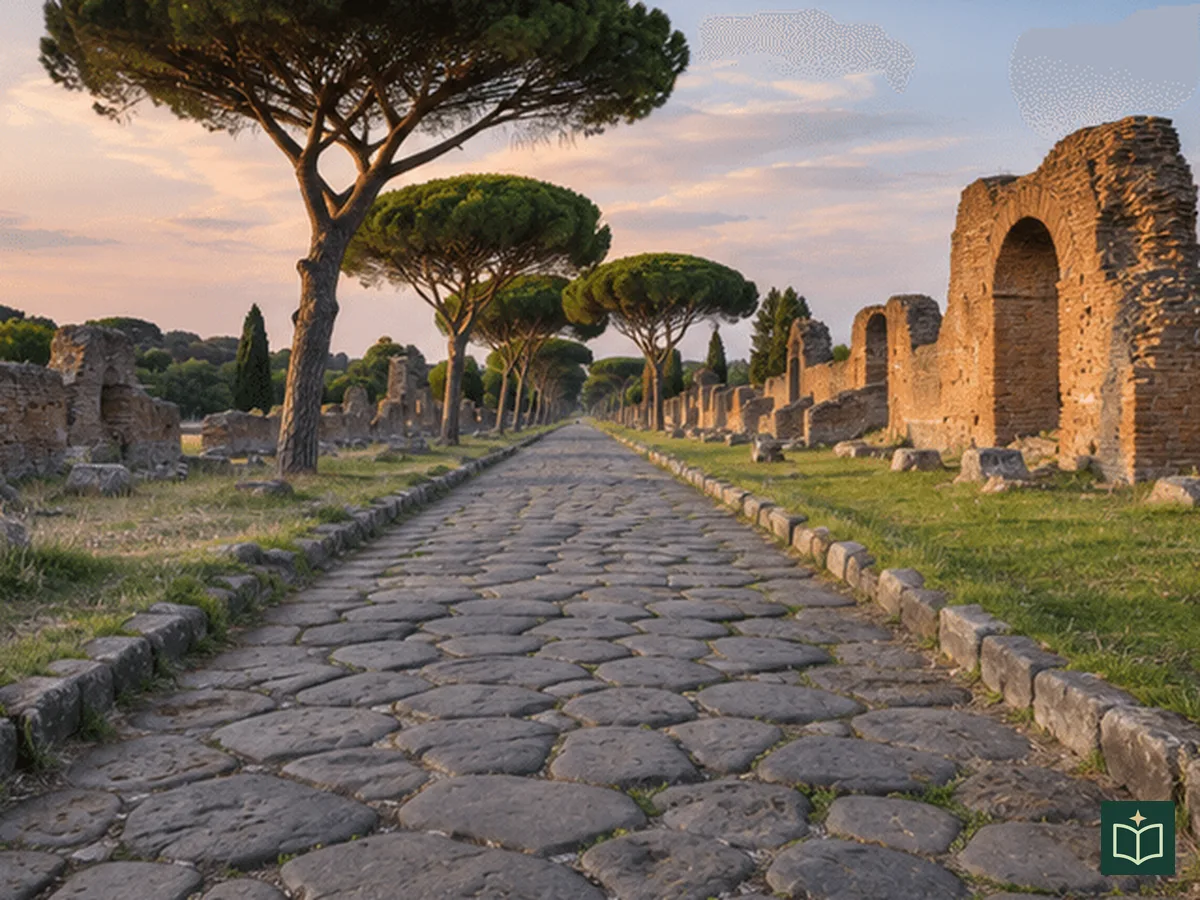
For a major road, workers dug a trench down to firm ground, sometimes a metre or more deep. They filled it in layers: first large flat stones, then a layer of rubble, sometimes bound with lime mortar, then finer gravel or crushed material compacted hard. Ancient writers name these layers, though the neat four-layer diagrams in textbooks draw partly on the architect Vitruvius, who was describing floors, and real roads varied widely. On important routes, the top was paved with large polygonal blocks of hard stone, such as basalt, fitted tightly together. Many roads, especially in the provinces, simply had a surface of packed gravel instead.
Built to drain
Water is the enemy of any road, and Roman builders designed against it. The surface was cambered, higher in the middle than at the edges, so rain ran off to the sides. Ditches alongside carried the water away, and raised kerbstones kept the edges in place. Where roads crossed marshes, builders laid them on raised embankments or timber foundations; where they met rivers, they built stone bridges, some of which are still in use. Main roads were typically four to six metres wide, enough for two carts to pass, often with footpaths alongside. Soldiers frequently did the heavy work, alongside local labourers and enslaved people.
Milestones and way stations
Distances were marked by milestones, cylindrical stone columns set up every Roman mile, a thousand paces, or about 1,480 metres. They often recorded the distance to a city and the name of the emperor who built or repaired the road. Augustus erected a gilded milestone in the Roman Forum as the symbolic centre of the network. Along major routes, the state courier service, the cursus publicus, used way stations where messengers could change horses, and larger inns for overnight stays. A message could cover roughly 80 kilometres a day by relay, much faster in emergencies. Travellers used itineraries, lists of stations and distances, to plan journeys.
Roads in Arabia and beyond
Roman roads reached the edges of Arabia too. After Rome annexed the Nabataean kingdom in AD 106, the emperor Trajan built the Via Nova Traiana, a road of about 430 kilometres running from Bostra in southern Syria through Petra to Aila, today’s Aqaba, on the Red Sea. Many of its milestones still stand in Jordan. Across the former empire, later roads often follow Roman lines, and stretches of original paving survive, such as on the Via Appia outside Rome, now a protected park and, since 2024, a UNESCO World Heritage Site. The saying that all roads lead to Rome reflects a network designed to bind territories together.
Sources & further reading
Figures are rounded and widely published; check the linked organisations for the latest editions. These organisations do not endorse this website.