An old craft with a precise basis
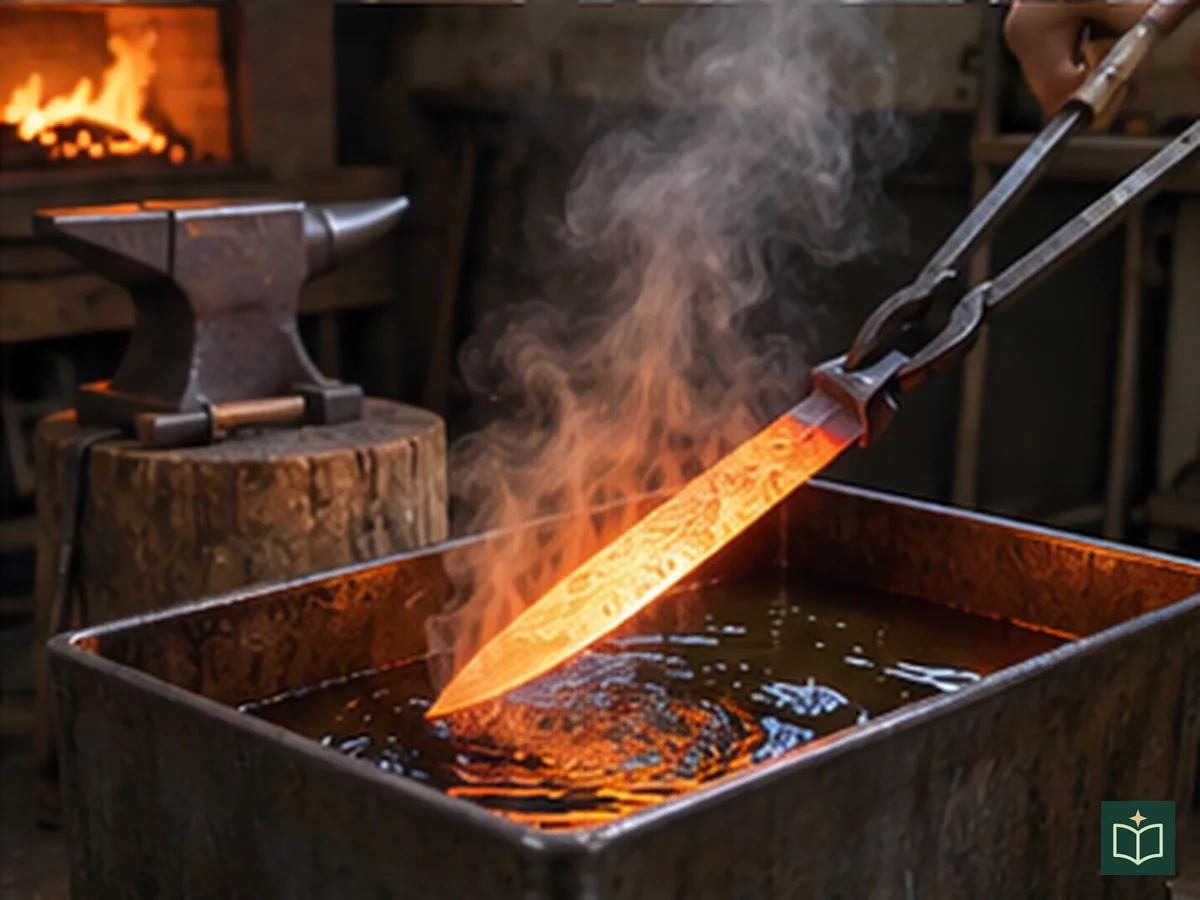
Blacksmiths have hardened steel for well over two thousand years, heating a blade until it glows, plunging it hissing into water or oil, then reheating it gently. For most of that history the process was guided by colour, sound and experience. Modern metallurgy explains what is happening at the scale of atoms. The craft depends on carbon, the small amount, usually well under 1%, that turns iron into steel. Heat treatment does not change how much carbon is present. It changes where the carbon atoms sit within the iron crystal, and that arrangement controls whether steel bends, holds an edge or snaps.
Heating: a crystal that opens up
At room temperature, iron's atoms are arranged in a body-centred cubic pattern that holds very little carbon. When steel is heated above about 727 °C, it starts to change into a different arrangement called austenite, with a face-centred cubic structure that has more room between atoms. Carbon dissolves readily into these larger spaces. Smiths typically heat hardening steels a little higher, often into the 800s, so the transformation is complete. A traditional check is the magnet test: steel stops being attracted to a magnet at around 770 °C, a useful sign that the right hardening temperature is close.
Quenching: carbon trapped
If austenite cools slowly, carbon has time to move out and form layers of iron carbide, giving a relatively soft structure. If it is cooled very quickly, the carbon has no time to escape. The iron tries to snap back to its room-temperature structure but the trapped carbon distorts it, creating martensite, a strained, needle-like structure. Martensite is extremely hard and resists wear, but it is brittle and full of internal stress. Brine cools fastest, then water, then oil, then air. A faster quench hardens more fully but risks warping or cracking, so many modern steels are designed to harden in oil.
Tempering: buying back toughness
A freshly quenched blade could chip or shatter if dropped. Tempering fixes this. The steel is reheated to a moderate temperature, typically between about 150 and 650 °C, and held there. Some carbon leaves the strained martensite and forms tiny carbide particles, and internal stresses relax. Hardness falls a little, while toughness, the ability to absorb impacts without cracking, rises substantially. The higher the tempering temperature, the softer and tougher the result. Kitchen knives are usually tempered at around 200 °C to stay hard enough to hold an edge, while springs and axes are tempered hotter so they flex or absorb blows.
Reading the colours
Before thermometers, smiths judged tempering by colour. When polished steel is heated in air, a very thin oxide film grows on its surface. Light reflecting from the top and bottom of that film interferes, producing colours that depend on its thickness and therefore on the temperature reached. Pale straw appears at a little over 200 °C, followed by bronze, purple and then blue at around 300 °C. A smith tempering a chisel might polish the edge, heat the body and watch the colours run towards the tip, quenching when the right shade arrived. The colours are a surface effect and fade if the steel is ground.
Not every steel hardens
Quenching only works well when there is enough carbon. Mild steel, with around 0.2% carbon or less, cannot form much martensite and barely hardens, which is why it is used for beams and car bodies that must bend rather than break. Alloying elements such as chromium, manganese and molybdenum slow the transformation, letting thicker parts harden through and allowing gentler quenches. Smiths also harden selectively. Japanese swordsmiths coated blades with clay, thicker on the spine, so the edge cooled fastest. The visible boundary, the hamon, marks a hard cutting edge backed by a tougher, more forgiving and slightly springy spine.
Sources & further reading
Figures are rounded and widely published; check the linked organisations for the latest editions. These organisations do not endorse this website.