An island of rock
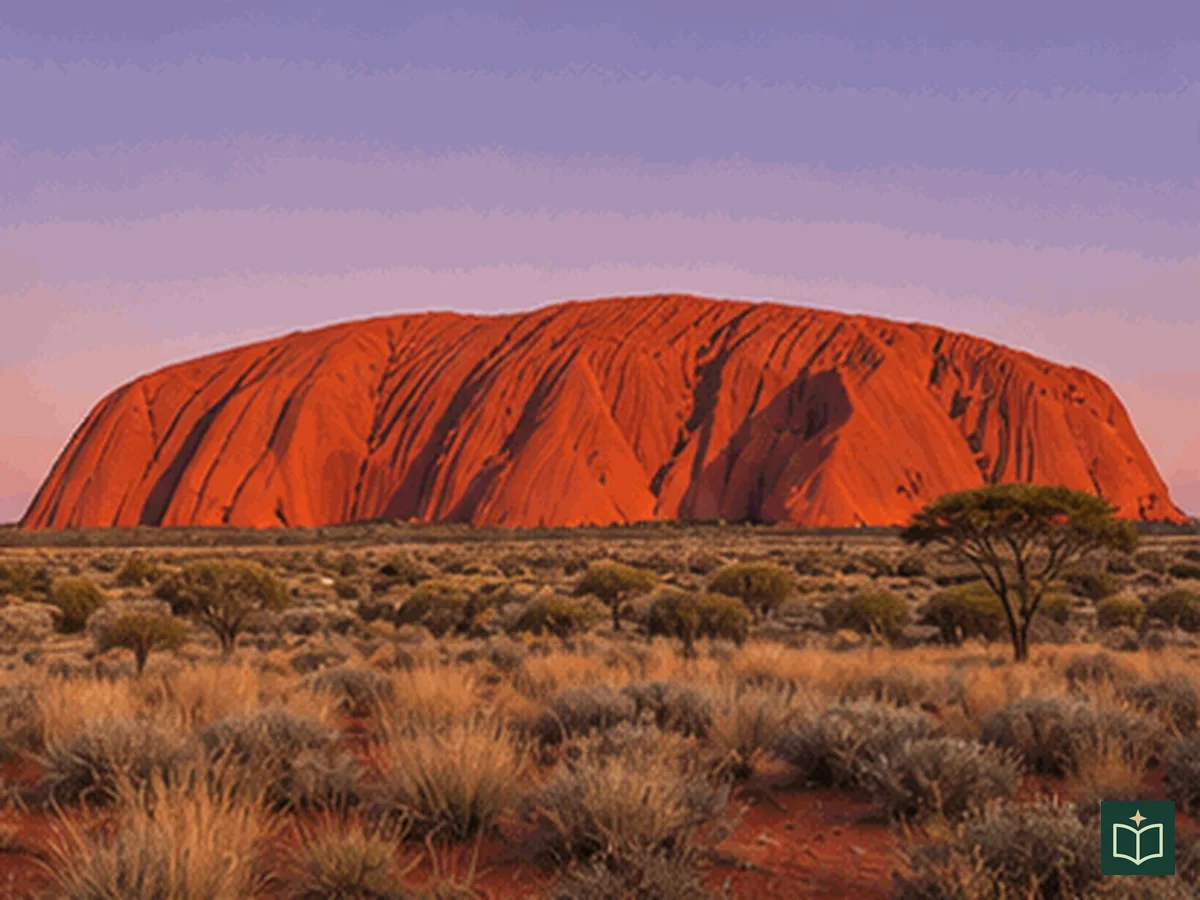
Uluru rises about 348 metres above the flat red sand plains of Australia’s Northern Territory, a single smooth-sided mass roughly 3.6 kilometres long. Geographers call landforms like this inselbergs, from the German for “island mountain”: isolated hills that stand abruptly above a level surrounding plain. Uluru is sacred to the Anangu, its traditional owners, and is jointly managed with Parks Australia inside the Uluru-Kata Tjuta National Park, a World Heritage site listed for both its natural and its cultural values. About 25 kilometres to the west lies Kata Tjuta, a cluster of domes made of coarser conglomerate rock, which formed in the same ancient basin but tells a slightly different story.
Sand from vanished mountains
The rock of Uluru began as sand. Roughly 550 million years ago a mountain range to the south-west, now worn almost flat, was eroding rapidly. Rivers carried its debris outward in great fans. The sand that became Uluru is arkose, rich in feldspar and only slightly rounded, a sign that it travelled a short distance before settling. The coarser boulders and cobbles nearer the mountains became the conglomerate of Kata Tjuta. Over time the fans were buried under younger sediments, including sea-floor deposits, and compressed. Water moving through the pores left mineral cements behind, binding the grains into hard, dense rock with very few cracks.
Standing on its end
Between roughly 400 and 300 million years ago, during a mountain-building episode known as the Alice Springs Orogeny, the region was squeezed and folded. The layers at Uluru were tipped until they stand at around 85 degrees, almost vertical. You can see them today as the parallel ridges and grooves that run along the rock’s flanks, each one the edge of an original sand layer. The layers at Kata Tjuta were tilted far less. Once the folding ended, erosion slowly stripped away the overlying rocks. Uluru continues well below the surrounding plain, so the visible rock is only the top of a much larger buried body.
Why it survived
Uluru stands high because it wore away more slowly than everything around it. Its sandstone is uniform, tightly cemented and almost free of joints, so water had few lines of weakness to exploit. The surrounding rocks were softer or more fractured and were lowered steadily by weathering, flash floods and wind over tens of millions of years. Rain on Uluru runs off quickly instead of soaking in, and most erosion happens as thin flakes peeling from the surface. That shedding produces its smooth, rounded profile. In effect the plain retreated downward and Uluru was left behind, the same process that creates inselbergs from Namibia to the gravel plains of Oman.
Why it glows at sunset
Fresh Uluru rock is grey. The famous red comes from a thin surface coating of iron oxide, essentially rust, formed as iron minerals in the sandstone react with oxygen and water. At midday, under high white sunlight, the rock looks orange-brown. Near sunrise and sunset the light reaching it passes through far more atmosphere, which scatters away much of the blue and leaves the light richer in red and orange. The iron-coated surface reflects those wavelengths strongly, so the rock appears to glow crimson and then fade to purple. After rare heavy rain the rock darkens to a silvery grey as water streams down its sides in short-lived waterfalls.
A place of meaning
For the Anangu, Uluru is not simply a landform but a living cultural landscape, crossed by the tracks of ancestral beings described in Tjukurpa, the law and knowledge that guides their life. Many sites around its base are sacred and may not be photographed. Climbing the rock was permanently closed in October 2019 at the request of the traditional owners. Visitors now walk the base track, roughly ten kilometres long, where waterholes, rock art and the rock’s detailed surface can be seen up close. Uluru shows how deep geological time and living human culture can occupy the same place, each giving a different but complementary meaning to it.
Sources & further reading
- Parks Australia · Uluru-Kata Tjuta National Park ↗
- UNESCO World Heritage · Uluru-Kata Tjuta National Park ↗
- Britannica · Uluru/Ayers Rock ↗
Figures are rounded and widely published; check the linked organisations for the latest editions. These organisations do not endorse this website.