Grassland with trees
A savanna is a tropical or subtropical grassland dotted with trees and shrubs that never close into a continuous canopy. Savannas cover roughly a fifth of Earth’s land, from the Serengeti and the Sahel’s southern edge to Brazil’s cerrado, the llanos of Venezuela and Colombia, the plains of central India and the woodlands of northern Australia. They share a climate of warm temperatures all year and a sharp split between a wet season and a long dry season, often lasting five months or more. Annual rainfall varies widely, from about 500 millimetres to more than 1,500. Some of the wetter savannas receive enough rain to support a closed forest.
The puzzle of the missing forest
That is the puzzle. If rainfall alone decided vegetation, many savannas would be woodland. Satellite studies of tree cover across the tropics show something unusual: at intermediate rainfall, land tends to be either open savanna or dense forest, with few places in between. Ecologists interpret this as two stable states, each reinforcing itself. In forest, the shaded, humid floor grows little grass, so fires struggle to spread and trees stay dominant. In savanna, abundant grass carries fire easily, and fire keeps trees sparse. Which state a landscape occupies depends partly on its history, so a savanna is not simply a forest waiting to happen.
Fire as gardener
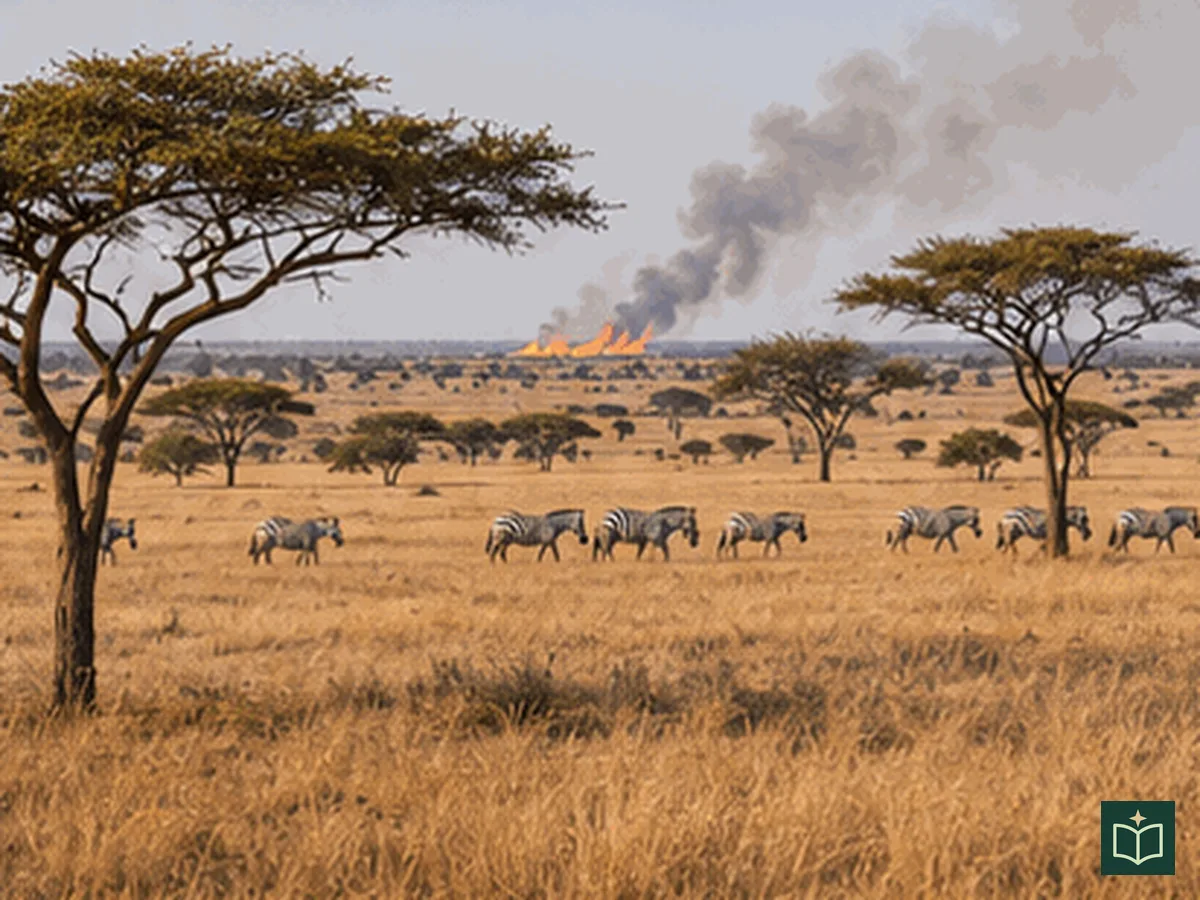
Fire is the main force holding the balance. In the dry season, grass that grew tall in the rains dries out and burns readily, often every one to three years in African and Australian savannas. Grasses survive easily because their growing points lie at or below the soil surface, and many savanna grasses use the efficient C4 form of photosynthesis that thrives in heat and strong light. Young trees are more vulnerable. A fire can kill a sapling’s stem, forcing it to resprout from the roots again and again. Only a tree that grows tall enough between fires, usually a few metres, escapes this “fire trap” and lifts its crown above the flames.
Grazers and browsers
Animals add to the pressure. Grazers such as wildebeest, zebra and buffalo crop the grass, which can reduce fuel and change how fires spread. Browsers such as giraffe, impala and goats eat leaves and young shoots, holding saplings down. Elephants are the most powerful gardeners of all: they strip bark, break branches and push over mature trees, opening woodland back into grassland. The Serengeti’s great migration of well over a million wildebeest follows the rains and the fresh grass they produce. Remove the large animals, or stop the fires, and many savannas fill steadily with woody shrubs, a process called bush encroachment that worries ranchers and conservationists alike.
People and fire
People have lit savanna fires for tens of thousands of years, to drive game, clear paths and bring on fresh green grazing. In northern Australia, Aboriginal ranger groups now restore early dry-season burning. Small, cool fires set while some moisture remains create a patchwork of burnt and unburnt ground, which breaks up the fuel and prevents larger, hotter fires late in the season. Those late fires do far more damage to trees and wildlife and release more greenhouse gas. A common misconception is that every savanna fire is a disaster. In this biome, the frequency, timing and intensity of fire matter far more than whether fire happens at all.
Why savannas matter
Savannas support some of the world’s richest communities of large mammals, store substantial carbon in their soils and roots, and provide grazing for hundreds of millions of livestock. They are also changing. Rising carbon dioxide favours trees over grasses, which may be one reason shrubs are spreading across many savannas. Conversion to cropland, especially in the Brazilian cerrado, is removing large areas entirely. Well-meaning tree-planting schemes can harm them too, because covering a natural grassland with forest destroys a distinct ecosystem rather than restoring one. Understanding savannas as fire-shaped landscapes, not degraded forests, is the starting point for managing them well.
Sources & further reading
Figures are rounded and widely published; check the linked organisations for the latest editions. These organisations do not endorse this website.