Two kinds of avalanche
An avalanche is a mass of snow sliding rapidly down a slope. Loose-snow avalanches start at a single point and fan out as they gather more snow, much like sand slipping on a dune. They are usually small. The dangerous kind is the slab avalanche, in which a whole block of cohesive snow, sometimes hundreds of metres wide and more than a metre deep, breaks away at once. Slab avalanches cause the great majority of deaths. They can reach speeds above 100 kilometres per hour within seconds, and the snow they carry can weigh thousands of tonnes. Once moving, a slab shatters into blocks and churns downhill.
A snowpack has layers
Snow does not fall as one uniform blanket. Each storm, warm spell, wind event and clear night leaves its own layer, and the snowpack builds up like the pages of a book. Some layers are strong and well bonded; others are fragile. Weak layers often form during cold, clear weather. Surface hoar, the feathery frost that grows on snow on clear nights, can be buried intact by the next storm. Large temperature differences within a shallow snowpack turn rounded grains into angular, sugary crystals called facets or depth hoar, which barely stick to each other. These weak layers can persist for weeks, hidden beneath a smooth, inviting surface.
How a slab lets go
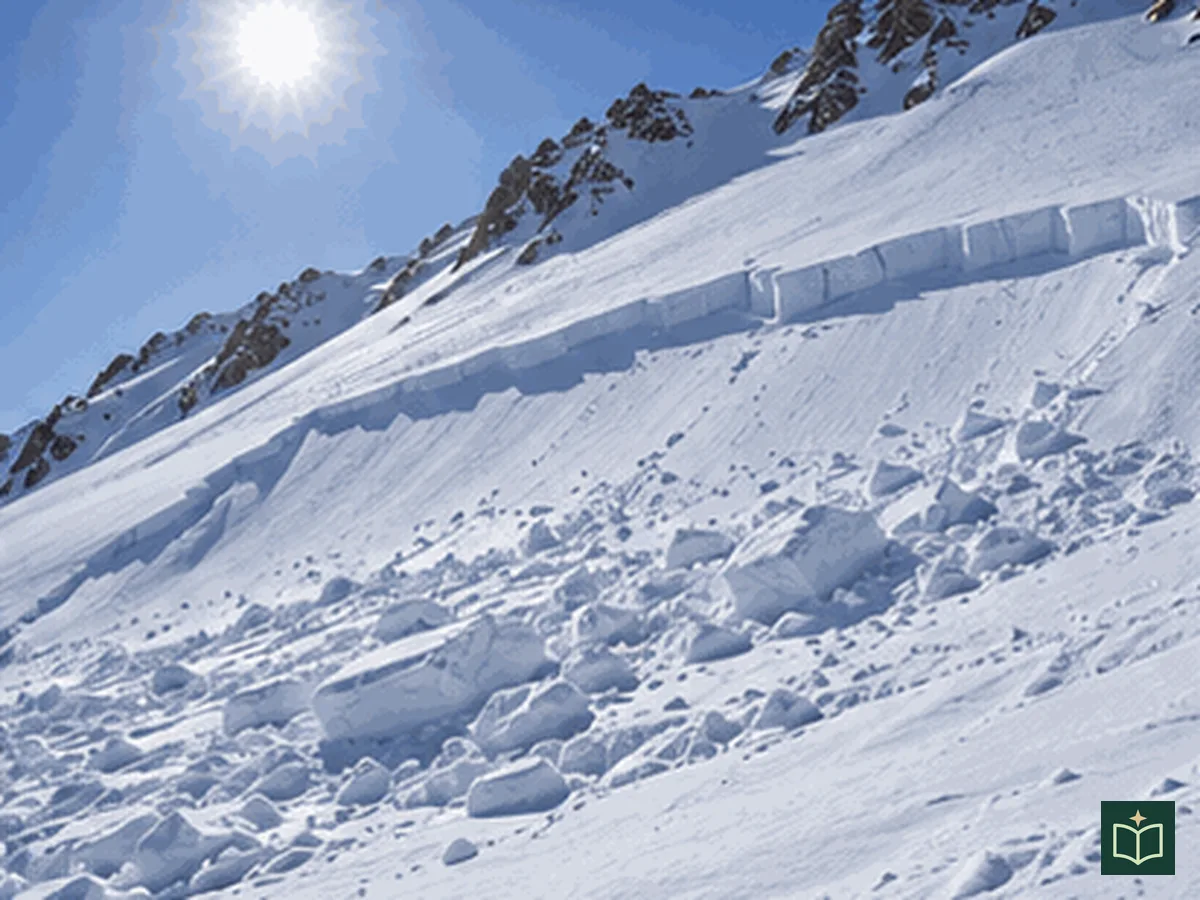
A slab avalanche needs three ingredients: a cohesive slab, a weak layer beneath it and a slope steep enough to slide. Most release on slopes between about 30 and 45 degrees, roughly as steep as an expert ski run. When extra weight is added, by new snow, wind-drifted snow or a person, stress on the weak layer rises. If it fails at one point, the collapse can spread through the layer faster than anyone could react, sometimes with a deep “whumpf” sound. The slab is suddenly unsupported and fractures across the slope like breaking glass. A clean, sharp crown face marks where it broke.
Why victims trigger them
Avalanche centres in Europe and North America consistently find that around nine in ten avalanche deaths involve slides set off by the victims or members of their own group. The reason is the weak layer. A buried layer may be almost ready to fail, needing only a little extra stress at the right spot. A skier, snowboarder, climber or snowmobile concentrates weight close to the surface, exactly where a slab is thin enough to transfer that stress downwards. Danger is often highest a day or two after a storm, when slopes have not released naturally but remain unstable. Shooting cracks and collapsing sounds are warnings that the snowpack is primed to fail.
Surviving the minutes after
Once an avalanche stops, the churned snow quickly sets almost as hard as concrete around anyone buried in it. Survival depends on time. Studies of buried victims show that most people dug out within about 15 minutes survive, but chances fall steeply after that, chiefly because of suffocation. That is why backcountry travellers carry a transceiver, which transmits a signal companions can track, along with a probe and a shovel, and practise using them. Rescue teams from outside rarely arrive within the critical window. Airbag packs, which inflate to help keep a person near the surface of moving snow, have improved survival rates but are no guarantee.
Reading the danger
Avalanche forecasting services publish daily bulletins using a five-level danger scale, from low to very high. A common misconception is that most accidents happen on the highest days. In fact many occur at moderate or considerable danger, when conditions look tempting and people venture onto steep slopes. Forecasters study weather records, test snow pits and track reported slides to identify weak layers. Terrain choice matters most: avoiding steep slopes, gullies that funnel debris and the ground below large slopes greatly reduces risk. Mountain roads and towns are protected by snow sheds, fences and controlled explosions that release unstable snow deliberately when nobody is below.
Sources & further reading
- Avalanche.org · US avalanche centres and education ↗
- WSL Institute for Snow and Avalanche Research SLF ↗
- Britannica · Avalanche ↗
Figures are rounded and widely published; check the linked organisations for the latest editions. These organisations do not endorse this website.