Beyond the limestone cave
When most people picture a cave, they imagine limestone: stalactites, underground rivers and chambers hollowed out over hundreds of thousands of years as slightly acidic water dissolves the rock. Those solution caves are the most common type, but they are not the only kind. Several other processes can open a space large enough for a person to enter. Molten lava can drain out of its own hardened skin, leaving a tunnel. Waves can batter a hole into a sea cliff. Meltwater can hollow out passages inside a glacier. These caves form in very different materials and on very different timescales, from a few months to many thousands of years.
Tunnels left by lava
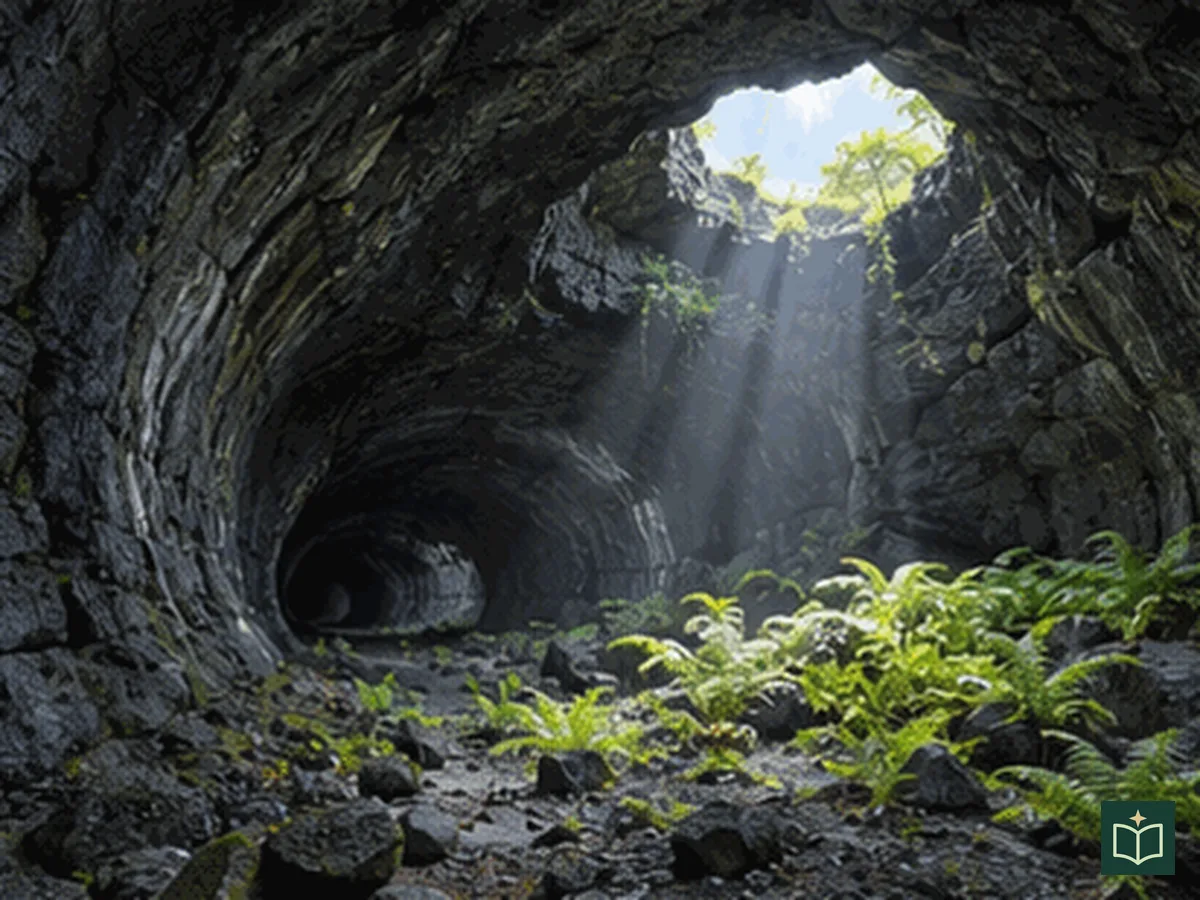
Lava tubes form in fluid basalt flows, the runny type common on shield volcanoes such as those of Hawai‘i, Iceland and the Canary Islands. As a river of lava flows downhill, its surface cools and crusts over while the interior stays molten and keeps moving, insulated by the roof above it. When the eruption wanes, the lava drains out of the downstream end, leaving a hollow tunnel behind. Kazumura Cave on Hawai‘i stretches about 65 kilometres, the longest known. Inside, tubes can show lava “stalactites”, ledges marking old flow levels and smooth, glassy walls. Where part of a roof collapses, a skylight opens, revealing the tube from the surface.
Caves cut by waves
Sea caves form where waves concentrate their energy on a weakness in a cliff, such as a joint, a fault or a band of softer rock. Each breaking wave compresses air into cracks; as it retreats, the air expands explosively, loosening blocks. Sand and pebbles thrown by the waves grind the walls like sandpaper. Over centuries the weakness widens into a cave. If waves cut through a headland from both sides, the cave becomes an arch; when the arch roof falls, a sea stack remains. Sea caves usually sit at or near today’s sea level, so caves found high above the shore can record ancient coastlines from times when the sea stood higher or the land lower.
Caves inside glaciers
Glacier caves are the most fleeting of all. Meltwater from the surface drains down through cracks and flows along the base of the ice, melting a channel as it goes. Warm air drawn in from the glacier’s edge enlarges the passage further. The result can be a tunnel of startling blue, because dense glacial ice absorbs red light and transmits blue. These caves change every season: they shift as the glacier moves, and they can collapse without warning, so entering them is genuinely dangerous. Geographers distinguish them from ice caves, which are ordinary rock caves that stay cold enough to hold ice all year, such as Eisriesenwelt in Austria.
Other ways to make a hole
A handful of other processes also create caves. Talus caves are gaps between huge fallen boulders at the foot of cliffs. Fissure caves open where blocks of rock pull apart along faults or slide on a slope. Wind and weathering can hollow out shallow shelters called tafoni in sandstone and granite, a honeycomb pattern visible on rocks across the deserts of Arabia. Some caves combine processes: a lava tube may later be widened by water, and a sea cave may develop along a limestone joint. Caves formed this way rarely contain the dripstone decorations of limestone caves, because there is little dissolved mineral to deposit.
Why these caves matter
Non-solution caves are more than curiosities. Lava tubes shelter unusual life, including blind insects and microbial mats, and they help volcanologists understand how far and how fast lava can travel underground. Sea caves mark the history of sea level and coastal erosion. Glacier caves give scientists a rare route to study the bed of a moving glacier, and their rapid changes are one visible sign of melting ice. Lava tubes have also been spotted on the Moon and Mars through collapsed skylights. Because their thick rock roofs would block radiation and soften temperature swings, they are studied as possible shelters for future human explorers.
Sources & further reading
Figures are rounded and widely published; check the linked organisations for the latest editions. These organisations do not endorse this website.