Two lines, one reason
The Tropic of Cancer and the Tropic of Capricorn are circles of latitude about 23.4 degrees north and south of the equator. They are not arbitrary. They mark the most northerly and most southerly places on Earth where the Sun can appear directly overhead at noon. North of the Tropic of Cancer and south of the Tropic of Capricorn, the midday Sun is always at least slightly to one side of the zenith, even at the height of summer. Between them lies the zone known as the tropics, which covers about 40% of Earth's surface, because the sine of 23.4 degrees is roughly 0.4. That band is home to a large share of the world's people.
Why the Sun moves
The lines exist because Earth's axis is tilted by about 23.4 degrees relative to the plane of its orbit around the Sun. As Earth travels around its orbit, first the Northern Hemisphere and then the Southern Hemisphere leans towards the Sun. Around 21 June, the June solstice, the Sun stands directly over the Tropic of Cancer at noon. Around 21 December, the December solstice, it stands over the Tropic of Capricorn. At the equinoxes in March and September, it is overhead at the equator. The overhead Sun appears to sweep between the two lines and back each year, turning at each tropic. The word tropic comes from the Greek for turning.
Names written in the stars
The names come from astronomy about 2,000 years ago. At the June solstice, the Sun appeared against the stars of the constellation Cancer, the crab; at the December solstice, it stood in Capricornus, the goat. Because Earth's axis slowly wobbles, an effect called precession, the Sun now sits in different constellations at those dates, in Taurus or Gemini in June and Sagittarius in December. The names have stayed. The tilt itself is not fixed either. Over cycles of about 41,000 years it varies between roughly 22.1 and 24.5 degrees, and today it is slowly decreasing, so the tropics are creeping towards the equator by around 15 metres a year.
Crossing the Gulf
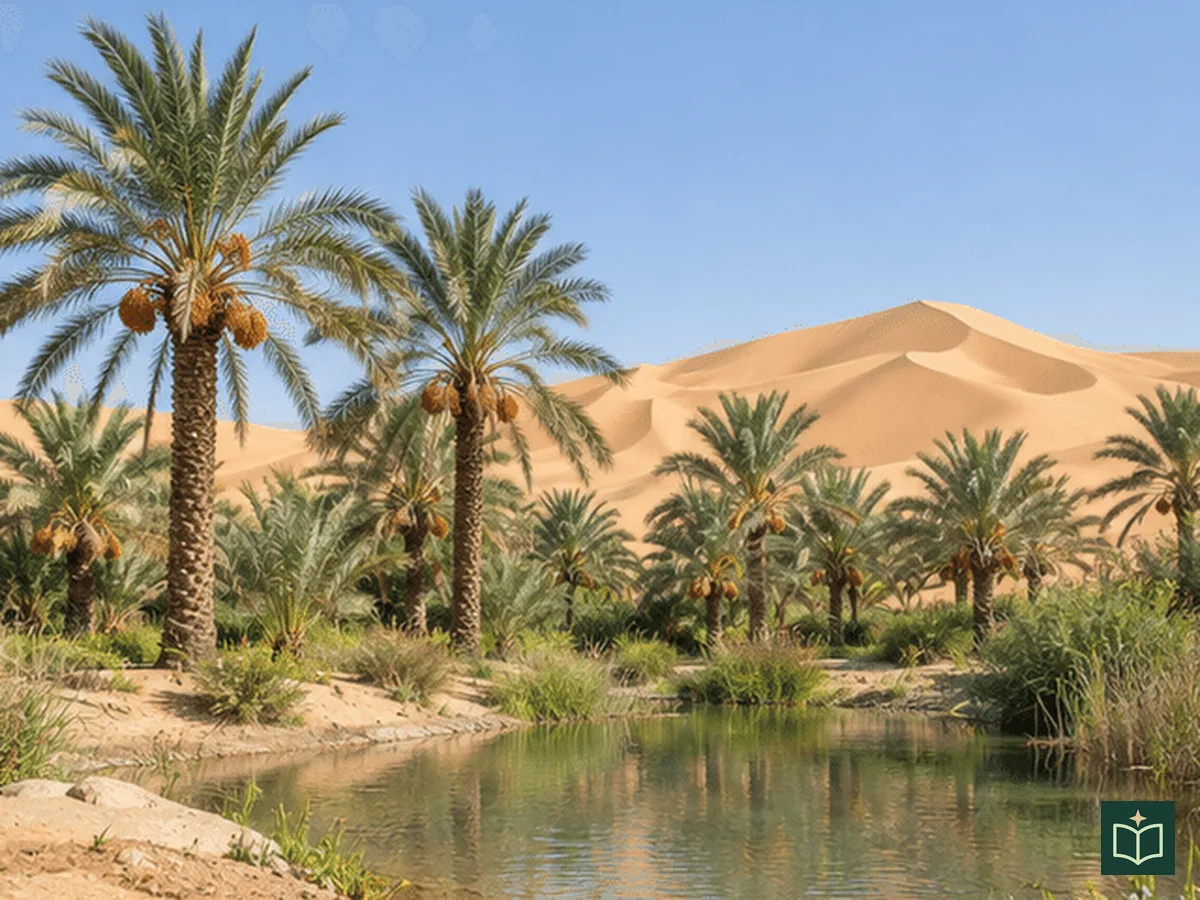
The Tropic of Cancer runs across the Arabian Peninsula. It crosses central Saudi Arabia south of Riyadh, then the southern part of the UAE's Al Dhafra region, passing north of the Liwa Oasis, and continues into Oman a short distance south of Muscat. Abu Dhabi city, at about 24.5 degrees north, lies just outside the tropics, but only barely: at noon on the June solstice the Sun stands about 89 degrees above the horizon, a single degree from overhead, while at the December solstice it reaches only about 42 degrees. Mecca, at about 21.4 degrees north, lies within the tropics, so the Sun passes directly overhead there twice a year, in late May and mid-July.
Around the globe
Elsewhere, the Tropic of Cancer passes through Mexico, the Bahamas, the Sahara in countries including Mauritania, Mali, Algeria, Libya and Egypt, then India, Bangladesh, Myanmar, southern China and Taiwan. Much of the land along it is desert, because the sinking air of the subtropical high-pressure belts lies near these latitudes. The Tropic of Capricorn crosses Chile, Argentina, Paraguay and Brazil, passing close to São Paulo, then Namibia, Botswana, South Africa, Mozambique and Madagascar, and the middle of Australia, where it runs near Alice Springs. There is much less land in the Southern Hemisphere, so the Tropic of Capricorn spends more of its length crossing ocean than its northern twin.
Lines, not climate borders
The tropics are astronomical lines, not climate boundaries. Places just outside them can be hotter than places inside: Gulf summers north of the Tropic of Cancer are among the hottest on Earth, while high tropical cities such as Quito or Addis Ababa are mild all year. Climate scientists define the tropical climate zone by temperature and rainfall instead, and its edges wander well beyond the lines. Still, the tropics matter for daylight. Within them, day length changes little through the year and the midday Sun is always high, which shapes everything from solar energy output to the design of shaded streets and buildings. They are paired with the Arctic and Antarctic Circles, which are also set by the same tilt.
Sources & further reading
- Britannica · Tropic of Cancer ↗
- Britannica · Tropic of Capricorn ↗
- National Geographic Education · Tropics ↗
Figures are rounded and widely published; check the linked organisations for the latest editions. These organisations do not endorse this website.