Elements: one kind of atom
An element is a pure substance made of only one kind of atom, defined by the number of protons in each nucleus. Gold, oxygen, carbon and iron are elements. There are 118 known, of which around 90 occur naturally in significant amounts, and they cannot be broken into simpler substances by ordinary chemical reactions. An element can still take different forms. Carbon exists as soft graphite and as hard diamond, and oxygen as O₂ in the air we breathe or as ozone, O₃, high in the atmosphere. In each case every atom is carbon or every atom is oxygen, which is what makes it an element.
Compounds: bonded in fixed ratios
A compound forms when atoms of two or more elements are chemically bonded in a definite proportion. Water is always two hydrogen atoms to one oxygen atom; carbon dioxide is always one carbon to two oxygen. A compound has properties quite unlike its ingredients. Sodium is a reactive metal that fizzes in water, and chlorine is a poisonous green gas, yet together they make sodium chloride, ordinary table salt. Separating a compound requires a chemical reaction, such as passing electricity through water to release hydrogen and oxygen. You cannot pick the elements out by sieving, filtering or boiling, because they are locked together by chemical bonds.
Mixtures: mingled, not bonded
A mixture contains two or more substances that are physically combined but not chemically bonded. Each keeps its own properties, and the proportions can vary. Air is a mixture of roughly 78% nitrogen and 21% oxygen, with argon, carbon dioxide and water vapour. Sand and gravel, salad and seawater are mixtures too. Chemists distinguish homogeneous mixtures, which look uniform throughout, such as salt water or air, from heterogeneous mixtures, where you can see the separate parts, such as oil floating on water. Alloys are also mixtures: 18-carat gold is about 75% gold blended with other metals, such as copper and silver, to make it harder.
The classic iron and sulfur test
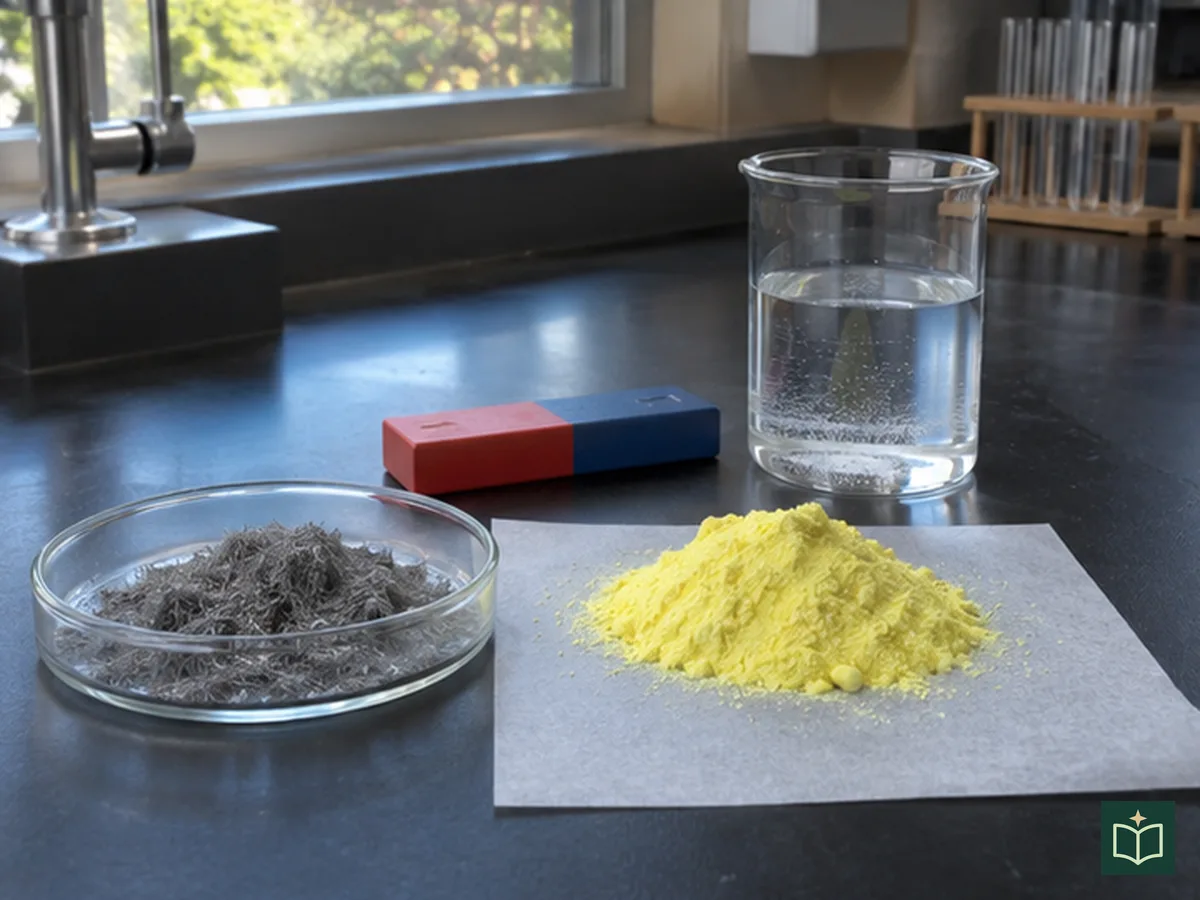
School laboratories show the difference with iron filings and yellow sulfur powder. Stirred together, they form a mixture. A magnet drawn over the dish pulls the iron back out, and the sulfur stays behind, because nothing has bonded. Heat the same mixture strongly, however, and it glows as a chemical reaction takes place. The product is iron sulfide, a dark, brittle compound. A magnet no longer separates the iron, and the material behaves as a single new substance. The ingredients are identical in both cases; what changed is whether their atoms are joined by chemical bonds. That is the dividing line between a mixture and a compound.
Separating mixtures in the Gulf
Because the parts of a mixture are not bonded, physical methods can split them: filtering, sieving, magnets, evaporation, distillation and chromatography. The Gulf relies on this every day. Seawater is a mixture of water and dissolved salts, about 3.5% salt by mass in the open ocean and more in the Gulf itself. Desalination plants separate it either by heating and condensing the water, a form of distillation, or by forcing it through fine membranes in reverse osmosis. No chemical reaction is needed. Coastal salt pans work the other way, letting the sun evaporate the water to leave the salt behind, an ancient technique still used around the world.
Where the categories blur
Real materials can be harder to sort. Some solids, called non-stoichiometric compounds, vary slightly in their ratios, and solutions such as sugar water can look as uniform as a pure substance. Everyday words also mislead: "pure" orange juice is a mixture, and "chemical-free" products are still made of chemicals. A practical test helps. Ask whether the substance has a fixed composition and properties different from its parts; if so, it is likely a compound. Ask whether you could separate it by physical means; if so, it is a mixture. Learning these three categories is the first step in chemistry, because every later idea about reactions builds on them.
Sources & further reading
- Royal Society of Chemistry · Periodic Table ↗
- IUPAC · Periodic Table of Elements ↗
- Britannica · Mixture ↗
Figures are rounded and widely published; check the linked organisations for the latest editions. These organisations do not endorse this website.