The difference is mass
Stars and planets can look alike as points of light, but they are built on very different scales. A star is a huge ball of gas, mostly hydrogen and helium, so massive that its own gravity compresses the core to millions of degrees. A planet is far smaller: a body of rock, ice or gas orbiting a star, without the weight to ignite anything at its centre. The Sun holds about 99.8% of all the mass in the solar system, and it is roughly a thousand times as massive as Jupiter, the largest planet. That gap in mass, more than size or colour, is what separates the two.
How a star makes its own light
In the Sun's core the temperature is around 15 million degrees Celsius and the pressure is immense. Under those conditions hydrogen nuclei collide hard enough to fuse into helium. Each reaction turns a tiny amount of mass into energy, as Einstein's equation E = mc² describes. The Sun converts roughly four million tonnes of matter into energy every second, and it has done so for about 4.6 billion years. That energy works its way outwards over many thousands of years before escaping the surface as sunlight. Every star in the night sky is doing the same thing, though some burn far faster and hotter than the Sun, and others far more slowly.
How a planet shines without fire
A planet produces no visible light of its own. When we see Venus blazing in the evening sky, we are seeing sunlight bouncing off its thick, bright clouds. Mars looks reddish because its iron-rich dust reflects red light well. Giant planets such as Jupiter do release some heat from slow contraction and leftover warmth from their formation, but this is infrared radiation, invisible to the eye. Brown dwarfs sit in between: heavier than planets, they briefly fuse a rare form of hydrogen called deuterium but never reach steady hydrogen fusion. Astronomers sometimes call them failed stars, a reminder that the line is drawn by mass.
Telling them apart tonight
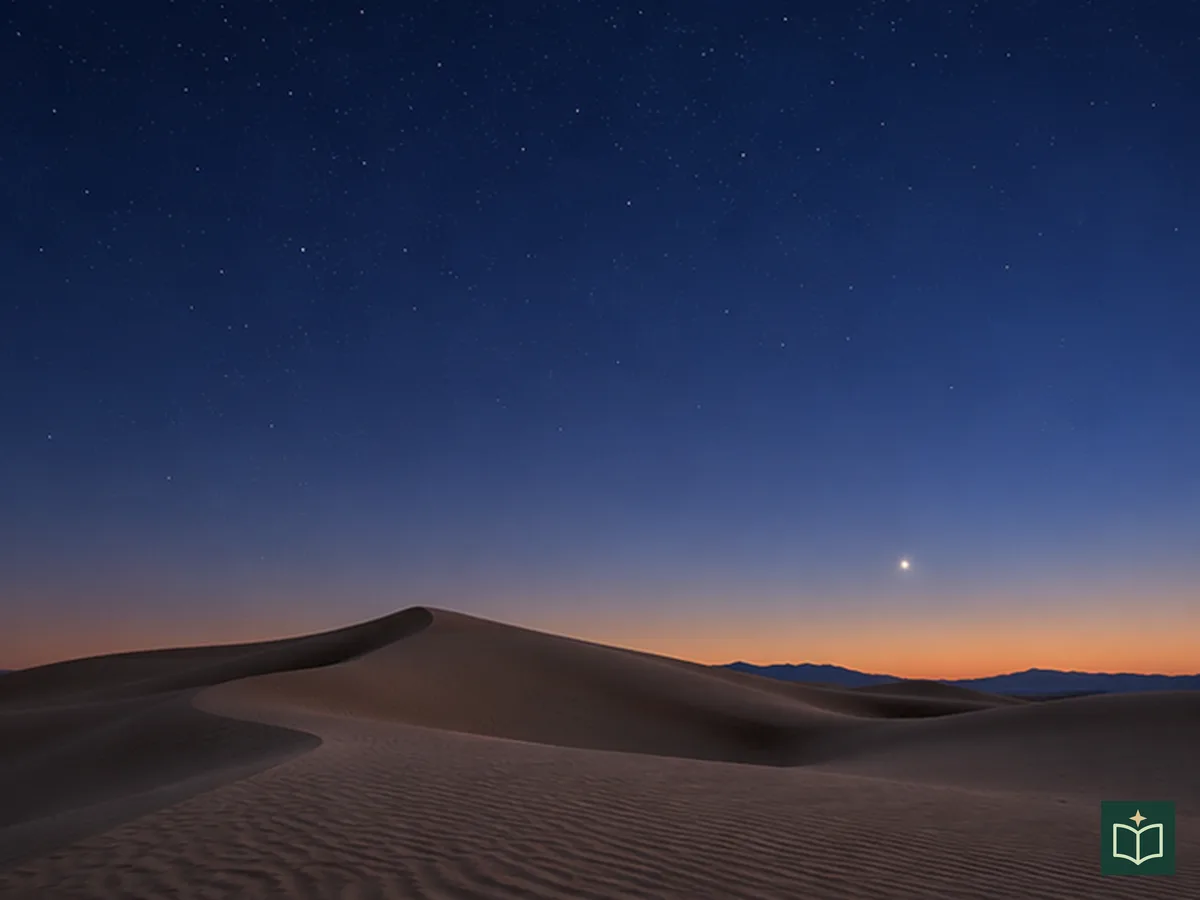
From a dark spot, or even a bright city such as Dubai, a few clues help. Stars usually twinkle, because their light arrives as a single point that air turbulence bends back and forth. Planets are close enough to show a tiny disc, so their light tends to shine more steadily, especially when high in the sky. Planets also keep to a narrow band across the sky, the ecliptic, roughly the path the Sun and Moon follow. Over weeks, a planet shifts its position against the background stars. The ancient Greeks named them planētēs, meaning wanderers, for exactly that reason, while the stars kept their fixed patterns.
The brightest lights mislead
Brightness is a poor guide on its own. Venus, the brightest object in the night sky after the Moon, outshines every star because it is close and highly reflective. Jupiter is usually brighter than any star too, and Mars can be at times. Meanwhile, most stars that look faint are in fact enormous and luminous, just extremely distant: the nearest star beyond the Sun lies more than four light years away, while the planets are measured in light minutes or hours. A common mistake is to treat a bright, steady light low in the west after sunset as an aircraft or a star when it is often Venus.
Why the distinction matters
The star-planet divide shapes how astronomers search for life and study other worlds. Thousands of planets have now been found orbiting other stars, most detected indirectly because they are drowned out by the glare of their host. Knowing a star's mass and output tells scientists where liquid water could exist on an orbiting planet, the so-called habitable zone. The difference also explains our own existence. Earth is warm, lit and alive because it orbits a stable star at a comfortable distance. Looking up, it helps to remember that each twinkling point is a distant sun, while the steady wanderers are neighbours lit by ours.
Sources & further reading
Figures are rounded and widely published; check the linked organisations for the latest editions. These organisations do not endorse this website.