Water too valuable to waste
In the Gulf, almost all drinking water is desalinated seawater, which costs significant energy to produce. Using it to water parks, roadside palms and golf courses is expensive. Yet cities also produce a steady flow of wastewater from homes, offices and hotels, every day of the year. Treated sewage effluent, often called TSE, turns that flow into a resource. Once wastewater has been cleaned beyond the standard needed for safe discharge, it can be reused for irrigation, district cooling and some industrial processes. Cities across the UAE, Saudi Arabia, Qatar and Oman now reuse a large share of their treated wastewater, much of it for landscaping.
Cleaning beyond discharge standard
The basic stages of sewage treatment remove solids and break down organic matter using bacteria. For reuse, plants add a tertiary stage. Water is filtered through sand or fine membranes to remove remaining particles, then disinfected with chlorine, ultraviolet light or both to kill bacteria and viruses. Some plants use ultrafiltration or reverse osmosis for even higher quality. Operators monitor turbidity, which measures cloudiness, along with indicator bacteria such as E. coli, nutrients and chlorine levels. Water that fails the checks is diverted rather than sent to the reuse network. The result is clear, odourless water that is safe for its intended use, though not approved for drinking.
A network of its own
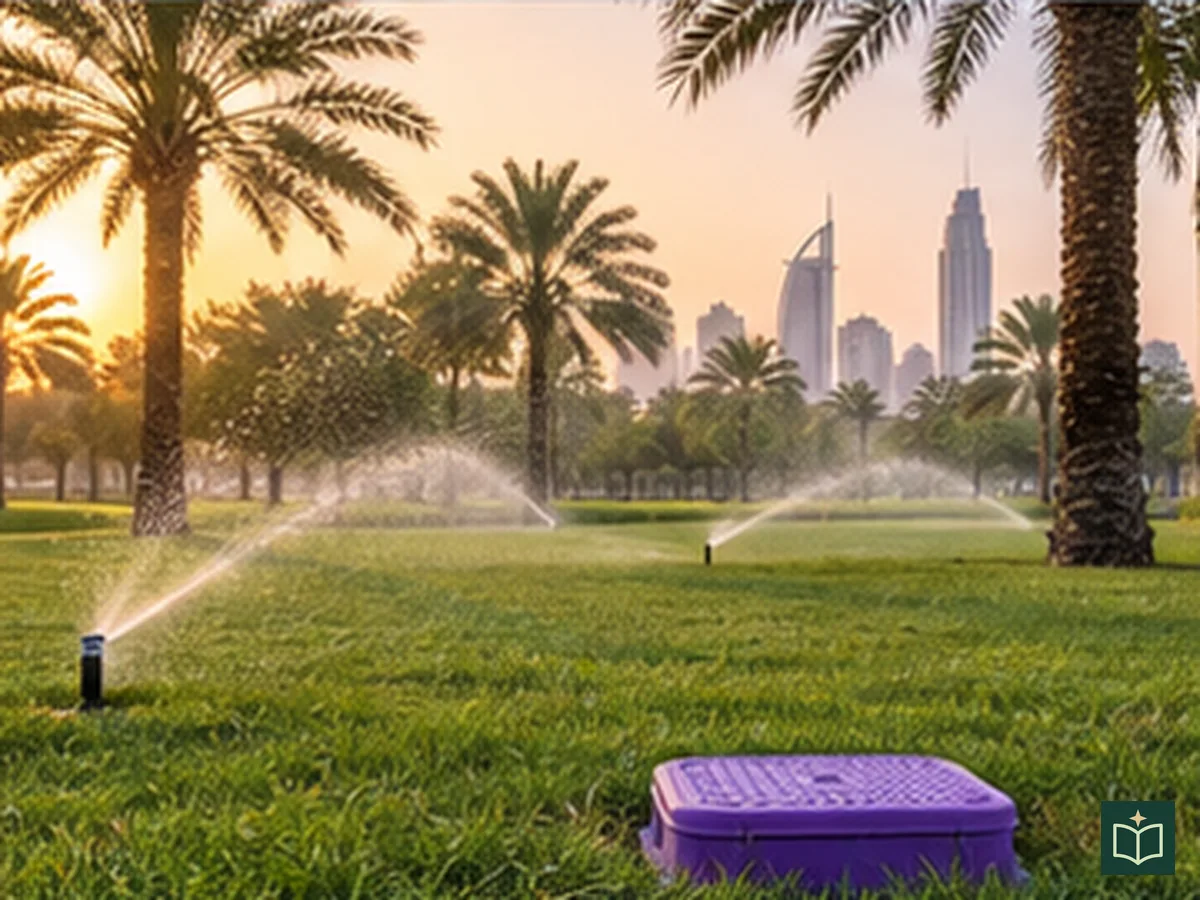
Reclaimed water travels through a separate distribution system, never connected to drinking-water pipes. Pumping stations push it to storage tanks and reservoirs around the city, from where it feeds irrigation networks. Pipes, valves and taps are typically coloured purple and labelled as non-potable, a convention used in many countries to stop accidental cross-connections. Plumbers and contractors working on sites must follow strict rules separating the two systems. In Gulf cities, demand for irrigation water peaks in summer, when evaporation is highest, while wastewater flows stay fairly steady. Storage helps balance the two, and surplus effluent may be discharged to the sea or injected underground in some places.
Who can use it, and where
Quality rules depend on how much contact people are likely to have with the water. World Health Organization guidelines, adopted in various forms by national regulators, set stricter limits for unrestricted irrigation of public parks, lawns and crops eaten raw than for restricted uses such as fodder crops, trees and fenced landscapes. Gulf authorities define grades of TSE and specify which uses each grade may serve, along with buffer distances and signage. Spray irrigation in public areas is usually scheduled at night, when parks are empty and less water evaporates. As an example, a 10,000-square-metre park watered at five litres per square metre a day needs 50 cubic metres daily.
Beyond irrigation
Landscaping is the largest use of reclaimed water in the Gulf, but not the only one. District cooling plants, which chill water for whole neighbourhoods of towers, need vast quantities of make-up water for their cooling towers, and treated effluent can replace desalinated water there. Construction sites use it for dust suppression and concrete curing where specifications allow. Some countries, such as Singapore and parts of the United States, go further, purifying wastewater to drinking standard and blending it into reservoirs. Gulf countries have so far concentrated on non-drinking uses, partly because of public acceptance, though several national water strategies aim to increase reuse to reduce reliance on desalination.
Limits and concerns
Reuse is not risk-free. If treatment fails, pathogens could reach people using parks, which is why monitoring and disinfection are continuous. Treated effluent contains more dissolved salts and nutrients than desalinated water. Over years, salts can build up in soils, and nutrients can encourage algae in ornamental lakes. Trace pharmaceuticals and other chemicals are an active research area, with higher-grade treatment able to remove most of them. Leaks and cross-connections are another hazard, managed through colour-coding and inspection. Finally, the water must reach where it is needed: new suburbs may lack purple networks, and trucking effluent is costly. Good planning makes reuse cheap; poor planning wastes it.
Sources & further reading
- WHO · Guidelines for the safe use of wastewater, excreta and greywater ↗
- FAO · AQUASTAT water information system ↗
- US EPA · Water reuse ↗
Figures are rounded and widely published; check the linked organisations for the latest editions. These organisations do not endorse this website.