A warehouse built for single items
Traditional warehouses moved goods by the pallet: whole loads in, whole loads out to shops. Online shopping changed the task. A fulfilment centre must send out millions of individual items in small, mixed orders, often within hours of a click. One customer wants a phone case, a book and a bottle of shampoo; the next wants something entirely different. That makes picking, the act of collecting the right items for each order, the most labour-intensive part of the operation. Fulfilment centres are designed around making picking fast and accurate, using barcodes, software and increasingly robots, while keeping costs low enough for free or cheap delivery.
Chaotic storage, perfect records
Many large fulfilment centres use what is called random or chaotic storage. Instead of keeping all phone cases in one aisle, workers stow incoming items in any free space and scan both the item and the bin's barcode. A single shelf might hold a toy, a cable and a pair of socks. To a visitor it looks disorganised, but the warehouse management system knows the exact location of every unit. Random storage uses space efficiently, since items fill whatever gaps exist, and it reduces errors because similar-looking products are rarely stored side by side. Popular items are spread across many locations so that pickers are never far from one.
Walking pickers and pick paths
In a conventional layout, pickers push trolleys through aisles while a handheld scanner or screen tells them where to go next. Software groups orders into batches and plans routes so each walk collects items for several orders at once, minimising wasted distance. Workers scan each bin and item to confirm they have the right product. This method is flexible and cheap to set up, but walking takes up much of a picker's time, and large buildings can stretch for hundreds of metres. During peak seasons, operators add temporary staff and extra shifts, and the software adjusts priorities so that orders with the earliest delivery promises are picked first.
Bringing the shelf to the person
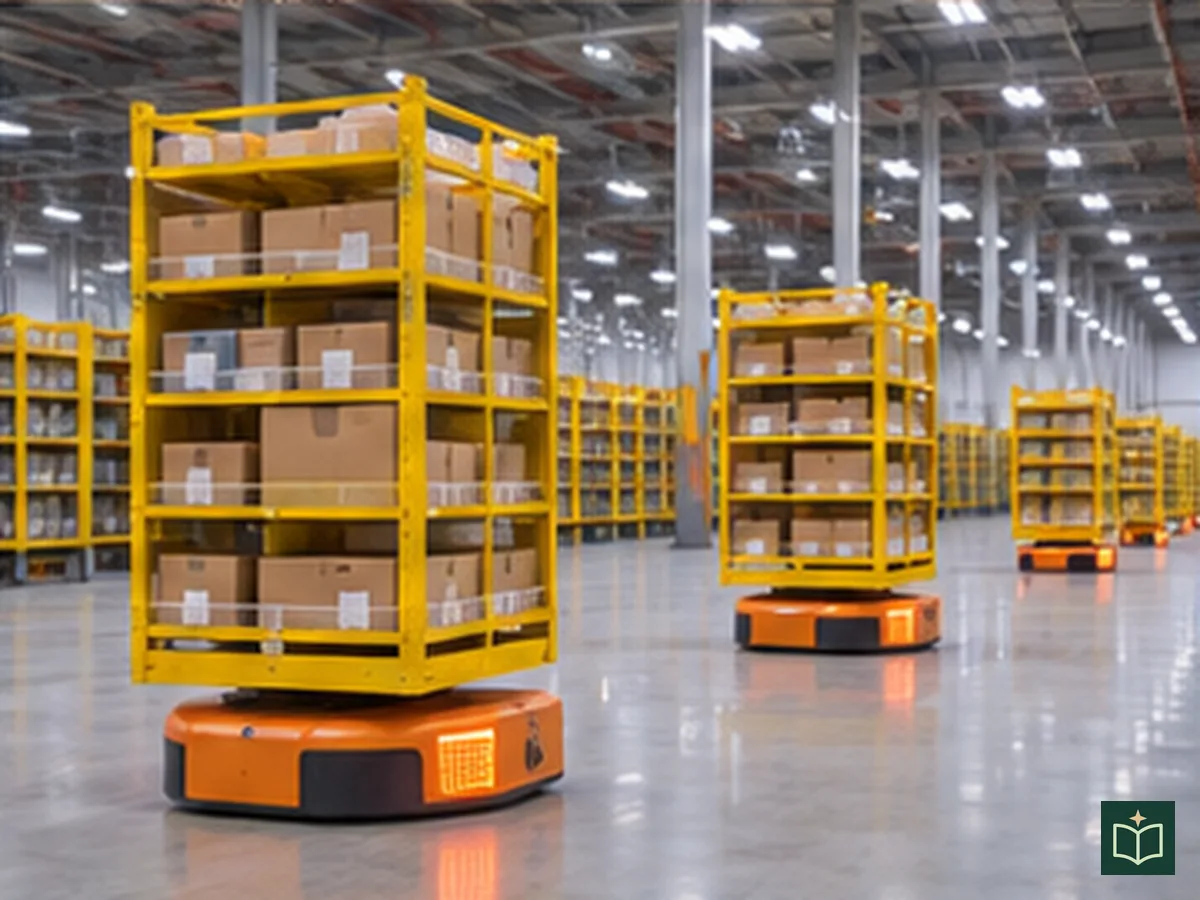
Goods-to-person systems flip the arrangement. In one well-known design, squat robots drive under portable shelving units, lift them and carry them to a picking station, where a worker takes out the item a screen highlights. The robots navigate by reading markers on the floor and return shelves to the storage field afterwards. Amazon bought the pioneer of this approach, Kiva Systems, in 2012. Other designs stack bins in a dense grid, with robots running on top that dig out the required bin and deliver it to a port. Both approaches cut walking almost entirely and let the storage area be packed far more densely than human-accessible aisles.
Packing and sorting
Once all items for an order are gathered, they go to packing stations. Software suggests the right box or envelope size, and some machines build a custom-fitted box around each order to reduce wasted space and filler. A label is printed and applied, often automatically, and a final scan links the parcel to the order. Conveyors then carry parcels to sorters that divert them into chutes by carrier and destination, ready for trucks. Weight checks along the way catch mistakes, such as a missing item. Returns flow back the other way: they are inspected, graded and either restocked, refurbished, sold off or recycled.
Limits and what to watch
Automation has not removed people from fulfilment centres. Robots excel at moving shelves and bins, but grasping thousands of differently shaped, soft or fragile products is still difficult, so human hands do most picking. Working conditions, such as pace targets and repetitive tasks, have drawn scrutiny in several countries. Warehouses also need huge amounts of land near cities, which is why multistorey facilities are appearing. In the Gulf, large fulfilment centres in Dubai, Riyadh and elsewhere serve regional e-commerce, often linked to airports and free zones. Watch for robotic arms that pick reliably, and for smaller urban sites that promise delivery within an hour.
Sources & further reading
Figures are rounded and widely published; check the linked organisations for the latest editions. These organisations do not endorse this website.