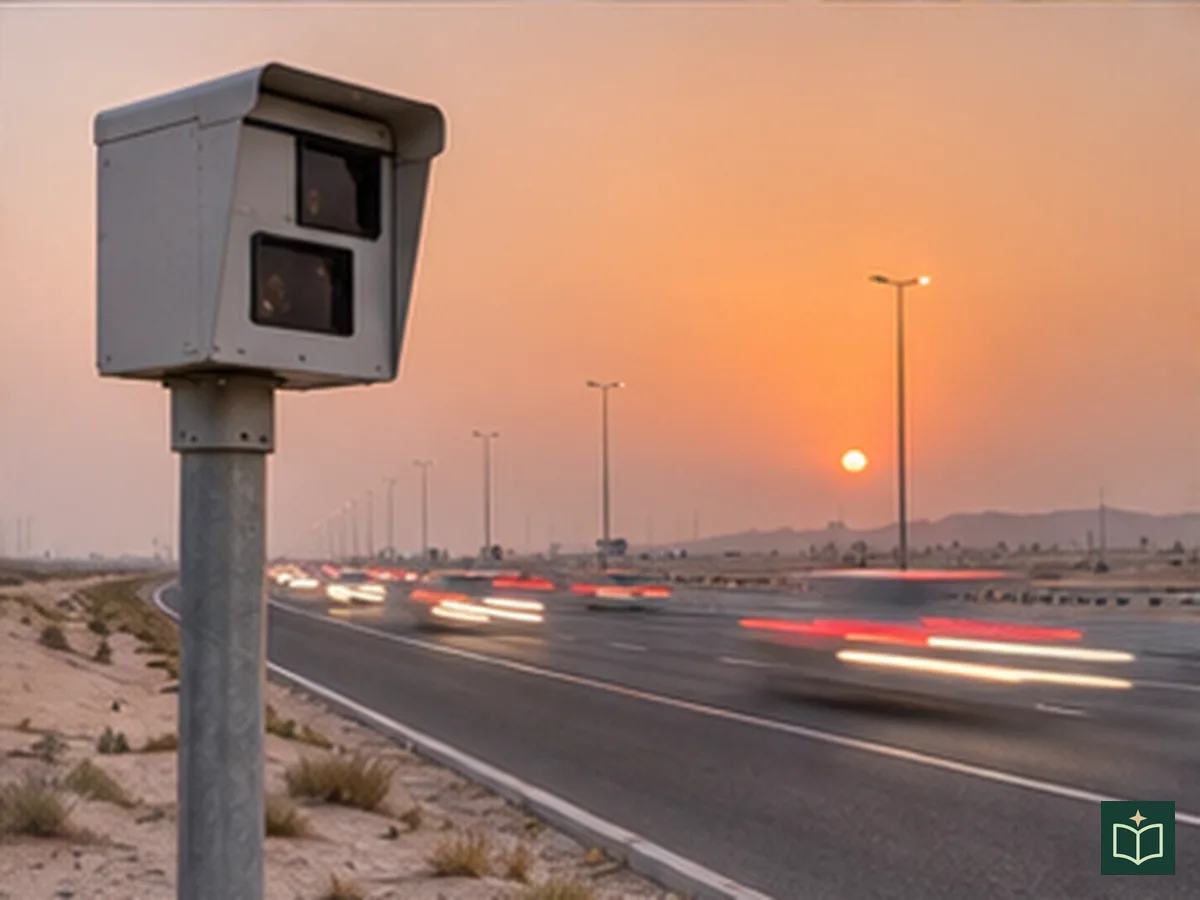
One idea, several tools
Speed is distance divided by time, and every enforcement camera is a way of measuring both precisely. The main technologies are radar, laser, sensors embedded in the road and average-speed systems that time vehicles over a long stretch. Each has strengths. Some can watch several lanes at once, while others pinpoint a single vehicle in heavy traffic. All must be approved by national authorities, installed according to rules and regularly tested, because their readings may be used as legal evidence. In the Gulf, fixed radar units along highways, mobile units and average-speed sections are all common, alongside red-light cameras at junctions that often measure speed as well.
Radar and the Doppler effect
Radar cameras send out a beam of radio waves and listen for the echo. When waves bounce off a moving car, their frequency shifts slightly: higher if the car approaches, lower if it moves away. This is the Doppler effect, the same principle that makes an ambulance siren change pitch as it passes. The size of the shift reveals the vehicle's speed. Modern tracking radars go further, following many vehicles at once and estimating each one's position, lane and speed over a short distance. That helps the system decide which car triggered the reading, a key question when several vehicles are close together.
Laser and buried sensors
Laser devices, often called lidar, fire very short pulses of infrared light and time how long each takes to bounce back. Distance follows from the speed of light. By firing many pulses in a fraction of a second, the device measures how quickly the distance changes, which gives speed. Its narrow beam makes it easy to target a single vehicle. Other systems put the sensors in the road itself. Inductive loops or pressure-sensitive strips are laid a known distance apart, and the time a car takes to cross from one to the next gives its speed. Painted marks on the road let officials check the result from photographs.
Clocked over kilometres
Average-speed systems use two or more cameras placed far apart. Each reads the number plates of passing vehicles and records the exact time. A computer matches plates between the cameras and calculates average speed. If two cameras are 10 kilometres apart and a car covers the distance in five minutes, its average speed is 120 kilometres per hour, regardless of how fast it was going at either camera. This discourages the familiar habit of braking briefly at a camera and accelerating away. Clocks in each unit must be tightly synchronised, and the distance must be surveyed precisely, because small errors in either would change the result.
Matching the plate
Measuring speed is only half the task. The system must also identify the vehicle. High-resolution cameras with infrared flash photograph the number plate day or night, and automatic number plate recognition software reads the characters. The data is linked to vehicle registration records to find the owner. Many cameras take two or more images a fraction of a second apart, which also allows a secondary speed check from the vehicle's movement against road markings. Some systems record short video. Human reviewers often check readings before a fine is sent, especially when an image is unclear, a plate is damaged or two vehicles appear close together in the frame.
Limits and myths
Speed cameras are calibrated and certified, but they are not infallible, which is why most legal systems allow fines to be challenged. Radar can be confused by reflections from large vehicles, and laser must be aimed correctly. Common myths include the idea that cameras never work at night, that flashing headlights confuses them or that a car is safe if it slows only at the camera. Average-speed systems specifically defeat the last. Rules on tolerances above the posted limit vary between countries and emirates and can change, so drivers should follow the signs. Ultimately, cameras are meant to reduce crashes on roads where speeding has proved dangerous.
Sources & further reading
Figures are rounded and widely published; check the linked organisations for the latest editions. These organisations do not endorse this website.