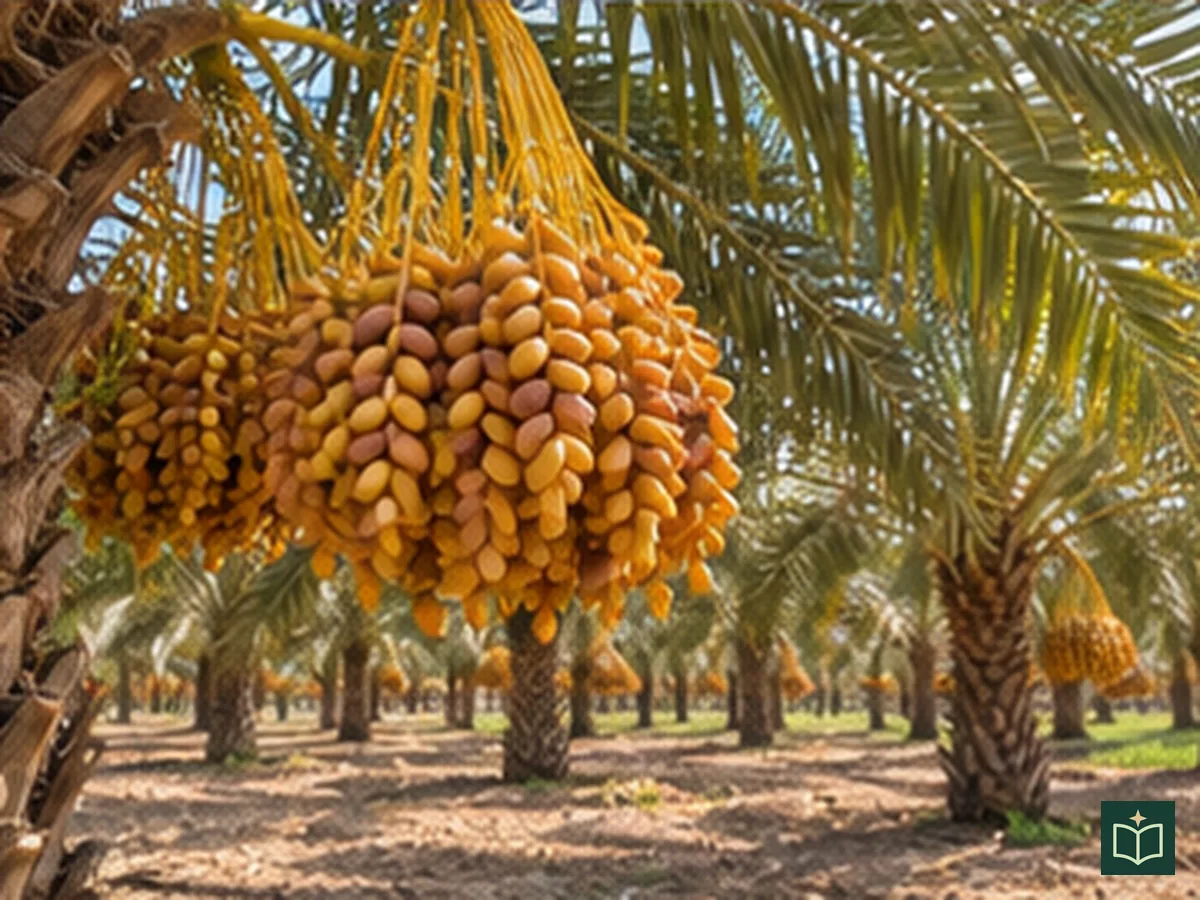
A tree with two sexes
The date palm, Phoenix dactylifera, has been cultivated in the Middle East and North Africa for thousands of years and remains central to Gulf food and culture. Unlike many fruit trees, it is dioecious: each palm is either male or female. Only females bear fruit, but they need pollen from males, which in nature is carried by wind. Wild pollination is unreliable, so growers would need almost as many males as females. Instead, farmers have long pollinated palms by hand, which allows a single male to serve dozens of females. Plantations therefore consist mostly of female trees, with a few carefully chosen males kept for their pollen.
Pollination in spring
In early spring, female palms produce flower clusters enclosed in tough sheaths called spathes. When a spathe splits open, a farmer climbs the trunk, traditionally using a rope belt, or uses a ladder or lifting platform, and inserts a few strands of male flowers among the female blossoms, sometimes tying them in place. Timing matters, because the female flowers are receptive for only a few days. Large farms increasingly use machines that blow dried pollen into the clusters, which saves labour on tall palms. Growers also thin the bunches, removing some strands so the remaining fruit grows larger, and later bend and support the heavy bunches so they do not snap.
Five stages of ripeness
After pollination, the fruit develops over several months, passing through stages with traditional Arabic names. At hababouk, it is tiny and green. At kimri, it grows quickly but is hard, green and astringent. At khalal, it turns yellow or red and becomes crunchy and sweet; some varieties are eaten fresh at this stage. At rutab, the fruit softens from the tip and turns brown, juicy and very sweet. At tamar, it has dried on the tree into the familiar wrinkled date that keeps for months. Harvesting happens from mid-summer into autumn, and many families celebrate the first ripe dates of the season.
Varieties and markets
Hundreds of date varieties exist, each with its own size, colour, texture and season. In the UAE, Khalas is prized for its caramel flavour, while Lulu, Khenaizi and Barhi are also widely grown. Saudi Arabia is known for varieties such as Sukkari and Ajwa, and Medjool, originally from Morocco, is now grown in many countries for its large, soft fruit. Prices differ greatly between varieties and grades. Gulf countries are among the world's leading producers, alongside Egypt, Algeria and Iran. Dates are central to hospitality, served with Arabic coffee to guests, and demand peaks during Ramadan, when many people break their fast with them.
Grading the harvest
At packing houses, dates are cleaned, often by washing and air-drying, and checked for pests. Fumigation or controlled heat treatment kills insects that could spoil stored fruit. Sorting lines then grade dates by size, colour, moisture, skin condition and defects such as cracks, blemishes or fermentation. Larger plants use optical sorters, with cameras and air jets that flick rejected fruit aside at high speed, alongside manual inspection. Premium grades are packed in boxes for retail and gifts; lower grades go to paste, syrup, baking and animal feed. Cold storage keeps soft dates in condition for months, so they can be sold well beyond the harvest season.
Challenges for date farming
Date palms tolerate heat and salty soils better than most crops, but they still need large amounts of water, often from groundwater that is being depleted in parts of the Gulf. Farmers are adopting drip irrigation and better scheduling to save water. The red palm weevil, an invasive beetle whose larvae bore into trunks, is a serious threat, tackled with traps, inspection and quarantine rules on moving palms. Labour for climbing and pollinating is costly, encouraging mechanisation. Research labs propagate elite varieties through tissue culture, creating identical young palms in large numbers. Festivals such as the annual Liwa Date Festival keep the culture visible and reward the best growers.
Sources & further reading
- UNESCO · Date palm, knowledge, skills, traditions and practices ↗
- Britannica · Date palm ↗
- FAO · Food and Agriculture Organization ↗
Figures are rounded and widely published; check the linked organisations for the latest editions. These organisations do not endorse this website.