Inspired by the brain
The brain contains billions of neurons, each receiving signals from many others and firing when the combined input is strong enough. In 1943, Warren McCulloch and Walter Pitts proposed a simplified mathematical model of such a neuron. In 1949, psychologist Donald Hebb suggested that learning happens when connections between neurons that fire together grow stronger. These ideas inspired researchers to ask whether a machine built from artificial neurons could learn.
Rosenblatt's machine
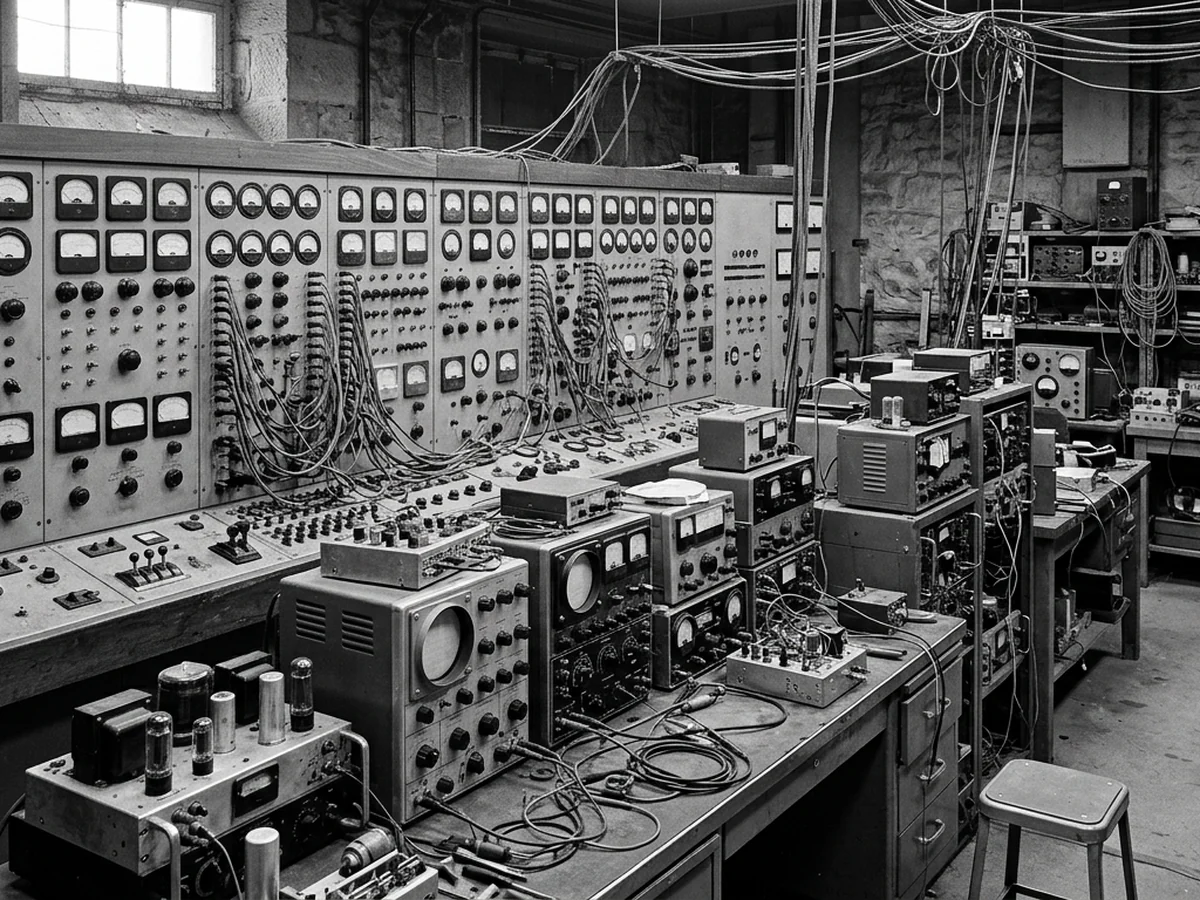
Frank Rosenblatt, a psychologist at the Cornell Aeronautical Laboratory, developed the perceptron and demonstrated it in 1958 with funding from the US Navy. It was first simulated on an IBM computer and later built as dedicated hardware, the Mark I Perceptron, which used a grid of 400 light sensors as a simple camera. Its connections were implemented with electric motors turning potentiometers, physically adjusting the strength of each connection as the machine learned.
How it learned
The perceptron took inputs, such as which light sensors were activated by a shape, multiplied each by a weight and added them together. If the total exceeded a threshold, it gave one answer; otherwise, the other. When it made a mistake, the weights were adjusted slightly in the direction that would have produced the right answer. Repeating this over many examples, it learned to distinguish simple patterns, such as marks on the left or right of a card.
Great expectations
The perceptron attracted enormous attention. A 1958 New York Times report described the Navy expecting a machine that would one day walk, talk, see, write and even be conscious of its existence. Rosenblatt himself was enthusiastic about its potential, and many researchers began working on similar learning machines. The excitement anticipated the hype that surrounds AI today, and it raised expectations that the technology of the time could not meet.
The critical book
In 1969, Marvin Minsky and Seymour Papert of MIT published Perceptrons, a rigorous mathematical analysis showing that a single-layer perceptron could not learn certain simple functions, famously the exclusive-or problem, where the answer is yes if one of two inputs is on but not both. They also expressed scepticism about whether multi-layer versions could be trained effectively. The book is often blamed for a sharp decline in neural network research during the 1970s.
A fair critique?
Historians still debate the book's role. Minsky and Papert's mathematics was correct for single-layer perceptrons, and they raised genuine questions about how larger networks could be trained. Rosenblatt and others had already discussed multi-layer designs, but nobody yet had an efficient method to train them. Funding agencies, disappointed by slow progress, were also turning away from neural approaches. The book captured a shift in mood as much as it caused it.
A tragic end
Rosenblatt died in a boating accident in 1971 on his 43rd birthday, before his ideas were vindicated. Research on neural networks continued in a few places, but funding and attention shifted largely to symbolic AI approaches based on rules and logic. Neural networks were often regarded as a dead end, and researchers who continued to work on them, such as Geoffrey Hinton, struggled for recognition for many years.
The revival
The key to overcoming the perceptron's limits was to stack layers of artificial neurons and find a way to train them. In 1986, David Rumelhart, Geoffrey Hinton and Ronald Williams published an influential paper popularising backpropagation, a method for calculating how to adjust every weight in a multi-layer network. This allowed networks to learn much more complex patterns, including the exclusive-or problem, and sparked renewed interest in neural networks.
Deep learning's triumph
Even after backpropagation, neural networks remained limited by small datasets and slow computers. That changed in the 2000s and 2010s with the internet's vast data, powerful graphics chips and improved techniques. In 2012, a deep neural network called AlexNet won the ImageNet image recognition competition by a wide margin, launching the deep learning revolution. Today's chatbots, image generators and speech recognition systems all use networks that are distant descendants of the perceptron.
Lessons from the perceptron
The perceptron's story shows how scientific ideas can be dismissed too early and how hype can backfire. Rosenblatt's core insight, that intelligence could emerge from many simple units adjusting their connections through experience, turned out to be among the most powerful ideas in computing. In 2024, Hinton shared the Nobel Prize in Physics with John Hopfield for foundational work on artificial neural networks, a recognition that traces back to the perceptron.
Sources & further reading
- Cornell Chronicle · Professor's perceptron paved the way for AI, 60 years too soon ↗
- Wikipedia · Perceptron ↗
- Nature · Learning representations by back-propagating errors (1986) ↗
A simplified historical account. Photograph: original AI-generated illustration (Adobe Firefly). Reference organisations do not endorse this website.