A political deadline
In 1961, after Soviet successes including Yuri Gagarin’s first human spaceflight, President John F. Kennedy set the goal of landing a man on the Moon and returning him safely before the decade was out. NASA built on the Mercury and Gemini programmes, which tested spacewalks, docking and long-duration flight.
The machines
The Saturn V, standing about 110 metres tall, remains one of the most powerful rockets ever flown. Apollo used lunar orbit rendezvous: the command module, flown by Michael Collins, stayed in lunar orbit while Neil Armstrong and Buzz Aldrin descended in the lunar module Eagle. The guidance computer, though tiny by today’s standards, managed critical navigation.
The landing
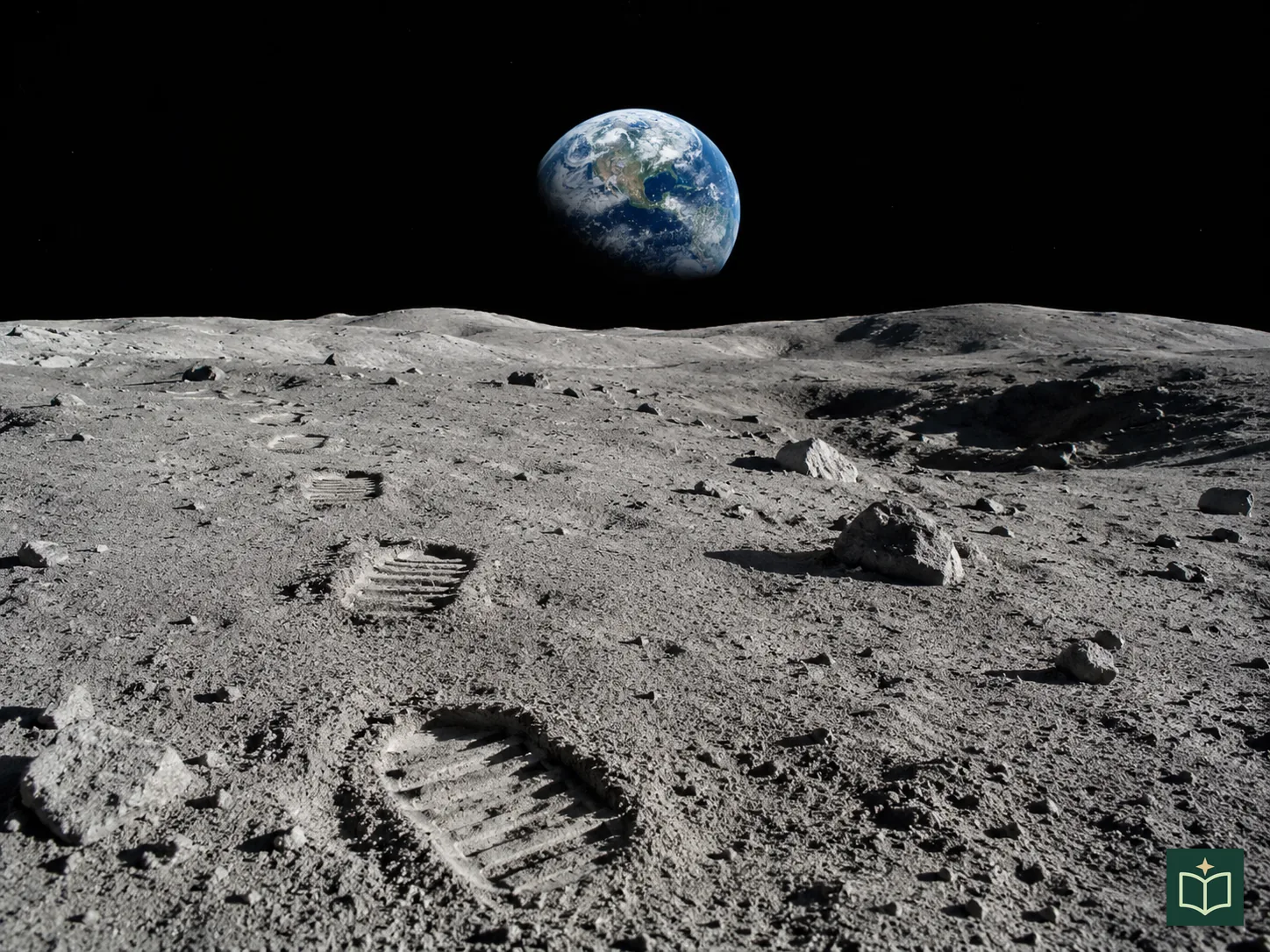
During the descent, computer alarms sounded and the planned landing area was strewn with boulders. Armstrong took manual control and landed with limited fuel remaining. On 20 July 1969, he stepped onto the surface, followed by Aldrin. They spent about two and a half hours outside, collecting samples and setting up experiments.
What followed
Five more Apollo missions landed, and Apollo 13 returned safely after an explosion in 1970. Returned rock samples reshaped understanding of the Moon’s origin. The last astronauts left in December 1972. Today, new programmes, including NASA’s Artemis, aim to return people to the Moon, this time with longer stays near the south pole.
Sources & further reading
Figures are rounded and widely published; check the linked organisations for the latest editions. These organisations do not endorse this website.