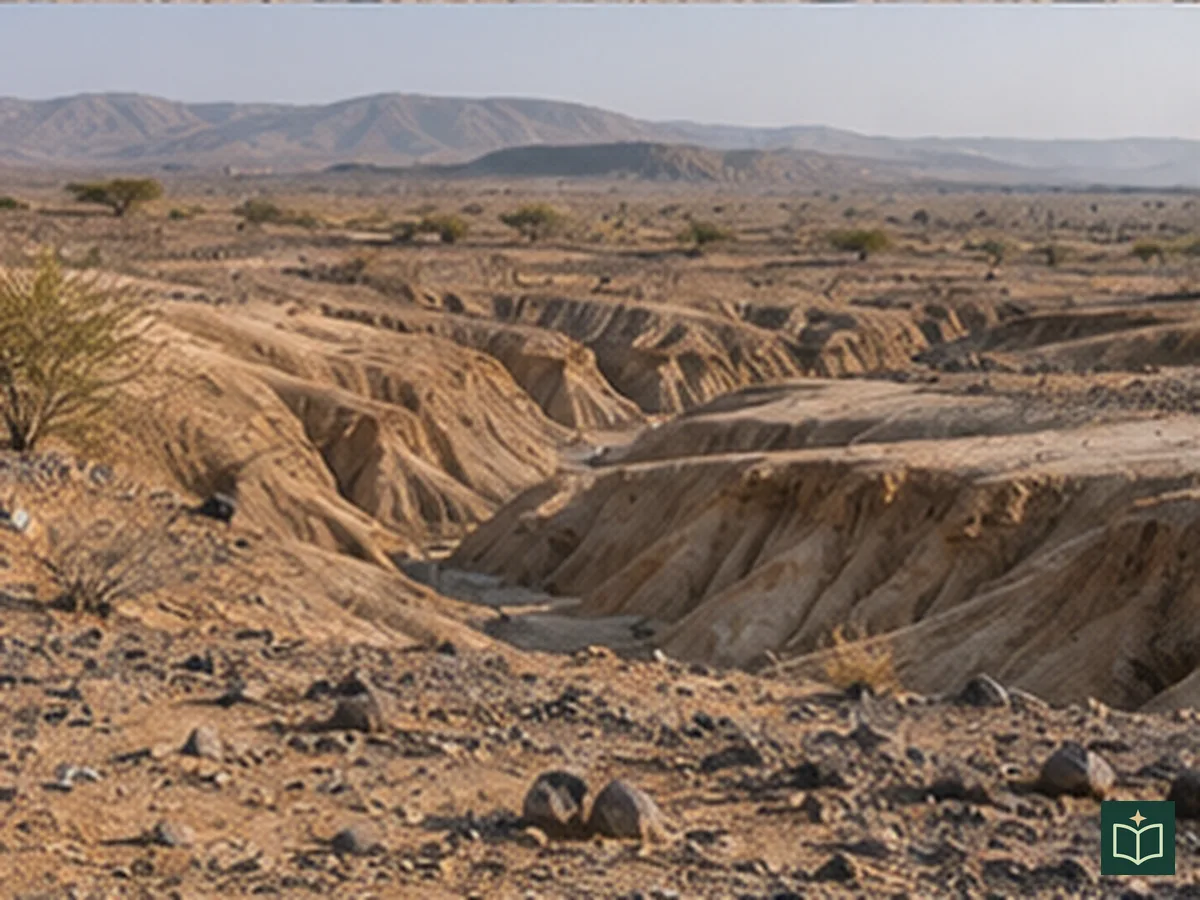
A skeleton from the Afar
In November 1974 a team led by the palaeoanthropologist Donald Johanson was surveying gullies at Hadar, in the Afar region of Ethiopia, when a fragment of arm bone caught their eye. Over the following weeks they recovered several hundred pieces of bone from a single individual, around 40 per cent of a skeleton. That night the camp played the Beatles song Lucy in the Sky with Diamonds, and the name stuck. In Ethiopia she is also called Dinkinesh, meaning “you are marvellous” in Amharic. She was a small adult female, about 1.1 metres tall and perhaps 29 kilograms, and the volcanic layers around her gave an age of about 3.2 million years.
What her bones reveal
The key evidence is in Lucy’s hips and legs. Her pelvis is short and broad, like ours, rather than tall and narrow like a chimpanzee’s, so the muscles that steady the body during each stride were positioned for walking. Her thigh bone angles inwards towards the knee, placing the feet under the body’s centre of gravity, a feature seen only in habitual two-legged walkers. Other afarensis fossils show arched feet and a big toe in line with the others. Yet Lucy also had long arms and curved finger bones. Most researchers conclude that her species walked upright on the ground but still climbed trees, perhaps to feed or to sleep safely.
Footprints in volcanic ash
Bones can be argued over, but footprints show behaviour directly. In 1978 a team working with Mary Leakey at Laetoli, in northern Tanzania, uncovered trails of prints left in damp volcanic ash about 3.66 million years ago. Several individuals had walked across the surface, and the ash then hardened and was buried. The prints show a heel striking first, a raised arch and a big toe pointing forwards, much like a modern human walking on soft sand. Most scientists attribute them to Australopithecus afarensis, Lucy’s species. Together, the skeleton and the footprints make a strong case that confident upright walking was in place more than three and a half million years ago.
A small brain, for now
Lucy’s skull is fragmentary, but other afarensis skulls held brains of roughly 400 to 500 cubic centimetres, close to the range of a modern chimpanzee. An average modern human brain is about 1,350 cubic centimetres, roughly three times larger. Brains began to expand markedly only with early members of our own genus, Homo, from around two million years ago, and the largest increases came much later. That sequence overturned an older idea, popular in the early twentieth century, that a big brain led the way and upright posture followed. In the human story, the legs changed first and the head caught up over a very long time.
Why walk at all?
Nobody knows for certain why our ancestors began walking on two legs, and several explanations may each hold part of the truth. As East African forests became more patchy, moving between clumps of trees on the ground may have been efficient: walking upright uses less energy than a chimpanzee’s knuckle-walking. Standing tall also frees the hands to carry food or infants and lets an animal see over grass. Lucy’s species shows how gradual the shift was. It combined a body suited to walking with features suited to climbing, a mosaic rather than a clean switch. Stone tools, once thought to arrive with upright walking, came hundreds of thousands of years later.
Lucy’s place today
Lucy is no longer the oldest known human relative. Older species, such as Ardipithecus ramidus, about 4.4 million years old, and fragmentary fossils older still, also hint at upright walking in some form. A remarkably complete afarensis child found at nearby Dikika in 2000, nicknamed Selam, has added detail about how the species grew. Lucy also need not be our direct ancestor; she may sit on a side branch of a bushy family tree. Even so, she remains a reference point because so much of one individual survived. The original bones are kept at the National Museum of Ethiopia in Addis Ababa, with casts displayed for visitors.
Sources & further reading
- Smithsonian Human Origins · Australopithecus afarensis ↗
- Britannica · Lucy (fossil) ↗
- Arizona State University · Institute of Human Origins ↗
Figures are rounded and widely published; check the linked organisations for the latest editions. These organisations do not endorse this website.