Time before machines
For thousands of years people told time with sundials, water clocks and burning candles. Sundials failed at night and in cloud, and water clocks froze or varied with temperature. Many societies also divided daylight into a fixed number of hours, so an hour in summer was longer than an hour in winter.
The escapement
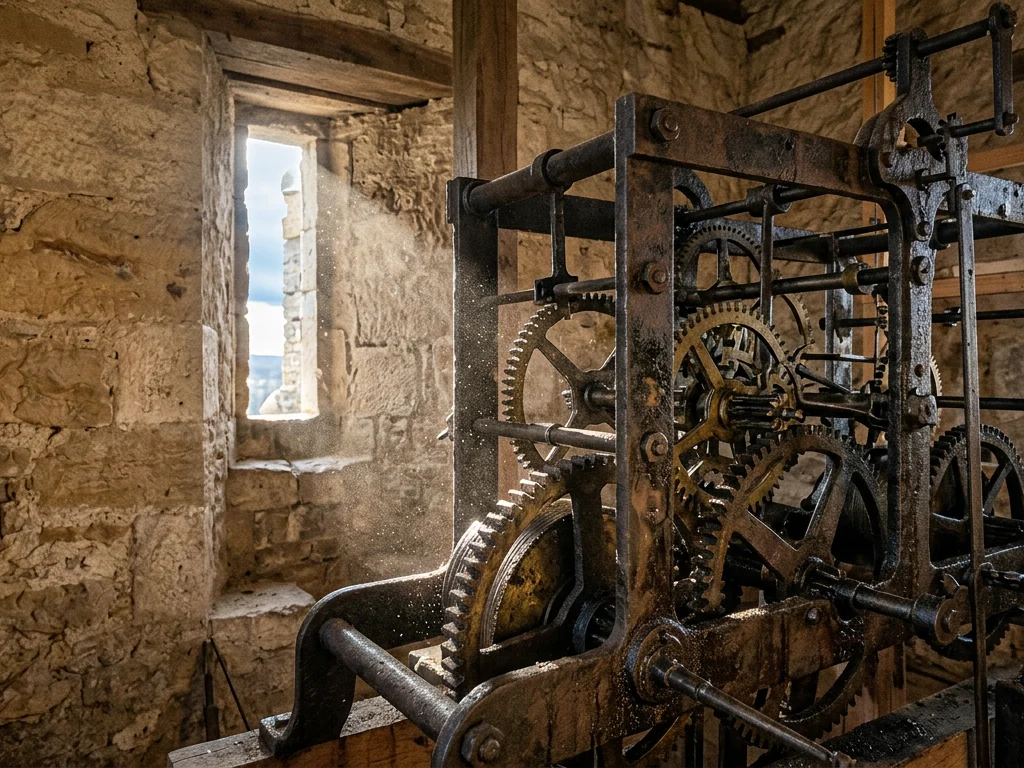
Sometime in the late thirteenth century, European craftsmen combined a falling weight with a device called the verge-and-foliot escapement. It repeatedly locked and released a toothed crown wheel, letting the weight’s energy out in regular beats. That steady, countable rhythm is the heart of every mechanical clock that followed.
Clocks in towers
The first mechanical clocks were large iron machines installed in cathedrals, monasteries and town halls. Many had no dial at all; they simply struck a bell to mark the hours for prayer, work and trade. Towns competed to install elaborate astronomical clocks that showed the phases of the Moon and the positions of the planets.
Equal hours, new habits
Mechanical clocks encouraged the use of equal hours of the same length all year round, and gradually reshaped daily life around shared, public time. Accuracy jumped in 1656 when Christiaan Huygens applied the pendulum, cutting errors from minutes to seconds a day and paving the way for navigation, science and the industrial working day.
Sources & further reading
Dates for the earliest mechanical clocks are approximate; surviving records are incomplete. Photograph: original AI-generated illustration (Adobe Firefly). Reference organisations do not endorse this website.